

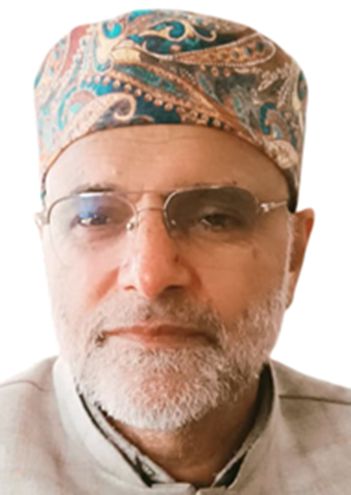
(Reflections on the Imprisonment of Dr. Mohamed El-Beltagy and the Martyrdom of Asmaa El-Beltagy)
Prof. Hamid Naseem Rafiabadi
The imprisonment of Dr. Mohamed El-Beltagy and the martyrdom of his daughter Asmaa at Rabaa are not merely chapters in Egypt’s political turmoil; they are revelations of a deeper moral catastrophe. They expose a world in which tyranny survives not only through guns and prisons, but through falsified religion, frightened scholarship, and an international order that rewards obedience to power rather than loyalty to justice. This is not simply a story of a ruler and his victims. It is a story of how truth is strangled when knowledge is tamed, how Islam is betrayed when its language is used to sanctify injustice, and how silence becomes a crime when oppression is systematic.
The Qur’an teaches that tyranny is never accidental. It is a pattern, a recurring structure of domination that feeds on fear and survives through deception. Pharaoh is presented not merely as a brutal ruler, but as the architect of a moral inversion. “Indeed, Pharaoh exalted himself in the land and divided its people into factions, oppressing a group among them” (Qur’an 28:4). Division was not a side effect of his rule; it was its foundation. Tyranny does not only crush bodies, it fractures society and reshapes conscience. The Qur’an then reveals the most dangerous element of this structure: public compliance. “So he deceived his people, and they obeyed him; indeed, they were a defiantly disobedient people” (Qur’an 43:54). Obedience to injustice, therefore, is not neutrality. It is participation.
Modern authoritarianism follows this Qur’anic script with unsettling precision. Military regimes rule through fear while speaking the language of stability. Imperial powers sustain them through weapons, money, and diplomatic silence. Yet the most corrosive element is the presence of religious and intellectual figures who provide tyranny with moral cover. When prisons are described as necessities, massacres as unfortunate excesses, and dissent as religious deviance, oppression no longer appears naked; it wears a turban, carries footnotes, and quotes scripture.
The Qur’an condemns this betrayal with unmatched severity. “Do not mix truth with falsehood, nor conceal the truth while you know” (Qur’an 2:42). Concealment here is deliberate suppression by those entrusted with guidance. Allah further declares, “Those who conceal what We sent down of clear proofs and guidance… upon them is the curse of Allah and the curse of those who curse” (Qur’an 2:159). Classical exegetes stressed that this curse falls most heavily upon scholars who remain silent when injustice becomes public and normalized. Silence at such moments is not wisdom; it is treachery.
Imam al-Ghazali diagnosed this moral decay centuries ago. In Ihya’ ‘Ulum al-Din, he warned that corrupt scholars are more destructive to religion than ignorant sinners, because they provide legitimacy to falsehood. Shaykh al-Islam Ibn Taymiyyah was even more explicit: supporting injustice, even with words, makes one a partner in it. A scholar who justifies oppression does not merely err in judgment; he transfers the authority of revelation to the service of power. Dr. El-Beltagy’s captivity exposes the consequences of this moral collapse. A physician, a senior professor at al-Azhar, and an elected representative, he has been imprisoned for more than a decade not for violence, but for refusing to submit his conscience to a military coup. His letter from Badr Prison describes years without sunlight, total isolation, denial of family contact, and deliberate erasure from public existence. From an Islamic perspective, this is not punishment; it is degradation. “We have certainly honored the children of Adam” (Qur’an 17:70), Allah declares, making human dignity an inviolable principle. The Prophet SAW warned, “Allah will punish those who punish people in this world” (Muslim). Jurists such as Imam Malik held that imprisonment that destroys body or soul is itself an act of injustice. A ruler who governs through such cruelty forfeits moral legitimacy, regardless of how many sermons are delivered in his name.
“While tyranny is forceful and loud, it is ultimately transient. True historical legacy belongs not to those with military or religious power, but to the courageous individuals who refuse to compromise their conscience despite suffering.”
The deeper crime, however, lies in redefining resistance itself as deviance. When peaceful dissent is criminalized and moral opposition is labeled sedition, Islam is turned upside down. The Prophet (SAW) did not teach obedience to tyranny; he taught courage before it. “The best jihad,” he said, “is a word of truth spoken before a tyrannical ruler” (Ahmad, al-Nasa’i). Dr. El-Beltagy’s so-called crime was precisely this jihad: speech without weapons, principle without violence, and refusal to bow to false authority.
The Rabaa massacre, in which Asmaa El-Beltagy was martyred, stands as a defining moral rupture of our time. Unarmed civilians were slaughtered while demanding political legitimacy and dignity. Asmaa’s final words, “Our peacefulness is stronger than bullets,” were not poetic defiance; they were Qur’anic ethics embodied. “Repel evil with that which is better” (Qur’an 41:34) is not a slogan; it is a prophetic methodology. Rabaa revealed a regime that feared peaceful bodies more than armed enemies, because moral clarity threatens tyranny more than chaos ever could.
Imperial complicity in such crimes is neither subtle nor new. Allah warns, “Do not incline toward those who do wrong, lest the Fire touch you” (Qur’an 11:113). Inclination includes dependence, justification, and silent endorsement. Modern empire rarely occupies lands directly; it governs through loyal strongmen, selective outrage, and controlled narratives. Muslim rulers who survive on foreign approval inevitably sacrifice their own people’s dignity. The Prophet SAW foresaw this humiliation when he warned that nations would gather against the Muslims not because of numerical weakness, but because of wahn—attachment to worldly power and fear of sacrifice (Abu Dawud). This wahn explains why rulers fear dissent more than injustice and why scholars fear prisons more than Allah.
Silence in the face of such oppression is not piety; it is betrayal. “Why do you not fight in the cause of Allah and the oppressed among men, women, and children?” (Qur’an 4:75). Imam al-Nawawi clarified that speaking against injustice becomes obligatory when silence enables harm. This obligation extends beyond activists to scholars, academics, journalists, and preachers. Sermons that demand patience from the oppressed while never naming the oppressor are a distortion of the Prophetic legacy.
The deaths of political prisoners in custody, including President Mohamed Morsi, and the ongoing danger faced by Dr. El-Beltagy are not tragic accidents. They are logical outcomes of a system in which cruelty is normalized and accountability erased. Islam does not romanticize suffering, but it honors steadfastness rooted in truth. “Do not think those who are killed in the path of Allah are dead; rather, they are alive with their Lord” (Qur’an 3:169). Abu al-Hasan al-Nadwi warned that when fear replaces faith among scholars, societies collapse morally long before they collapse politically.
The central question raised by this story is not who destabilized the state, but who betrayed Islam. Was it the imprisoned doctor and the peaceful protester, or the ruler who ordered fire on his own people? Was it the young woman who faced bullets with dignity, or the scholar who justified her killing? The Qur’an answers with chilling clarity: “And the oppressors will soon know to what end they will return” (Qur’an 26:227).
Dr. Mohamed El-Beltagy’s letter is not a plea for mercy. It is a moral indictment of an age in which chains speak louder than law, prisons louder than parliaments, and religious stooges prove more destructive than open enemies. Yet the Qur’an reminds us that tyranny is loud but short-lived, while truth is patient and enduring. History does not belong to generals or their clerics. It belongs to those who stood, spoke, and suffered without surrendering their conscience.
(The author a veteran academician is a former Professor and Head Department of Islamic Studies, Kashmir University. The views, opinions and conclusions expressed in this article are those of the author and aren’t necessarily in accord with the views of “Kashmir Horizon”)







