

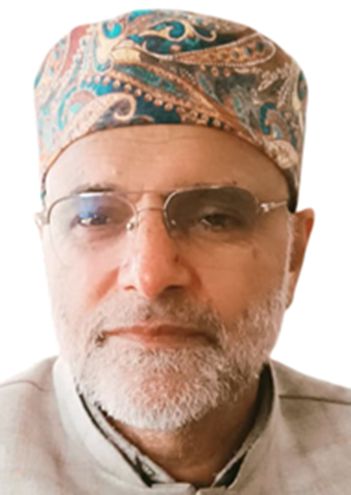
The visit to Deoband in December 2025 revolved entirely around participation in the International Conference on Imam al-ʿAsr Allama Anwar Shah Kashmiri (RA), held from 13 to 14 December 2025 under the auspices of Hujjatul Islam Academy, Darul Uloom Deoband Waqf, an academic gathering of exceptional intellectual depth and historical significance that reaffirmed Deoband’s enduring position as a living centre of Islamic scholarship in the Indian subcontinent. I reached Deoband on the night of 12 December 2025, and upon arrival at the Deoband Railway Station, I was warmly received by students and young scholars studying at Deoband, whose discipline, humility, and sense of responsibility immediately reflected the ethos of the institution. From the station, they escorted me to Darul Qur’an, which served as my place of stay during the days of the conference, and from the very beginning it became evident that this residence was not merely a lodging arrangement but an extension of Deoband’s scholarly and spiritual environment, where simplicity, devotion, learning, and discipline are woven into daily life. The conference itself, originally conceptualised before the COVID-19 pandemic and realised after a prolonged delay, was conceived not as a ceremonial commemoration but as a serious academic effort aimed at reviving, reassessing, and transmitting the intellectual legacy of Imam al-ʿAsr Allama Anwar Shah Kashmiri, a scholar whose mastery of Hadith, jurisprudence, theology, and engagement with modern intellectual challenges remains unparalleled in the recent history of Islamic scholarship. On the morning of 13 December 2025, the inaugural session commenced at Darul Uloom Deoband Waqf with the recitation of the Qur’an, setting an atmosphere of reverence and scholarly sobriety, after which Maulana Dr Shakaib Ahmad Qasmi, Deputy Muhtamim of Darul Uloom Deoband Waqf, conducted the proceedings and presented an illuminating introduction to the comprehensive scholarly personality of Allama Kashmiri, highlighting his encyclopaedic knowledge of Islamic sciences and particularly his towering stature in the field of Hadith, and aptly capturing his uniqueness through the poetic observation that it is not beyond divine wisdom to gather immense knowledge in a single individual. The inaugural session was further enriched by the presence of eminent scholars such as Maulana Khalid Saifullah Rahmani, Maulana Sufyan Qasmi, Maulana Ahmad Khazar Shah Kashmiri, Maulana Rahmatullah Kashmiri, Maulana Faisal Rahmani, and others, whose participation itself underscored the national scholarly importance of the conference and the continued relevance of Allama Kashmiri’s legacy.
Over the course of the two days, the conference addressed multiple dimensions of Allama Kashmiri’s intellectual contribution, including his unrivalled command over Hadith literature, his extraordinary memory, analytical precision, and ability to synthesise vast bodies of knowledge, qualities that led many speakers to describe him as one of the last truly encyclopaedic scholars of the Muslim world. Particular attention was paid to his juristic insight and ijtihadic capacity, and speakers repeatedly emphasised that while he remained firmly grounded in the Hanafi school, his adherence was rooted in intellectual conviction rather than blind imitation, enabling him to engage with other juristic traditions respectfully and critically without undermining their legitimacy. A major theme that recurred throughout the conference was Allama Kashmiri’s broad-mindedness and intellectual magnanimity, especially his refusal to denigrate other schools of Islamic jurisprudence or their founding imams, a quality that reflected both scholarly maturity and ethical balance, and which stands as a powerful corrective to sectarian narrowness in contemporary religious discourse. During the academic sessions, I had the opportunity to present my paper on the scholarly stature of Allama Anwar Shah Kashmiri and the endorsement of his intellectual greatness by his contemporaries and later generations of scholars, in which I sought to highlight several interrelated dimensions of his legacy. I argued that despite the substantial body of literature already produced on Allama Kashmiri, the Muslim scholarly world still awaits a truly comprehensive and versatile work capable of encompassing the full breadth of his erudition, intellectual versatility, and methodological depth, as no single study has yet succeeded in capturing the totality of his contribution across Hadith, fiqh, theology, philosophy, and engagement with modern thought. I further emphasised that one of the most striking features of Allama Kashmiri’s scholarship was his broad-minded approach, and that although he was a deeply committed Hanafi scholar, he never sought to degrade or diminish the status of other schools of thought or their founding authorities, but instead treated them with respect and intellectual fairness, recognising the diversity of juristic reasoning within the unity of the Islamic tradition.
“The recent conference that concluding on 14 December 2025 at Deobad honored Allama Anwar Shah Kashmiri’s legacy while proving that his scholarly tradition remains vibrant and productive today.”
In my presentation, I also highlighted the exceptional fact that Allama Kashmiri was among the very few religious scholars of his time who were actively approached by leading intellectuals and philosophers at the highest levels of contemporary thought for guidance on religious and metaphysical matters, a testament to the depth of his learning and the confidence that even non-traditional intellectual circles placed in his scholarship. I drew attention to acknowledgements of his greatness by prominent figures such as Rashid Rida and others, who openly recognised his vast knowledge and intellectual authority, thereby situating Allama Kashmiri not merely as a regional scholar but as a figure of international intellectual stature within the broader Muslim world. The final and most significant emphasis of my presentation concerned the contemporary relevance of Allama Kashmiri’s life, message, and intellectual approach, particularly in a world increasingly torn apart by materialism, secularism, and anti-God philosophies, where religious meaning is often marginalised or distorted. I argued that the most authentic tribute to Allama Kashmiri does not lie merely in conferences, commemorations, or academic praise, but in drawing inspiration from his intellectual courage, depth of faith, critical engagement with modern challenges, and unwavering commitment to truth, and in applying these qualities to confront the ideological, moral, and spiritual crises of the present age. These themes resonated strongly with the broader discussions of the conference, many of which stressed that Allama Kashmiri’s legacy offers a model of scholarship that is at once rooted in tradition and responsive to modern realities. The conference was further enriched by the participation of distinguished scholars such as Maulana Abul Qasim Nomani, Maulana Saadatullah Husaini, Maulana Asghar Imam, and Maulana Bilal Abdul Hai Hasani Nadwi, whose contributions added depth and diversity to the proceedings and highlighted the wide-ranging influence of Allama Kashmiri across different intellectual and institutional contexts.
Across the two days, more than one hundred and fifty scholarly papers were presented, making the conference a major academic undertaking, and although time constraints required presenters to summarise their research, the sheer scale and thematic richness of the contributions testified to the enduring relevance of Allama Kashmiri’s thought. The organisational excellence of the conference was evident throughout, from the clarity of its academic objectives to the disciplined management of sessions, thoughtful hospitality, and sustained coordination with participants, reflecting the seriousness and vision of Hujjatul Islam Academy and the administrators of Darul Uloom Deoband Waqf. Beyond the formal sessions, the conference created an atmosphere of vibrant intellectual exchange, and I benefited greatly from personal interactions with scholars such as Maulana Sajjad Nomani, Maulana Khalid Saifullah Rahmani, Maulana Ahmad Khazar Shah Kashmiri, Maulana Atiq Ahmad Bastavi, Maulana Ayub Sahib, and Maulana Izharul Haq Qasmi, conversations that were marked by intellectual openness, scholarly humility, and mutual respect.
Throughout the stay, the broader environment of Deoband reinforced the impression that it remains a living centre of Islamic learning, where scholarship is integrated with discipline, spirituality, and ethical responsibility, as reflected in the dedication of students to Qur’anic memorisation, the accessibility of senior scholars, and the sobriety of academic discourse. As the conference concluded on 14 December 2025, it became clear that this gathering had succeeded not only in honouring the memory of Imam al-ʿAsr Allama Anwar Shah Kashmiri but also in reaffirming the vitality of the scholarly tradition he embodied, demonstrating that the intellectual soil which produced such towering figures has not lost its fertility. The reception at the railway station by Deoband’s students, the stay at Darul Qur’an, the disciplined academic environment, the depth of scholarly exchange, and the substantive academic engagement together formed a single, coherent experience that reaffirmed a fundamental truth: that authentic Islamic scholarship endures where knowledge, sincerity, intellectual breadth, and responsibility towards the Ummah converge. In this sense, the International Conference organised by Hujjatul Islam Academy, Darul Uloom Deoband Waqf, from 13 to 14 December 2025, stood as a powerful reminder that Deoband is not merely a memory of the past but a living, breathing reality of Islamic intellectual life, capable of guiding the present and illuminating the future.
(The author a veteran academician is a former Professor and Head Department of Islamic Studies, Kashmir University. He recently attended International Conference on the legacy of Maulana Anwar Shah Kashmir –RA at Deoband. The views, opinions and conclusions expressed in this article are those of the author and aren’t necessarily in accord with the views of “Kashmir Horizon”)







