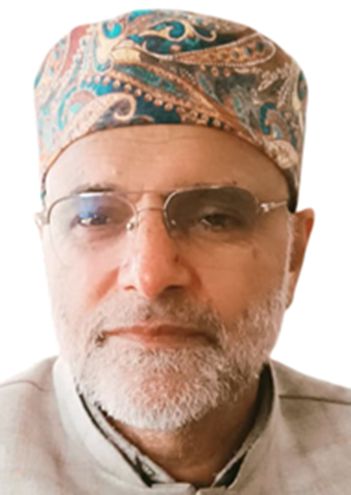
Among the constellation of Kashmir’s great scholars and intellectuals, the late Professor Ghulam Mohiuddin Hajini stands out as a singularly gifted and multifaceted figure whose intellectual radiance continues to illuminate the cultural and academic firmament of the Valley. He was not merely a teacher of Arabic or a connoisseur of Persian; he was a philosopher steeped in metaphysics, a scientist conversant with the frontiers of modern physics, a critic of remarkable insight, a mystic of spiritual depth, and a thinker who sought to bridge the worlds of science, religion, and literature with rare originality. Prof Hajini was a man of encyclopedic knowledge and penetrating intellect — a true polymath whose intellectual horizon transcended linguistic and disciplinary boundaries. He embodied the ideal of the traditional Muslim scholar who engages fearlessly with contemporary thought while remaining deeply rooted in spiritual and cultural authenticity. Many, limited by their narrow frames of reference, tried to confine Hajini within their own restricted definitions, failing to comprehend the depth of his scholarship. In doing so, they exposed their intellectual inadequacy, for Hajini’s mind was a towering mountain — its peak visible only to those capable of the climb.
A Legacy Among Giants: The eminent Kashmiri litterateur, the late Ghulam Muhammad Aajir, once remarked to me, “Kashmir has produced only three great philosophers and thinkers of global stature: Maulana Anwar Shah Kashmiri, Professor Ghulam Mohiuddin Hajini, and one other whose name history may yet recall.” The comparison itself reveals the extraordinary stature Hajini commanded — for to be placed alongside Maulana Anwar Shah Kashmiri is no small honour.
A teacher of Arabic by profession, Hajini’s erudition extended far beyond language and literature. His deep familiarity with Persian poetry, mastery of Kashmiri idiom, and profound understanding of Sufi thought made him a rare intellectual bridge between classical Islamic learning and modern scientific inquiry.
Scholar, Critic, Custodian of Kashmiri Heritage: Hajini’s contribution to Kashmiri language and literature is immense. Muhammad Nazir Fida, in his Tazkira Aslaf (pp. 222–225), pays rich tribute to him, noting: “Hajini Sahib was neither a novelist nor a fiction writer nor even a poet in the conventional sense; rather, he was a scholar of literature whose poetic insight and interpretive acumen had no parallel. His comparative approach and deep understanding of European criticism were remarkable. Fluent in Arabic and Persian, he wrote with equal authority on scientific subjects, displaying a rare fusion of scientific precision and humanistic breadth.” Fida further writes that Hajini rendered invaluable service to the Cultural Academy of Jammu and Kashmir, particularly in compiling the Kashmiri Dictionary and Encyclopaedia, projects that significantly enriched the linguistic and intellectual resources of the region.
A Scholar Remembered By His Students: During my own student days at Government Degree College Sopore (1974–1978), Hajini Sahib’s intellectual influence was palpable even among those who had not directly studied under him. My respected teachers, Prof. Mohammad Farooq Bukhari and Prof. Mishal Sultanpuri, often spoke reverently of Hajini’s brilliance in our Arabic and Urdu classes. I recall vividly two occasions when I personally had the privilege of listening to him. The first was during a guest lecture organized for Arabic students at Sopore College, where he spoke on the philosophical dimensions of language and the metaphysical symbolism embedded in classical Arabic poetry. Though I was still a young student, his eloquence and clarity of thought left an indelible impression upon my mind. His discourse was profound yet engaging — the very model of pedagogical brilliance. The second occasion, however, remains unforgettable. It was around 1978 or 1979, when Maulana Wahiduddin Khan, the renowned scholar and thinker, was invited to deliver a lecture on “Science and Islam” at Sopore College. That day, Hajini Sahib’s response to Maulana Khan’s address became a legend in the annals of Kashmir’s academic history.
The Sopore Symposium| Science, Philosophy, Revelation: As narrated by Malik Ghulam Hasan in his detailed Facebook recollection, the event was intellectually charged. Maulana Wahiduddin Khan presented a classical theological argument, deriving proofs for the existence of God from the Second Law of Thermodynamics, particularly the concept of entropy — the inevitable progression toward disorder, which he interpreted as evidence that the universe had a temporal beginning. When invited to comment, Professor Hajini rose with his characteristic calm dignity. Beginning with a courteous acknowledgment of Maulana’s erudition, he declared, “Maulana Sahib has beautifully expounded the classical theories of science, but let us now see how modern physics — through relativity and quantum theory — invites us to a deeper understanding of divine creation.” What followed was a breathtaking intellectual performance.
Relativity, The Curvature Of Creation: Prof Hajini began with Einstein’s Special Theory of Relativity, explaining with remarkable simplicity how mass, time, and space are not absolute but relative. Newtonian mechanics, he said, holds true only at low velocities; when objects approach the speed of light, all conventional laws collapse. Matter increases in mass, time dilates, and spatial dimensions contract. Quoting from Einstein’s General Theory of Relativity, he described how space itself is curved, invisible to the naked eye, much like the ocean surface appears flat though it is curved by the Earth’s shape. This curvature, he explained, means that the universe is not static but constantly expanding — new stars and galaxies emerging in obedience to the divine command “Kun Fayakoon” (Be, and it is). At this point, he invoked Allama Iqbal’s famous couplet:
“Yeh ka’inat abhi na-tamaam hai shayad,
Ke aa rahi hai dama dam sadaaye ‘Kun Fayakoon’.”
“The universe is perhaps yet unfinished,
For the eternal echo of ‘Be and it is’ still resounds.”
Prof Hajini argued that this continuous process of expansion and contraction — creation and annihilation — is but a cosmic reflection of divine will, and that the Qur’anic descriptions of Qiyamah (Resurrection) may well correspond, in physical terms, to the universe’s final collapse or implosion.
“Professor Ghulam Mohiuddin Hajini was a visionary Kashmiri scholar who exemplified the integration of faith and science, tradition and modernity, and East and West. His intellectual courage, humility, and humor embodied the Kashmiri scholarly spirit, showing deep roots in tradition while embracing change. He championed a holistic pursuit of knowledge, merging the material and spiritual, offering a reminder of the need for broad vision over narrow specialization. Celebrating his legacy reaffirms the intellectual dignity of Kashmir and the vitality of contemporary Islamic scholarship.”
Quantum Mechanics, The Mystery Of The Atom: From relativity, Hajini transitioned seamlessly into the quantum world, invoking names like Niels Bohr, Werner Heisenberg, Pauli, and Erwin Schrödinger. He explained the Uncertainty Principle — that it is impossible to know both the position and momentum of an electron simultaneously — and linked this scientific paradox to the metaphysical mystery of divine omniscience. Citing Heisenberg’s discovery and Einstein’s protest (“God does not play dice”), Hajini observed that quantum physics had revealed a reality far more mysterious than classical science ever imagined. “If man cannot predict the motion of a single electron,” he asked rhetorically, “how can he claim to fathom the essence of the Creator?” He illustrated relativity by drawing a curved line and asking his audience whether it appeared convex or concave. When different answers emerged, he smiled and said, “Both are right — it depends on your point of view. That, gentlemen, is relativity.”
His wit, erudition, and humility charmed the audience. Even seasoned physicists present admitted that Hajini’s understanding of modern physics surpassed their own. Maulana Wahiduddin Khan himself, visibly moved, acknowledged Hajini’s brilliance with admiration.
A Mind That Bridged Faith, Reason : This legendary encounter between revelation and reason, between science and spirituality, encapsulates the essence of Hajini’s intellectual project. He believed that the Qur’an encourages human inquiry and that scientific discovery, far from diminishing faith, deepens our awe of divine wisdom. For him, modern science was not an alien enterprise but a continuation of the Qur’anic imperative to observe, reflect, and infer. His approach resonates with the Islamic intellectual tradition of thinkers like Ibn Sina, Al-Biruni, and Iqbal, who saw no dichotomy between empirical investigation and metaphysical contemplation.
A Philosopher’s Wit, Humility : Beyond his scholarship, Hajini possessed a rare combination of wit, modesty, and spiritual detachment. Shamim Ahmad Shamim, the noted journalist and satirist, wrote about him in evocative prose:
“Among our professors of small stature, Hajini appeared as a giant. He did not carry a necktie and a self-conscious academic face to class; he carried with him the living wisdom of ages. Though formally a professor of Arabic, his grasp of science, art, and psychology was extraordinary. His indifference to appearance was not carelessness but the mark of a dervish-like asceticism — a philosopher in the garb of a humble teacher.” Shamim humorously added that Hajini had become so integral to the S.P. College of Srinagar that “he seemed not a man who joined the college, but a spirit who had always been part of its very walls.”
The Need to Recognize, Revive His Legacy: Despite his towering intellect, Hajini’s contributions remain underappreciated in academic and public discourse. His papers on philosophy, science, Sufism, and literary criticism lie scattered across old journals and cultural archives, awaiting collection and publication.
It is imperative that universities in Kashmir and beyond recognize his work by instituting research chairs and study centres in his name. His writings offer rich material for interdisciplinary study, blending Islamic metaphysics with scientific rationality and cultural criticism — themes urgently relevant in today’s fragmented world.
Conclusion| A Philosopher For All Times: Professor Ghulam Mohiuddin Hajini was not just a scholar of the past; he was a visionary who foresaw the need for dialogue between faith and science, tradition and modernity, East and West. His intellectual courage, combined with humility and humour, made him an exemplar of the Kashmiri scholarly spirit — deeply rooted in tradition yet open to the winds of change. In an age when specialization often narrows vision, Prof Hajini reminds us of the holistic pursuit of knowledge that integrates the material with the spiritual. To rediscover and celebrate his legacy is to reaffirm the intellectual dignity of Kashmir and the continuing vitality of Islamic scholarship in our times. “May Allah grant eternal peace to this radiant soul,” as I wrote elsewhere, “for he was indeed a philosopher, critic, scientist, and saint — a beacon of light in the intellectual history of Kashmir.”
(The author a veteran academician is a former Professor and Head Department of Islamic Studies, Kashmir University. The views, opinions and conclusions expressed in this article are those of the author and aren’t necessarily in accord with the views of “Kashmir Horizon”)