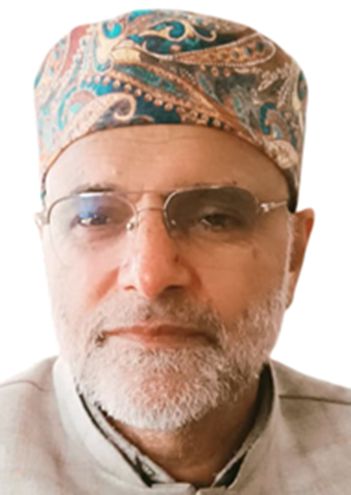
Prof. Hamid Naseem Rafiabadi
Maulana Jalaluddin Rumi (1207–1273) was born in Balkh, in present-day Afghanistan, and later settled in Konya, Anatolia, in modern Turkey. Following in his father’s footsteps, Rumi initially trained as a jurist and theologian, teaching Shari’a law in a madrasa. However, his spiritual trajectory transformed profoundly after meeting the wandering mystic Shams al-Din of Tabriz at the age of thirty-seven. This encounter awakened in him a boundless passion for divine love, turning the ascetic and scholar into an ecstatic poet and Sufi master. His discipleship to Shams and his devotion to the path of love defined his philosophy, emphasizing that knowledge and love are inseparable dimensions of spiritual realization. Rumi’s magnum opus, the Mathnawī-i-Ma‘nāwī, alongside the Dīwān-i Shams-i Tabrīzī, captures the ecstatic and mystical essence of his thought, addressing both human and divine love, the transcendence of self, and the unity of existence. Deeply influenced but never fully subsumed by the metaphysics of Ibn ʿArabi, Rumi developed an independent mystical vision that harmonized the transcendent with everyday life. Celebrated globally, his poetry continues to inspire spiritual seekers across cultures, offering timeless guidance in compassion, love, and the pursuit of the divine.
The birth anniversary of Maulana Jalaluddin Rumi was commemorated at the Amar Singh Club in Srinagar in a vibrant and intellectually stimulating gathering. The event brought together a distinguished galaxy of Kashmiri intellectuals, educationists, scholars, lawyers, researchers, social workers, university teachers, and students, who collectively reflected on the enduring significance of Rumi’s thought in contemporary times. I had the honour of presenting a paper on “Maulana Jalaluddin Rumi and His Concept of Love.” Scholarly presentations were also delivered by Prof. Hamid Naseem Rafiabadi, Prof. Jehangir, Dr. Shahnawaz, Dr. Mudasir Nazar, Dr. Sameer Sadiqi, Dr. Mushtaq Ganai, and several others, while equally thought-provoking addresses were made by Prof. Mushtaq Ahmad Sadiqi, Advocate Mr. Zaffar Shah, Mr. Saleem Beg Sahib, Prof. Ajaz Husain, and other eminent personalities.
The discussions underscored the profound relevance of Rumi’s philosophy of love and spiritual wisdom in a world increasingly marked by materialism, fragmentation, and alienation. Participants emphasized that Rumi’s teachings remain a bridge between Eastern and Western traditions, highlighting universal human values that transcend religion, nationality, and ideology. At the same time, concern was voiced over how certain Western interpretations have misrepresented Rumi, often reducing him to a “New Age” figure while overlooking the depth of his Islamic and Sufi roots and the transformative influence of his relationship with Shams Tabrizi. In this context, participants recalled Rumi’s own words that capture his lifelong spiritual journey. He exhorted seekers to remain steadfast and diligent in the path of love: “In this path, keep cutting and polishing; until your last breath, never remain idle.” (Andarīn rāh mī-tarāsh u mī-kharāsh / Tā damī ākhir damī fārigh mabāsh) This ceaseless striving, Rumi taught, is sustained by a spirit of humility and recognition of one’s dependence on God: “What turns a fox-natured man into a lion is need, and nothing but need, need, need.” (Ū ki shīrān kunad rūbāh-mizāj / Iḥtiyāj ast u iḥtiyāj ast iḥtiyāj).
Above all, Maulana Rumi openly confessed that his transformation from a learned jurist and theologian into the “Mawlana of Rum” was only made possible through his discipleship and love for Shams Tabrizi: “The scholar of Rum would never have become the Master of Rum, had he not been the slave of Shams of Tabriz.”
(Mawlavi hargiz na-bāshad Mawlā-yi Rūm / Tā ghulāmī Shams-i Tabrīzī na-shud)
Such couplets, reflected upon during the gathering, reinforced the view that Rumi’s philosophy of love was rooted in discipline, humility, and spiritual companionship — principles urgently needed in today’s age of moral and spiritual confusion.
Rumi’s popularity today extends far beyond the Muslim world. William Dalrymple, the British historian and journalist, observed with amazement: “It seems almost unbelievable in the world of 9/11, bin Laden, and the Clash of Civilizations, that the bestselling poet in the US in the 1990s is a classically trained Muslim cleric who taught Shari’a law in a madrasa.” He was referring, as Graham Fuller explains in A World Without Islam (2010), to Rumi, whose mystical verses have become a spiritual balm in turbulent times. Fuller notes that Islamic spiritualism is among the great contributions of Muslim civilization: “It would be great if there would be more room for those spiritual themes in the troubled political and cultural lives of both Muslims and Westerners, as the debates swirl over religion, identity, citizenship, tolerance, and belonging.” American scholar William Chittick (2005) describes Rumi’s works as carrying a “universal message in the context of Islamic spirituality,” emphasizing that the meeting with Shams al-Din of Tabriz was a transformative turning point in Rumi’s life. Sultan Walad, Rumi’s son, vividly describes the impact of this encounter: “He had been a mufti: he became a poet. He had been an ascetic: he became intoxicated by Love. ’It was not the wine of the grape: the illumined soul drinks only the wine of Light.”
“Maulana Jalāl ad-Dīn Muhammad Rūmī’s path was characterized by relentless spiritual effort, humility, and devotion, notably his soul’s refinement, dependence on God, and transformation through his love and discipleship under Shams Tabrīzī. Reading Rūmī today offers a timeless voice emphasizing love as life’s essence, God as the Beloved, and the potential for human peace in divine compassion.”
Maulana Rumi’s poetry repeatedly affirms that love (ʿishq) is the essence of spiritual life. Love, he asserts, is not a human invention but an attribute of God Himself. Through love, human beings are liberated from their limitations and raised beyond selfhood. In the Mathnawī, he declares: “Hail, O Love that bringest us good gain — thou art the physician of all our ills, the remedy of our pride and vainglory, our Plato and our Galen” (I, 22-24). For Rumi, love and knowledge are inseparable. As Nicholson notes, he does not distinguish between the gnostic (ʿārif) and the lover (ʿāshiq); to know God is to love Him, and to love Him is to know Him. Love, in this sense, is transformative: “This is Love: to fly heavenwards, to rend every instant, a hundred veils. Love is that flame which, when it blazes up, consumes everything else but the Beloved” (Dīwān, 137; V, 588). Unlike ordinary mortals, the lovers of God did not dread death but longed for it, for “death is a bridge that leads the lover to the Beloved.” Annemarie Schimmel (1980) records Rumi’s poignant words during his last illness in 1273: “If death’s a man — let him come close to me that I can clasp him tightly to my breast! I’ll take from him a soul, pure, colourless; He’ll take from me a coloured frock, no more!”
The decisive turning point in Rumi’s life was his meeting with Shams Tabrizi, whom Schimmel describes as the light of the Divine Sun.
Though Shams, Rumi perceived the world transformed, finding God’s grandeur and grace in every particle of existence. Their companionship was not merely personal but deeply spiritual: “Not only the thirsty seek the water, but the water seeks the thirsty as well” (Mathnawī) This mutuality of longing became central to Rumi’s philosophy of love. Western philosophers also recognized his genius; Hegel praised him as a great thinker as well as a poet, though he emphasized pantheism over mysticism, a misreading noted by Hedley Davis in 1912. Iqbal invoked Rumi in the 20th century as a guide for humanity, stating, “The world of today needs a Rumi to create an attitude of hope and to kindle the fire of enthusiasm for life.” Scholars such as Seyyed Hossein Nasr and William Chittick emphasize that while Rumi was associated with the circle of Ibn ʿArabi and Ṣadr al-Dīn Qūnawī, he remained an independent gnostic whose poetry transcends technical metaphysical systems. The Mathnawī is not a philosophical treatise but a living ocean of spiritual wisdom. In today’s fractured and materialistic world, Rumi’s verses remain a beacon of hope. His works have been translated into dozens of languages, recited worldwide, and embraced by people of all faiths. He famously wrote: “Come, come, whoever you are, Wanderer, worshipper, lover of leaving. It doesn’t matter that you’ve broken your vow a thousand times. Still come, and yet again, come.”
This universal call transcends creed, nationality, and ideology, cementing Rumi’s status as a spiritual icon. At the Srinagar commemoration, speakers cautioned against superficial Western appropriations that overlook his Islamic roots and his profound companionship with Shams Tabrizi. They urged presenting Rumi authentically — as a Muslim mystic, a lover of God, and a guide for humanity. The discussions also addressed current global crises, including the suffering in Gaza, seeing Rumi’s call for divine love and universal brotherhood as an urgent antidote to contemporary barbarism. In times when compassion is endangered, Rumi’s vision of love as the “physician of all ills” is profoundly relevant. The event concluded with a collective recognition that Rumi’s erudition and spiritual vision remain timeless. His poetry illuminates the path of love, dialogue, and renewal in a world dominated by alienation and despair. The Persian couplets discussed during the gathering remind us that Maulana Rumi’s path was one of relentless striving, humility, and devotion: his ceaseless polishing of the soul, his dependence on God, and his transformation through discipleship and love for Shams Tabrizi. To read Rumi today is not merely to encounter a medieval poet but to hear a voice that transcends time, insisting that love is the essence of life, that God is the Beloved of all, and that humanity can still find peace in the embrace of divine compassion.
(The author a veteran academician is a former Professor and Head Department of Islamic Studies, Kashmir University. The views, opinions and conclusions expressed in this article are those of the author and aren’t necessarily in accord with the views of “Kashmir Horizon”)