Says “Post-COVID Rebound, Global Investments India’s Economic Chapter 2”
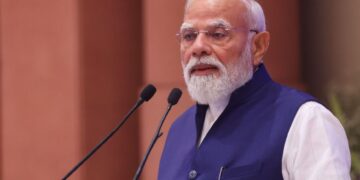
Srinagar: This week Prime Minister Narendra Modi, at NDTV Global Summit 2025, hailed Operation Sindoor as a defining moment that showcased India’s growing strength, preparedness, and moral clarity on the global stage. He said the successful mission reflects India’s commitment to protecting its citizens anywhere in the world — a sign of a nation that no longer waits for others to act but leads from the front with courage and compassion.
The Prime Minister observed that Operation Sindoor symbolized the essence of “New India” — confident, capable, and compassionate. Conducted with remarkable speed and precision, the mission demonstrated India’s expanding diplomatic influence and military readiness. “Today’s India has the capacity to rescue, to respond, and to rebuild,” the PM said, noting that such operations are not just about power projection but about humanity and national pride. He also linked the success of Operation Sindoor to India’s larger journey from being seen as a “fragile five” economy to becoming one of the world’s leading voices of resilience and reform. The Prime Minister emphasized that the operation was a message to the world — that India’s rise is not merely economic or technological, but moral and strategic. “When India acts, the world takes notice,” he said, reaffirming that Operation Sindoor represents not only military and diplomatic efficiency but also the unbreakable spirit of a nation that stands for justice, compassion, and strength. Speaking amidst the festive atmosphere of Diwali, Modi emphasized that India is neither pausing nor slowing down. “140 crore Indians are moving forward together, with full momentum,” he asserted, highlighting that in a world facing unprecedented challenges, India has emerged as a model of growth, self-reliance, and responsible governance.
From Fragile Five To Top Global Economy: Reflecting on the nation’s journey over the past eleven years, the Prime Minister contrasted the pre-2014 era with the present. He recalled India’s position among the so-called Fragile Five, a period marked by policy paralysis, corruption scandals, inflation concerns, and the lingering threat of terrorist sleeper cells. India, he noted, had been perceived as fragile, with citizens and the global community alike skeptical of its ability to navigate crises. Today, that perception has dramatically changed. India has emerged as one of the world’s top five economies, boasting growth rates above seven percent, low inflation, and a burgeoning confidence across sectors—from electronics and semiconductors to shipping and pharmaceuticals.
Self-Reliance Across Sectors: Central to India’s transformation, Modi noted, is its commitment to self-reliance, or Atmanirbhar Bharat. “From chips to ships, India is confident in every sphere,” he said, pointing to technological and industrial advancements that have placed the country on a global stage. The Prime Minister highlighted major achievements in digital infrastructure, including the development of a domestic 4G stack by BSNL, which now supports millions in remote and previously unconnected areas. Services like e-Sanjeevani, delivering telemedicine to millions, underscore the nation’s ability to harness technology for inclusive growth.
India’s Decisively Response : Operation Sindoor, the Prime Minister emphasized, is a testament to India’s decisive response to threats, particularly terrorism. Referring to surgical strikes, air strikes, and targeted operations like Sindoor, Modi noted that India no longer remains silent in the face of aggression, and actively safeguards its citizens’ security and sovereignty. The operation exemplifies India’s strategy of turning every risk into reform, every reform into resilience, and every resilience into revolution. The Prime Minister linked these security measures directly to the larger narrative of an unstoppable India, demonstrating that the nation’s growth is inseparable from its strength and preparedness.
Combating Maoist Terrorism, Naxalism: In addition to external security, Modi addressed internal threats, particularly Maoist terrorism and Naxalism, describing them as grave injustices against India’s youth. Over decades, these movements deprived large regions—especially tribal and marginalized communities—of education, healthcare, and development. Since 2014, the government has prioritized the reintegration of misguided youth into mainstream society, emphasizing rehabilitation, security, and developmental outreach. Today, the number of Naxal-affected districts has dropped from over 125 to just 11, and 303 Naxalites surrendered within a span of 75 hours, symbolizing the government’s commitment to peace, justice, and inclusivity. Initiatives like Operation Sindoor not only target external threats but also ensure that India’s youth can thrive free from fear and deprivation.
Resilient Growth Amid Global Challenges: The Prime Minister further highlighted India’s economic resurgence, citing rapid recovery from COVID-19 and sustained growth thereafter. Despite global speculation about the challenges of managing a population of 1.4 billion during a pandemic, India developed its own vaccines, executed record-breaking immunization campaigns, and emerged as the fastest-growing major economy. Merchandise exports rose nearly seven percent year-on-year, agricultural exports reached ₹4.5 lakh crore, and strategic international investments—from Google’s $15 billion AI investment to green energy and semiconductor projects—have underscored global confidence in India. The EFTA Trade Agreement, promising $100 billion in European investments, demonstrates how India’s growth is actively shaping global opportunities.
Democratization, Financial Inclusion: Prime Minister Modi also emphasized democratization and financial inclusion as key drivers of the country’s success. Over 50 crore Jan Dhan accounts have been opened, banking penetration has expanded to every village, and digital transactions through platforms like UPI now account for half of the world’s real-time digital payments. Subsidy reforms, affordable data, Ayushman Bharat, and PM Jan Aushadhi schemes have collectively saved citizens thousands of crores, showcasing a government committed to empowering individuals while reducing bureaucratic bottlenecks. Petrol pumps operate round-the-clock, gas connections have reached over 10 crore families, and public sector companies such as LIC and SBI are achieving record profitability—illustrating that governance rooted in service and democratization can drive both social and economic progress.
People-Centric Governance|The True Strength of India: The Prime Minister emphasized that India’s unstoppable trajectory is fueled by its people, whose potential is unleashed when policies are streamlined, corruption is minimized, and bureaucratic control is reduced. The government’s reforms, both economic and social, have lifted 25 crore citizens out of poverty, created employment, and strengthened the nation’s global standing. Platforms like NDTV World Summit provide a global audience to appreciate India’s achievements, from Operation Sindoor and the defeat of Naxalism to technology, trade, and financial inclusion.
Transforming Lives Through Technology: Modi framed India’s journey as one where development walks hand in hand with dignity, and progress is coupled with empathy. From defeating internal and external threats through operations like Sindoor to fostering technological and economic self-reliance, India has demonstrated that obstacles are opportunities, risks are reforms, and resilience becomes revolution. Services such as e-Sanjeevani, remote 4G connectivity, and affordable digital infrastructure illustrate how technology is transforming lives in even the most remote areas.
India’s Gateway To Global Opportunities: Modi concluded by emphasizing that in India, the edge of the unknown is not a barrier but a gateway to opportunity. From industrial growth to digital transformation, from international trade to internal security operations like Sindoor, India has showcased a model of balanced progress, resilience, and innovation. The world now sees India as a reliable, responsible, and resilient partner, while its citizens continue to drive the nation forward with confidence, courage, and collective resolve.