
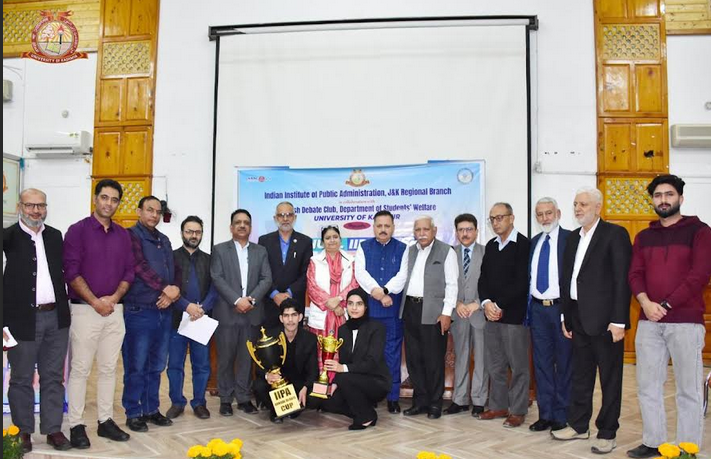
VC KU Prof Neelofar lauds IIPA for the initiative
Srinagar| : The Indian Institute of Public Administration (IIPA) J&K Regional Branch, in collaboration with the University of Kashmir, hosted a debate competition focused on the theme “The House Believes that Urban Living Offers Better Prospects for Quality Life and Livelihoods.”
The event attracted significant participation, with 54 students registering and 40 actively debating from nearly 20 institutions across the Kashmir Division, including SSM College of Engineering and SKUAST-K. The debate was presided over by Dr. G.N. Qasba, Vice Chairman of IIPA J&K, with Prof. Nilofar Khan, Vice Chancellor of the University of Kashmir, serving as the Chief Guest. The event featured notable guests, including Er. Iftikhar Ahmad Hakim, Chairman of the Indian Institute of Engineers (IIE) J&K Chapter, and other distinguished figures. Participants were allotted five minutes for their arguments, followed by a two-minute rebuttal period for the audience. After several rounds of debate, winners were announced: Gazifah Mohsin from SKUAST-K, Saaquib from the Department of Law, and Syed Alizah from the Department of Anthropology received trophies and cash prizes. The Department of Law, University of Kashmir, won the IIPA Trophy, with Saaquib and Noha recognized as the Best Team. The judging panel included esteemed faculty members who evaluated participants on content, articulation, and presentation. In his closing remarks Vice Chairman IIPA Dr. G.N. Qasba highlighted the importance of informed civic debate on urban issues, stressing the challenges of liveability and sustainability in cities like Srinagar. Prof. Khan praised IIPA’s initiative in fostering youth engagement in public discourse and announced an upcoming Memorandum of Understanding (MOU) between IIPA and the University of Kashmir to promote good governance and knowledge exchange. Er. Iftikhar Ahmad emphasized the growing importance of critical thinking in the job market, particularly as AI and machine learning evolve, and encouraged participants to support their arguments with empirical evidence in future debates. The collaboration aims to bridge the gap between academic and civil service institutions, enhancing public policy formulation.