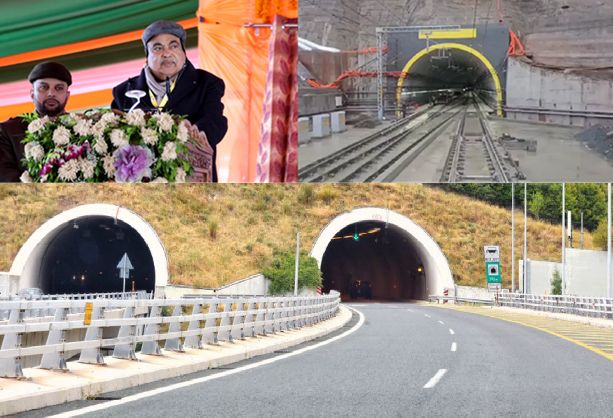
Srinagar: Union Minister Nitin Gadkari recently unveiled ambitious plans for Jammu and Kashmir’s (J&K) infrastructure development, which include the construction of 33 tunnels, five of which have been completed and nine are under construction. The government’s commitment is clear: to establish J&K as a hub for fast, sustainable mobility solutions. The inauguration of the Sonamarg Tunnel, formerly known as the Z-Morh Tunnel, marks a pivotal moment in the region’s development. Spanning 11.98 km and constructed at a cost of ₹2,717 crore, this all-weather tunnel ensures uninterrupted traffic between Srinagar and Ladakh. It bypasses avalanche-prone zones, providing a safe route for travelers and facilitating the smooth transport of agricultural goods from Srinagar to Leh. By reducing travel time, the tunnel enhances connectivity, boosting economic growth.
Union Minister Gadkari also said that ongoing efforts to transform J&K into a well-connected region. The Zojila Tunnel, a crucial 14 km project with an 18 km approach road, is under construction at a cost of ₹6,800 crore. He said that once completed, it will reduce travel time between Srinagar and Leh by 3.5 hours and provide year-round connectivity. Gadkari noted that the project’s cost had been reduced by approximately ₹5,000 crore, demonstrating efficient resource management. Furthermore, Gadkari highlighted the government’s plans for four major corridors in J&K, which together amount to an estimated ₹50,000 crore. “The Jammu-Udhampur-Srinagar Corridor, with a budget of ₹16,000 crore, will reduce the travel distance by 70 km and save five hours of travel time. Fifteen tunnels have been completed, with nine more expected by December 2025. The Jammu-Chenani-Anantnag Corridor, developed at ₹14,000 crore, will cut the distance by 68 km and is scheduled for completion by December 2025,” he added. Meanwhile, the Surankote-Shopian-Baramulla-Uri Corridor, with an estimated cost of ₹10,000 crore, is expected to be completed by 2027. Lastly, the Jammu-Akhnoor-Surankote-Poonch Corridor, currently in the DPR stage, will span 203 km and cost ₹5,000 crore. Additionally, the Kathua-Basohli-Bhaderwah-Doda Corridor, a 250-km four-lane project worth ₹3,400 crore, will allow direct travel from Kathua to Srinagar, bypassing Jammu. This innovative project highlights the government’s focus on improving accessibility and minimizing travel distances. The Union Minister said that Srinagar Ring Road Project, another transformative initiative, involves a 104-km four-lane road at a cost of ₹7,200 crore. “Scheduled for completion by the end of the year, it will help prevent congestion in Srinagar and provide direct access to Gurez, Baramulla, and Ladakh without having to pass through the city,” he added. Gadkari also emphasized the importance of the Delhi-Amritsar-Katra Greenfield ExpressHighway, a 670-km corridor costing ₹41,000 crore. This highway will reduce travel time between Delhi and Srinagar to 8-8.5 hours, vastly improving connectivity and convenience.
The Union Minister said that these infrastructure projects will have a profound impact on J&K’s economy, especially its tourism sector. The improved road network, alongside ongoing ropeway projects like the Shankaracharya Ropeway in Srinagar and the Baltal-Amarnath Shrine Ropeway, will make tourist destinations more accessible. Gadkari also announced the Sonamarg-Thajiwas Ropeway, further underscoring the government’s commitment to boosting tourism, creating jobs, and empowering local communities. The government’s infrastructural initiatives not only enhance tourism but also promote economic growth by improving trade and supply chains. The Sonamarg Tunnel, for example, facilitates the uninterrupted movement of goods, including local agricultural produce, between Srinagar and Leh. “This connectivity strengthens regional trade and empowers farmers by providing faster access to markets. Moreover, the infrastructure projects contribute to national security by ensuring reliable supply chains, especially in the strategically important Ladakh region,” he added. Gadkari also highlighted the environmental benefits of these projects. By reducing travel distances and times, fuel consumption is lowered, leading to reduced greenhouse gas emissions. This aligns with Prime Minister Modi’s vision of a “Viksit Bharat,” focusing on economic development alongside environmental responsibility. The completion of the Sonamarg Tunnel, despite challenging terrain and harsh weather, stands as a testament to the resilience and expertise of engineers and contractors involved. Gadkari praised their efforts, emphasizing that such projects, once deemed impossible, are now a reality under Modi’s leadership.
The Zojila Tunnel, set to be Asia’s highest tunnel, is another engineering achievement. Spanning 14 km at an altitude of over 11,500 feet, it will provide all-season connectivity between Srinagar and Leh. Its completion will not only improve mobility but will also symbolize India’s determination to overcome geographical and climatic hurdles in the pursuit of progress. Under Modi’s leadership, J&K is undergoing an unprecedented transformation. Gadkari’s announcements underscore the government’s holistic approach to development, with a focus on connectivity, economic growth, and sustainability. “By prioritizing infrastructure, tourism, and job creation, the government aims to empower the youth and uplift the socio-economic fabric of the region,” he said. Gadkari said that Sonamarg Tunnel’s inauguration is not merely a milestone in connectivity but a symbol of hope and progress for J&K. As the region moves toward its goal of becoming “heaven on earth” once again, the combined efforts of the government, local leaders, and citizens will be crucial in ensuring lasting peace and prosperity. “The ambitious projects outlined by Gadkari—from corridors and tunnels to ring roads and ropeways—are laying the foundation for a more connected and prosperous J&K. These initiatives exemplify resilience and innovation, proving that with determination and vision, even the most formidable obstacles can be overcome.” Gadkari said that Under the Prime Minister’s leadership, road and rail connectivity has vastly improved, transforming what was once thought impossible into reality.