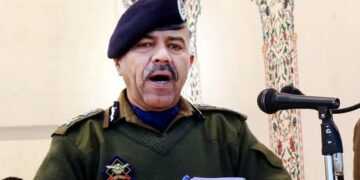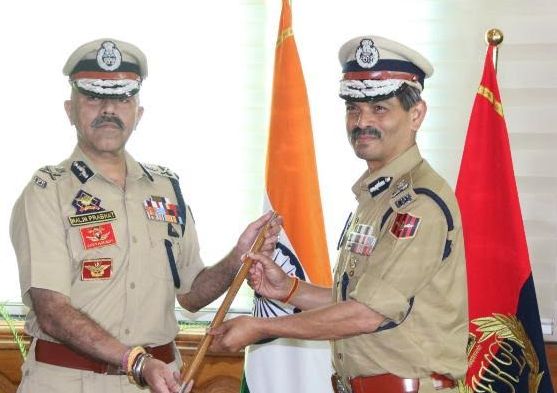
Srinagar: Senior IPS officer Nalin Prabhat assumed the role of the 18th Director General of Police (DGP) of Jammu and Kashmir at the police headquarters in Srinagar, succeeding R R Swain. The event was attended by several senior officers, highlighting the significance of this leadership transition.
Nalin Prabhat, a 1992 batch IPS officer, is recognized for his extensive expertise in countering militancy in Kashmir. His past postings in Jammu and Kashmir earned him the respect of security forces, worked as Deputy Inspector General for South Kashmir, Operations Range, and within the Srinagar Sector of the Central Reserve Police Force (CRPF). He also held the position of Inspector General for the Kashmir Ops Sector of the CRPF and has received notable accolades, including the Antrik Suraksha Seva Padak and the Police (Special Duty) Medal and Bar for his dedicated service. Born on March 14, 1968, in Thungri village, Manali, Himachal Pradesh. Prabat graduated from St. Stephen’s College in Delhi with a BA (Honours) and an MA. As a 1992-batch IPS officer, Prabhat has extensive experience in counter-insurgency operations, having previously led the Greyhounds, an elite anti-Naxal unit in Andhra Pradesh. At 55, he has been serving as the Director General of the National Security Guard (NSG) since April 2024. His distinguished career includes multiple accolades, such as three Police Gallantry Medals and the Parakram Padak. Prabhat’s appointment comes at a critical juncture as Jammu and Kashmir grapples with an increase in militant activities, including recent encounters and violent clashes like the assault on an army convoy in Kathua, as well as skirmishes in Doda and Udhampur. This year, the region has witnessed over 20 soldier fatalities and a dozen civilian casualties. Prabhat’s strategic approach to law enforcement is anticipated to introduce a new dynamic to the security landscape. Prior to joining the NSG, he oversaw the Central Reserve Police Force’s (CRPF) operations in Jammu and Kashmir as its Special Director General and Additional Director General.
The outgoing Director General Police (DGP) RR Swain reflected on his 30 years in the Jammu and Kashmir Police, focusing on his commitment to a fear-free environment for residents. Following his tenure, Senior IPS officer Nalin Prabhat was appointed the new DGP at a transition ceremony in Srinagar, attended by senior officials. In recent interaction with media, DGP RR Swain reflected on his three-decade journey in the Jammu and Kashmir Police, emphasizing his commitment to ensuring that the residents of the region live free from fear and intimidation. His tenure was marked by a dedication to fostering a peaceful environment amidst ongoing challenges. For a police officer, Balidan Stambh holds the same reverence as a place of worship. It symbolizes the countless heroes who sacrificed their lives for our cause. On my last day in service, it is my solemn duty to honor these brave souls. Reflecting on his journey from Senior Superintendent of Police (SSP) to DGP, he expressed profound gratitude for the opportunity to serve the people of Jammu and Kashmir, acknowledging that not everyone is afforded such a chance. Swain conveyed his aspiration to bring lasting peace and dignity to the region, emphasizing the importance of eliminating fear and putting smiles on people’s faces. “I am deeply grateful to all the mothers, sisters, children, and elderly citizens for their unwavering support,” he stated. Outgoing DGP Swain stressed that everyone in Jammu and Kashmir deserves to live peacefully, free from fear and intimidation. “I believe I have maximized the opportunity to help achieve this,” Swain remarked, as he prepared to hand over the reins to Nalin Prabhat, the incoming police chief. During his farewell address, the outgoing DGP expressed appreciation for all the officers who attended the event, whether in person or virtually, noting that each one holds a special place in his heart. He expressed gratitude to God for allowing him to be part of the extensive police family in Jammu and Kashmir, acknowledging the love and respect he received from personnel across all ranks. Significantly, Swain’s tenure saw a marked reduction in militancy. Local recruitment into militant groups dropped to an all-time low of just eight individuals, a stark contrast to a five-year average of 113, reflecting the effectiveness of the counter-militancy measures implemented under his leadership. Moreover, civilian casualties due to militancy fell to 16, significantly lower than the five-year average of 34, showcasing a successful approach in safeguarding civilians amidst ongoing challenges. Additionally, the number of security personnel killed in action decreased to 34 from an average of 50 over the past five years, showcasing enhanced safety protocols and operational strategies.
Under Swain’s leadership, incidents of stone-pelting and protests orchestrated by separatist networks were reduced to zero, marking a significant stabilization of public order. His focus on community policing played a crucial role in bridging gaps between the police force and local communities, fostering trust and cooperation. Furthermore, he emphasized the importance of enhancing training and resources for J&K Police personnel, equipping them better to handle diverse challenges while maintaining public safety. Swain also initiated various non-kinetic measures aimed at addressing the root causes of unrest, focusing on dialogue and community engagement to foster peace. He praised the diverse composition of the J&K Police, drawn from various regions and communities, which reflects the fabric of the society it serves. This diversity has been pivotal in addressing the unique challenges faced in the region. The J&K Police stands out for its dual role as both a formidable and people-friendly force, combating militancy while managing to control unrest with minimal casualties. Swain highlighted that the J&K Police is unique in facing adversaries with such overt support from hostile entities across the border. “No other police force in India confronts adversaries with such blatant support from hostile entities across the border,” he stated, adding that without these foreign elements, the J&K Police could have long ago quelled the cycle of violence. As history unfolds a new dawn of peace and tranquility in Jammu and Kashmir, Swain expressed confidence that the change of guard will not deter the J&K Police from remaining focused on the larger fight against militancy. He extended his gratitude to colleagues at all levels for their unwavering support. In a coffee table book commemorating his tenure, DGP Swain outlined significant achievements, marking a transformative period for the J&K Police. He reiterated the exceptional nature of the force, emphasizing its role as a tough yet people-friendly entity in the fight against militancy. “We stand shoulder to shoulder with armed militants and confront stone-pelting mobs, minimizing loss of life and property—something that hostile entities despise,” he remarked. Swain described the J&K Police as a microcosm of the larger region, with personnel from diverse backgrounds and faiths, reflecting the unique challenges they face.