“Migrant KPs empowered with special polling stations, A total of 415 candidates contested across seven distts”
“Voter turnout rises from previous phases, signals renewed engagement, 65.58% Turn Out Recorded In Final Phase
“From 61.38% to 68.72%: Notable Increase in Voter Turnout Across Phases, Election Results on Oct, 8
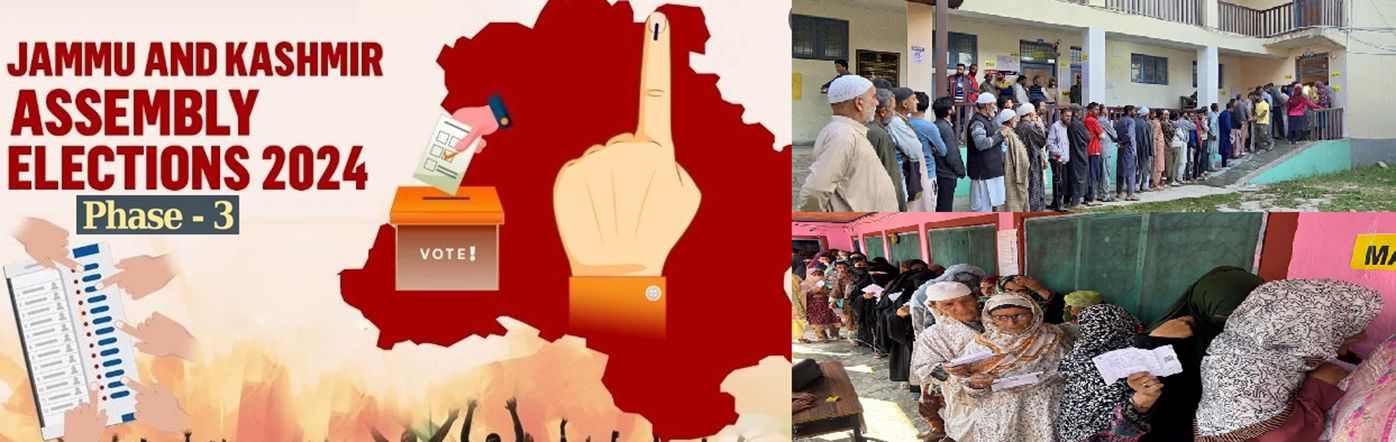
Srinagar: The third and final phase of polling for the Jammu and Kashmir Legislative Assembly elections concluded peacefully today, with a remarkable voter turnout of 65.58 percent reported by the Election Commission of India (ECI) until 7 PM. This phase covered seven districts, marking the culmination of the electoral process in the Union Territory. The results of this pivotal election are set to be announced on October 8.
The three-phased Assembly elections in Jammu and Kashmir concluded today with a notable increase in voter turnout, particularly in the final phase.
The Election Commission of India had announced the election schedule on August 16, 2024. The elections unfolded in three phases: the first phase on September 18 for 24 Assembly constituencies, the second phase on September 25 for 26 constituencies, and the final phase today for 40 Assembly constituencies.
The voter turnout for each phase is as follows: Phase 1: 61.38%, Phase 2: 57.31% and Phase 3: 68.72% (tentative). The overall voter turnout for the elections stands at 63.45% (tentative), reflecting a robust engagement from the electorate.
The Election Commission of India announced the election schedule on August 16, 2024, with voting occurring in three phases: the first on September 18 for 24 Assembly constituencies, the second on September 25 for 26 constituencies, and the final phase on October 1 for 40 Assembly constituencies.
District-wise comparisons revealed that Kishtwar led with the highest turnout at 80.20%, followed by Udhampur at 75.87%, Samba at 75.22%, and Reasi at 74.68%. A detailed analysis of specific Assembly constituencies further highlighted strong participation, particularly in Inderwal (82.16%), Padder-Nagseni (80.67%), and Shri Mata Vaishnodevi (80.45%).
According to the data released by the ECI, Udhampur emerged as the district with the highest voter turnout at 72.91 percent, followed closely by Samba at 72.41 percent, and Kathua at 70.53 percent. Other districts reported varying turnout rates, with Jammu recording 66.79 percent, Bandipora at 64.85 percent, Kupwara at 62.76 percent, and Baramulla at 55.73 percent.
The ECI issued a press release highlighting that the polling for the Jammu and Kashmir Legislative Assembly elections concluded in a peaceful and celebratory atmosphere, a significant achievement given the historical context of the region. “The elections were a resounding statement in favor of democracy,” the release stated, echoing the sentiments expressed by Chief Election Commissioner (CEC) Rajiv Kumar during the announcement of the general elections in Jammu and Kashmir on August 16.
In his earlier address, CEC Rajiv Kumar had expressed optimism about the elections, stating, “In Jammu-Kashmir, the world will witness the defeat of nefarious and inimical interests and the triumph of democracy.” His words have resonated throughout the electoral process, emphasizing the importance of democratic values in the region. Kumar remarked that the J&K Assembly elections signify a deepening of democracy, a milestone that will be remembered in the annals of history. “These elections will continue to inspire a democratic spirit in the region for years to come,” he asserted, dedicating the electoral process to the resilient people of Jammu and Kashmir. He acknowledged their determination and faith in the democratic process, reinforcing the notion that democracy is gaining a more profound foothold in the region.
The peaceful and participative nature of the elections has been a historic event, especially in areas traditionally known for militancy and boycotting democratic processes. The ECI reported a significant increase in voter turnout in constituencies that have previously experienced low electoral participation. Notably, the polling percentage in the Pulwama Assembly constituency saw a remarkable increase of 12.97 percent compared to the previous elections held in 2014. Similarly, the Zainapora Assembly constituency in Shopian registered a 9.52 percent increase, while the Eidgah constituency in Srinagar saw a 9.16 percent rise in voter turnout. These statistics reflect a growing confidence among the electorate in the electoral process and indicate a positive shift in the political landscape of the region.
In an effort to ensure that all eligible voters could participate, the ECI set up 24 special polling stations specifically for Kashmiri migrant voters. These special facilities were established in various locations, with 19 stations in Jammu, one in Udhampur, and four in Delhi, allowing migrants to exercise their franchise despite geographical barriers.
Phase 3 of the elections involved 40 Assembly constituencies across the seven districts, with a total of 5060 polling stations established to accommodate voters. A total of 415 candidates contested in this phase, comprising 387 men and 28 women. The districts that participated in this final phase of voting included Bandipora, Baramulla, Jammu, Kathua, Kupwara, Samba, and Udhampur. To provide context, the previous two phases of the elections witnessed voter turnouts of 61.38 percent and 57.31 percent, respectively. The overall trend of increasing voter participation is a promising sign for the democratic process in Jammu and Kashmir, reflecting a renewed engagement from the electorate. The upcoming vote counting scheduled for October 8 is highly anticipated, as it will reveal the preferences of the voters and determine the political landscape of Jammu and Kashmir for the coming years. The election results will provide insights into the public sentiment regarding various issues affecting the region, including governance, security, development, and social welfare. The significance of these elections extends beyond mere numbers. They represent a critical juncture for Jammu and Kashmir, where the voices of the people can finally be heard in the corridors of power. The recent electoral process has been characterized by an atmosphere of hope and change, with voters expressing their desire for a better future and effective representation. The participation of women candidates in these elections is also noteworthy. With 28 women contesting, there is a growing recognition of the importance of women’s voices in the political arena. This development reflects a broader societal change towards inclusivity and representation, which is essential for a healthy democracy.
As the counting day approaches, political analysts and party leaders are gearing up for a keen contest. The results will not only indicate the success of individual candidates but will also reveal the shifting dynamics among political parties in Jammu and Kashmir. Given the historical context of elections in the region, the implications of these results will be significant for both state and national politics.
The peaceful conduct of the third phase of polling in Jammu and Kashmir, marked by a substantial voter turnout, signifies a positive trend for democracy in the region. The sentiments expressed by the Chief Election Commissioner and the increased participation of the electorate highlight the growing confidence in the democratic process.
As the people of Jammu and Kashmir await the results on October 8, the significance of this electoral exercise cannot be overstated. It represents not just a procedural formality but a genuine reflection of the hopes and aspirations of the people for a better tomorrow.