• Says “Heritage must remain a living force in society”
• “Onus on universities to promote research, translate classical texts”
• “Connect youth with Kashmir’s civilisational legacy”
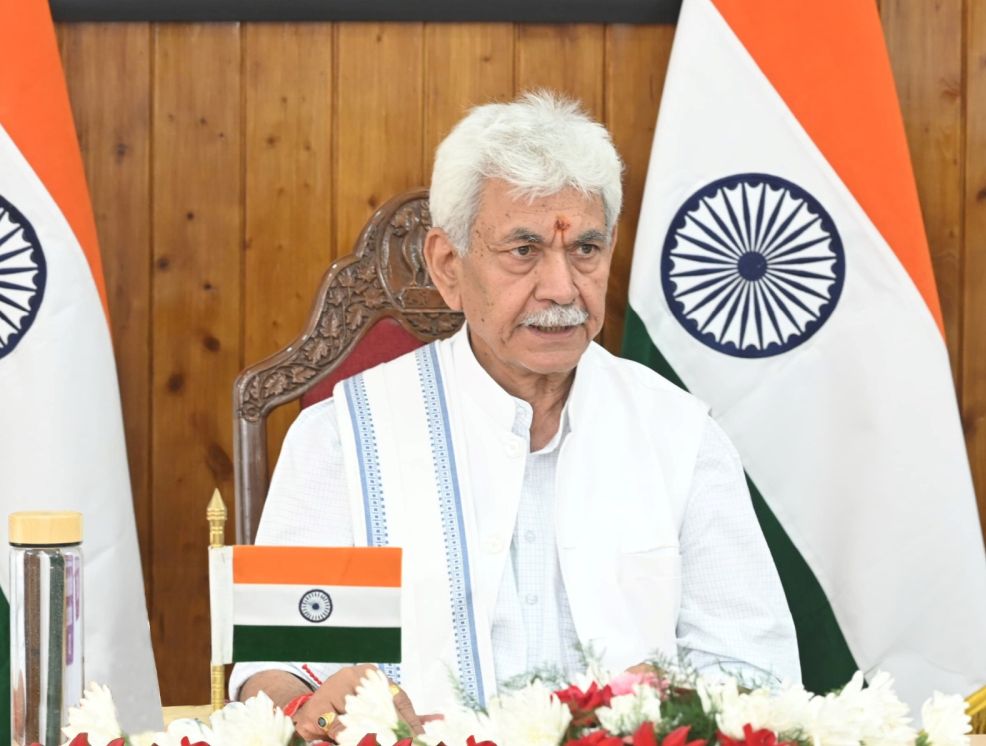
Srinagar, Nov 12:Lieutenant Governor Manoj Sinha on Thursday called for a people-centric movement to preserve, document and promote Jammu and Kashmir’s rich cultural heritage, asserting that the region’s civilisational legacy must remain a living force in society rather than being confined to academic institutions and archival records.
Addressing a two-day national seminar on ‘Revival, Preservation and Sustainability of Cultural Heritage of Kashmir’, organised by Kakini Building Humanity, the Lieutenant Governor stressed the need for collective efforts involving universities, cultural institutions, scholars and civil society to safeguard the region’s historical, literary and spiritual inheritance.
Union Minister for Culture and Tourism Gajendra Singh Shekhawat also participated in the event virtually.
Describing heritage as an invaluable inheritance from generations of philosophers, saints, writers and thinkers, Sinha said the present generation had a responsibility to preserve and make it accessible to future generations.
He called upon universities and teachers to encourage research, translate classical texts and introduce younger generations to Kashmir’s intellectual traditions, particularly the contributions of Acharya Abhinavagupta.
“Heritage must be alive, it must converse, and it must guide our new generation,” he said.
Emphasising Kashmir’s contributions to philosophy, spirituality, language and aesthetics, the Lieutenant Governor said a deeper understanding of cultural roots strengthened identity, self-respect and national consciousness.
Highlighting the scale of ongoing conservation initiatives, Sinha said 106 heritage projects had been taken up during the first two phases, with more than 40 completed. Under Phase III, 321 projects had been identified, of which 312 had received administrative approval.
He said nearly 96.8 lakh pages of historical records had been digitised in the Jammu and Srinagar archives, accounting for around 68 per cent of available documents. Under Mission Gyan Bharatam, surveys had identified 43,000 manuscripts, with digitisation efforts progressing.
The Lieutenant Governor also highlighted initiatives concerning the Sufiana School in Srinagar, modernisation of Abhinav Theatre and Kala Kendra in Jammu, restoration of Mubarak Mandi and research into Kushan-era Buddhist remains discovered in Baramulla district.
On Naranag Heritage Complex in Ganderbal, he welcomed the research and documentation work undertaken by Kakini Building Humanity and expressed hope that restoration activities would commence after completion of necessary procedural requirements.
Underlining Kashmir’s traditions of harmony and mutual respect, Sinha said the teachings of Yogini Lalleshwari and Nund Rishi continued to connect people across generations.
He described the preservation of this shared cultural legacy as a collective public responsibility and acknowledged the invaluable contribution of Kashmiri Pandits to the Valley’s literary, spiritual and cultural traditions. Their dignified return, he said, would help restore Kashmir’s complete social and cultural fabric.
He also appreciated the initiatives associated with the Harmukh-Gangbal pilgrimage, describing it as a reflection of the region’s enduring spiritual traditions.
The Lieutenant Governor commended the Department of Archives, Archaeology and Museums, scholars, archivists, museum professionals, former Army officers and civil society organisations for their contribution to heritage conservation.
On the occasion, Padma Vibhushan awardee Dr Padma Subrahmanyam and other personalities were felicitated for their contributions to culture and heritage.
Maj Gen R.K. Raina (Retd.), Chairman, Kakini Building Humanity; Cdr Sanjay Kaul (Retd.); Dr Aanchal Khurana, Vice-President, Kakini Building Humanity; Secretary Culture Ramesh Kumar; Divisional Commissioner Kashmir Anshul Garg and other senior officials, scholars and prominent citizens attended the seminar.