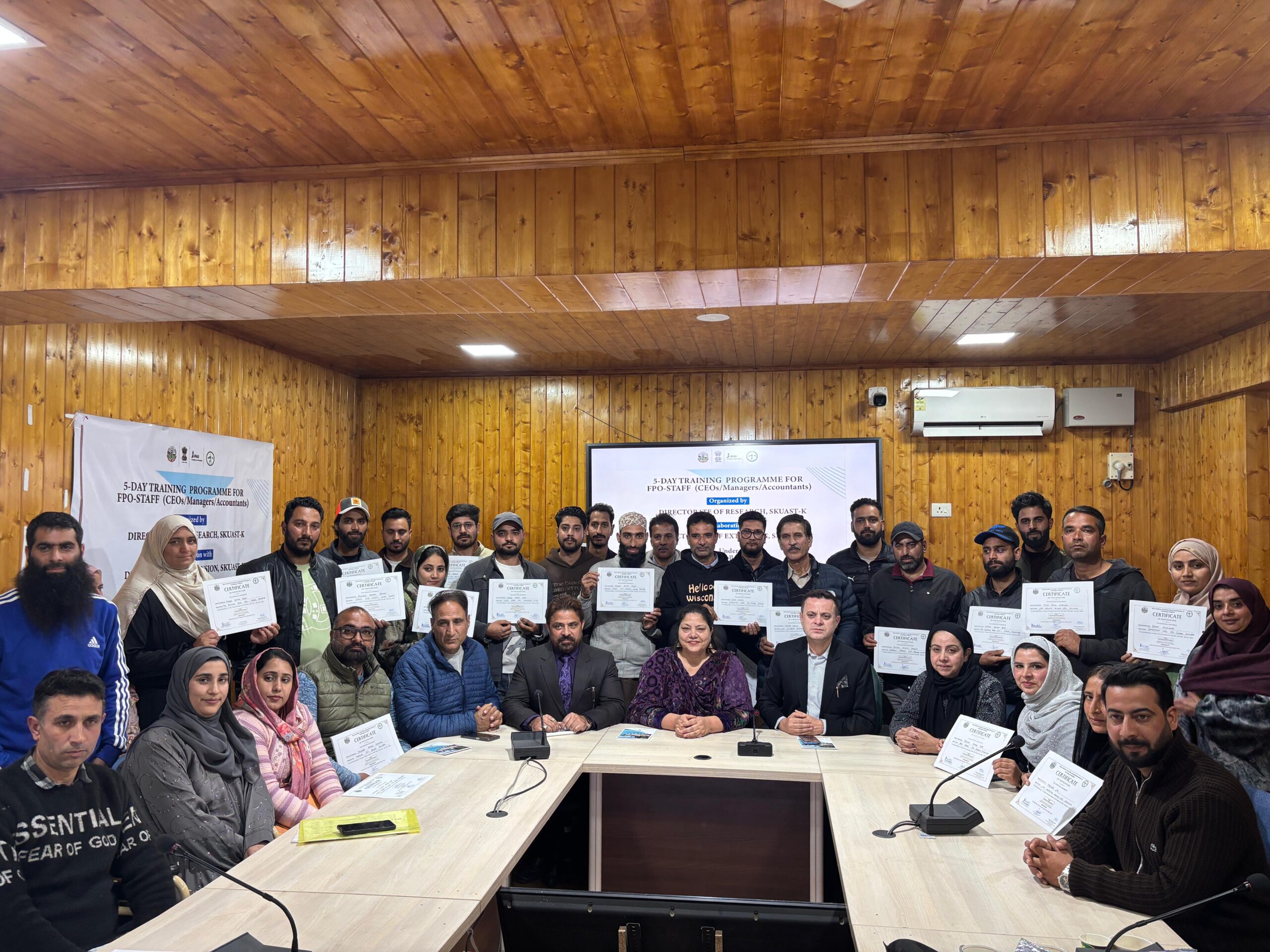
With farmer collectives increasingly being seen as a key link between agricultural production and market access, Sher-e-Kashmir University of Agricultural Sciences and Technology of Kashmir (SKUAST-K) has trained around 50 functionaries of Farmer Producer Organisations (FPOs) from across Kashmir to strengthen their managerial, financial and institutional capacities.
The five-day training programme, which concluded on Monday, brought together Chief Executive Officers, managers, accountants and members of FPO boards representing different districts of the Valley. The initiative aimed at equipping them with professional skills required to improve the functioning, financial management and long-term sustainability of farmer collectives.
Organised by the Directorate of Research in collaboration with the Directorate of Extension, SKUAST-K, the programme was conducted under the Upscaling Collectivisation component of the JKCIP-SKUAST-Kashmir, an IFAD-sponsored project.
The training assumes significance as professionally managed FPOs can help farmers overcome challenges associated with fragmented production, limited bargaining power, market access and value addition by bringing them together under a collective institutional framework.
Addressing the valedictory function, Director Extension and Chairperson, Upscaling Collectivisation, JKCIP, Prof. Raihana Habib Kanth, underscored the importance of extension services in connecting farmers with scientific technologies, market opportunities and institutional support.
She said trained FPO functionaries were essential for translating agricultural innovations into practical benefits for farming communities, adding that professionally managed organisations could strengthen farmer collectivisation, improve agricultural marketing and enhance farmers’ income.
Director Research, SKUAST-K, Prof. Syed Zameer Hussain, stressed the need for research-driven interventions and institutional capacity building to improve the performance of FPOs. He urged participants to adopt professional management practices and utilise the university’s scientific expertise to ensure the sustainability of their organisations.
Dean, Faculty of Horticulture and Project Coordinator, JKCIP, Prof. Ashiq Hussain Pandit, highlighted the potential of horticulture-based FPOs in Kashmir, stressing collective marketing, value addition, quality management and stronger market linkages to improve returns to farmers.
He called for innovative approaches, better technical knowledge and efficient management practices to make FPOs economically viable, competitive and farmer-centric institutions.
Dr. Mohammad Iqbal Bhat, Vertical Coordinator, Upscaling Collectivisation, JKCIP, highlighted the importance of structured capacity-building initiatives in strengthening FPO institutions. He stressed that sound financial management, transparency, accountability and effective institutional governance were essential for their long-term growth.
The speakers observed that CEOs, managers and accountants form the backbone of FPO operations, with their professional competence directly influencing organisational efficiency, financial discipline and sustainability.
The programme concluded with a vote of thanks, acknowledging the contributions of the university leadership, resource persons, organising team and participating FPO representatives.