First woman chairperson brings focus on transparency, digitisation, infra development, employee welfare, preservation of Kashmir’s spiritual heritage
Neelofar Shakeel
Srinagar| Nov, 09: From upgrading centuries-old shrines and improving facilities for devotees to introducing administrative reforms, strengthening financial management and modernising institutional functioning, the Jammu and Kashmir Waqf Board has witnessed a series of initiatives under the leadership of its Chairperson, Dr Syed Darakhshan Andrabi.
Appointed in March 2022 as the first woman to head the J&K Waqf Board, Andrabi has sought to bring greater institutional discipline, transparency and a development-oriented approach to an organisation entrusted with managing an extensive network of religious, educational and charitable institutions across the Union Territory.
Her tenure has increasingly focused on transforming Waqf institutions from traditional property-management establishments into more professionally managed bodies, with an emphasis on public facilities, preservation of religious heritage and better utilisation of resources.
One of the significant areas of attention has been the modernisation and development of important Sufi shrines and religious places, which hold immense spiritual and cultural importance for the people of Kashmir.
The Board has undertaken infrastructure development, renovation, beautification and improvement of public amenities at several religious sites. The objective has been to ensure that devotees visiting these shrines receive better facilities while the historical and spiritual character of these institutions remains protected.
Among the notable initiatives was the installation of new carpets at the revered Dargah Hazratbal shrine in Srinagar after nearly seven decades. The initiative marked an important improvement in facilities at one of Kashmir’s most significant religious centres.
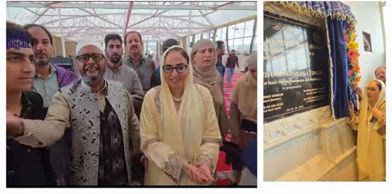
More recently, on October 5, 2026, Andrabi inaugurated the newly constructed Sabaat Complex and a high-tech conference hall at the revered shrine of Hazrat Sheikh Noor-ud-Din Noorani (RA) at Chrar-e-Sharief in Budgam. The project is aimed at strengthening infrastructure and providing improved facilities at the historic spiritual destination.
The development of shrine infrastructure has also been accompanied by efforts to improve administrative arrangements, financial management and institutional accountability.
According to the Waqf Board, reforms undertaken since the constitution of the present Board in 2022 include the survey, geo-tagging and digitisation of Waqf properties, introduction of e-governance mechanisms, implementation of the e-office system and modernisation of financial and administrative processes.
These measures are aimed at improving record management, strengthening oversight of Waqf assets and ensuring that resources entrusted to the institution are utilised more effectively for public welfare.
A particularly important aspect of the reform process has been the focus on revenue generation and better management of existing assets. The Board has highlighted measures such as the utilisation of previously abandoned properties, timely collection of rents and transparent management of donations to strengthen its financial position.
The emphasis on financial discipline has also been linked with employee welfare. In July 2025, Andrabi highlighted the revision of wages of Waqf employees and engaged staff, stating that salaries which had remained unchanged for decades had been revised as part of the Board’s welfare measures.
The Board has also highlighted the release of salaries and pensions in advance on the occasion of Eid-ul-Adha in 2026, reflecting its stated effort to combine administrative accountability with employee welfare.
Education remains another important component of the Board’s responsibilities. Waqf institutions run educational establishments and a nursing college, providing opportunities to students, including those from economically weaker sections. The Board has emphasised improving educational infrastructure, academic standards and institutional management.
The implementation of the National Education Policy in Waqf-run educational institutions was also among the administrative decisions taken during the Board’s reform process.
Beyond infrastructure and administration, Andrabi has also stressed the social responsibilities of religious institutions. During Eid-ul-Adha in May 2026, she highlighted the arrangements made for congregations across Waqf-managed shrines and mosques, including the availability of facilities for worshippers. Special sermons against the drug menace were also delivered at religious places across the Union Territory.
The Board has increasingly sought to use religious institutions as platforms for promoting social awareness, community engagement and welfare-oriented activities.
Technology has emerged as another priority. In September 2026, the Board launched a technological empowerment initiative under which computer systems were distributed among shrine administrations and sub-units to improve digital record management, official communication and day-to-day administrative efficiency.
The initiative is part of a broader effort to bring Waqf administration in line with contemporary governance practices.
For Dr Andrabi, the challenge has been to balance the preservation of Kashmir’s centuries-old spiritual traditions with the need to modernise the institutions responsible for their upkeep. The shrines, mosques and other Waqf properties are not merely administrative assets; they represent a living heritage deeply connected with the region’s religious and cultural identity.
Her tenure has also brought greater attention to the need for professionally managed institutions, stronger financial systems and improved public facilities.
The journey of institutional reform, however, remains ongoing. Effective utilisation of Waqf properties, protection of assets, improved educational standards and sustained public confidence will remain important measures of the Board’s performance.
As the Waqf Board continues its development initiatives, the larger objective is to ensure that these institutions serve not only as centres of faith and spiritual heritage but also as instruments of education, charity and social welfare.