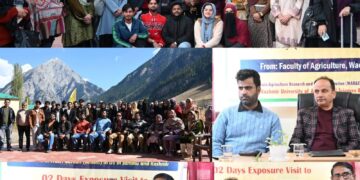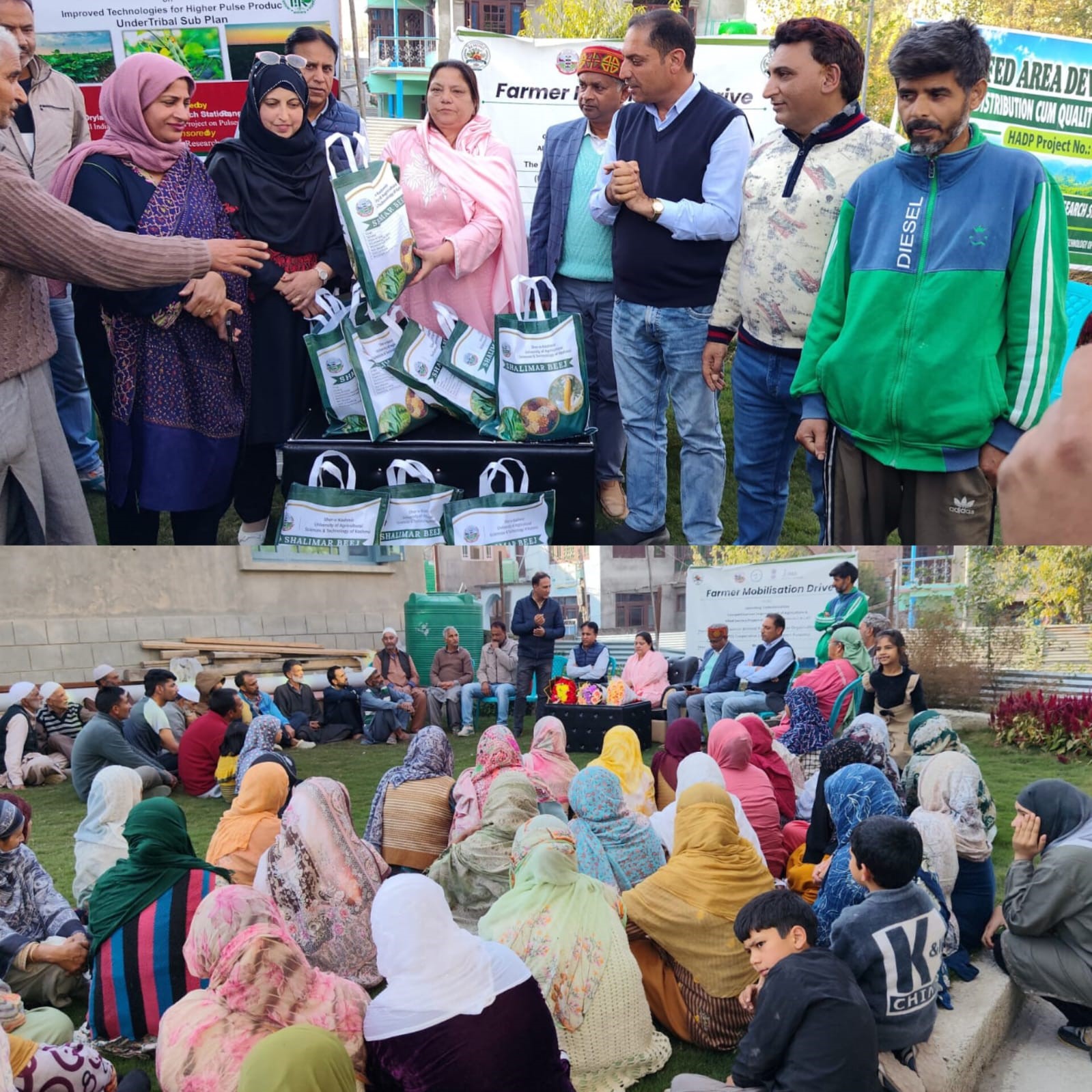
Pampore, October 22: A farmer mobilisation drive was organised at Meej, Pampore, by The Kashmir Almond FPO Cooperative Limited under the Jammu and Kashmir Competitiveness Improvement Project (JKCIP), supported by the International Fund for Agricultural Development (IFAD), to promote farmer collectivisation, pulse cultivation and climate-resilient agriculture.
The programme was organised in collaboration with the Directorate of Extension, SKUAST-Kashmir, Krishi Vigyan Kendra (KVK) Pulwama and the Dryland Agriculture Research Station (DARS), Srinagar, under the project’s Upscaling Collectivisation component.
Seeds of field pea and garden pea were distributed among Farmer Producer Organisation (FPO) members under HADP Project 15, Rainfed Area Development, and the Tribal Sub-Plan (TSP) of DARS Srinagar to encourage pulse cultivation and strengthen participation in collective farming.
Prof. Raihana Habib Kanth, Director Extension, SKUAST-Kashmir, stressed the need to strengthen agricultural extension services to bridge the gap between scientific research and field-level farming practices. She called for greater adoption of modern agricultural technologies and improved coordination among research institutions, extension agencies and farmer organisations.
Prof. Zafar Afroz Badri, Programme Coordinator, KVK Pulwama, highlighted scientific cultivation methods, quality seed use and improved pulse production technologies. He urged farmers to follow recommended practices and seek technical guidance from KVK experts.
Dr. Mohammad Iqbal Bhat, Coordinator, Upscaling and Collectivisation, JKCIP-IFAD, SKUAST-Kashmir, said strong Farmer Producer Organisations could help farmers access quality inputs, strengthen collective bargaining, improve market linkages and increase returns through collective procurement and marketing.
Prof. Liyaqat Ali and Prof. Zahida Rashid also highlighted the importance of farmer participation in extension programmes and the adoption of improved agricultural practices.
The discussions focused on rainfed area development, efficient resource utilisation and climate-smart farming practices to improve productivity and strengthen agricultural systems in rain-dependent areas of the region.