The 2047 Horizon: Centering Viksit Bharat in the Prime Minister’s Political DNA
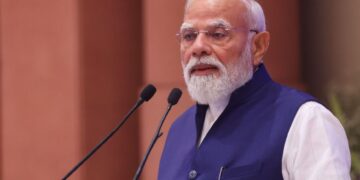
New Delhi| Oct 6 : The Union Cabinet has adopted a 10-point resolution to commemorate Prime Minister Narendra Modi’s 25 years of continuous leadership, marking a significant milestone in India’s political and economic evolution.
The resolution, set to be formally recognized on October 7, highlights Modi’s journey from Gujarat Chief Minister to Prime Minister, emphasizing his contributions to welfare delivery, economic reforms, infrastructure development, technological advancements, national security, and India’s growing global stature. The Cabinet’s narrative positions Modi’s leadership as a cohesive journey driven by the principles of prioritizing the nation and its citizens, with an overarching goal of transforming India into a developed nation by 2047. The resolution underscores Modi’s electoral successes, including victories in the 2014, 2019, and 2024 Lok Sabha elections, and notes his record as the longest-serving elected Prime Minister, surpassing Jawaharlal Nehru’s tenure. It emphasizes policy continuity and administrative reforms, showcasing initiatives like the SWAGAT grievance-redressal system and the Jyotigram electricity project as examples of governance models that have been scaled nationally.
The Cabinet also highlights significant achievements in poverty alleviation, with claims of over 25 crore people lifted out of poverty, the establishment of nearly 60 crore Jan Dhan bank accounts, and the construction of over four crore houses, all aimed at enhancing access to essential services for vulnerable populations. Women’s empowerment and social inclusion are prominently featured, with initiatives such as the Lakhpati Didi program and the Nari Shakti Vandan Adhiniyam aimed at improving women’s socio-economic status. The resolution also details economic reforms, including the introduction of the Goods and Services Tax and various welfare delivery mechanisms, which are presented as efforts to reshape governance and enhance citizen participation. Infrastructure development is highlighted, with public capital expenditure increasing significantly, alongside advancements in domestic manufacturing and self-reliance initiatives.
Technological innovation is portrayed as a hallmark of Modi’s administration, with the expansion of digital financial services and significant achievements in space exploration and vaccine development. The government’s crisis management during the Covid-19 pandemic is noted, alongside its strategic responses to international challenges affecting energy security. National security measures, including surgical strikes and the abrogation of Article 370, are presented as part of a broader strategy to enhance internal security and address regional grievances. On the international front, Modi’s leadership is credited with expanding India’s diplomatic influence, particularly through initiatives like Vaccine Maitri and active participation in global forums. The resolution also connects economic development with cultural heritage and environmental responsibility, showcasing India’s renewable energy initiatives and cultural outreach programs.
Overall, the Cabinet’s resolution seeks to unify various initiatives under a comprehensive political narrative, reinforcing Modi’s vision of a developed India and presenting his leadership as a continuous journey of governance and national transformation. As Modi approaches the 25-year mark, the government positions this milestone as a testament to sustained public confidence and a commitment to realizing the vision of a prosperous and self-reliant India by 2047.