Says “TEPA carries an investment commitment of USD 100 billion over 15 years, It is linked to facilitation of one million direct jobs in India”
New Delhi, Oct 5 : Prime Minister Narendra Modi on Monday said India and the European Free Trade Association (EFTA) countries had entered a new phase of economic cooperation with the implementation of their landmark Trade and Economic Partnership Agreement (TEPA), describing it as India’s “first free trade agreement” with a European economic bloc.
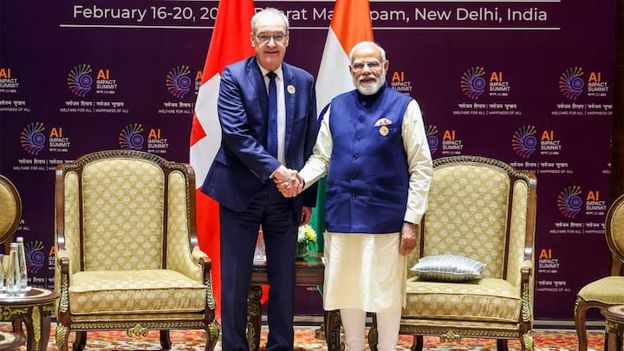
Addressing the press alongside Swiss Confederation President Guy Parmelin, Modi said the agreement would significantly expand market access for Indian products in Switzerland and facilitate greater investment flows between the two countries. “We have implemented a historic Trade and Economic Partnership Agreement between India and the European Free Trade Association, or EFTA, countries. This is India’s first FTA with any European economic bloc,” PM Modi said. EFTA comprises Switzerland, Iceland, Norway and Liechtenstein.
The agreement, signed in March 2024, entered into force on October 1, 2025, providing preferential market access and establishing a framework for deeper cooperation in trade, investment, services and technology. EFTA countries have offered market access covering 92.2 per cent of tariff lines, accounting for 99.6 per cent of India’s exports.
PM Modi said India and Switzerland had taken several important decisions to improve access for Indian products in the Swiss market and make investments between the two countries easier. Agriculture, pharmaceuticals, textiles and engineering goods are among the sectors expected to gain from expanded export opportunities. At the same time, India is seeking to attract fresh Swiss investment into sectors including biotechnology, life sciences, banking, insurance, food processing and sustainability. The TEPA carries an investment commitment of USD 100 billion over 15 years and is linked to the facilitation of one million direct jobs in India.
The agreement is also expected to deepen cooperation in services and enable Indian companies to integrate more closely with advanced European value chains, giving a further push to India’s efforts to expand its global trade and investment partnerships. PM Modi placed particular emphasis on people-to-people ties, describing them as “the greatest strength” of the India-Switzerland partnership. He said the Migration and Mobility Partnership Agreement and the Young Professionals Agreement between the two countries would create new opportunities for Indian students, researchers, professionals and young people in Switzerland.
“People-to-people ties are the greatest strength of our partnership,” the PM said, adding that the new arrangements would provide greater avenues for mobility and professional engagement. India and Switzerland have been seeking to broaden their relationship beyond trade, with cooperation extending to science and technology, innovation, skill development, research and investment. Swiss companies have expanded their presence in India, while Indian companies in sectors such as information technology, pharmaceuticals and life sciences have established operations in Switzerland.
According to the Ministry of External Affairs, 140 Indian companies have invested in 180 entities in Switzerland, creating around 5,600 jobs, underlining the growing commercial dimension of the bilateral relationship. Turning to international affairs, Modi said India and Switzerland shared a commitment to democratic values, the rule of law, dialogue, and diplomacy and would continue to work together for global peace and stability. “Whether it is Ukraine or West Asia, India has consistently supported every meaningful effort towards peace,” he said.
Modi also said the two sides agreed on the need to reform global institutions so that they could respond more effectively to mounting international challenges. “We are also in agreement that reforms in global institutions are essential to find solutions to the growing global challenges,” he said.
The Prime Minister’s remarks came as India and Switzerland seek to convert the implementation of TEPA into stronger trade and investment flows. Modi and Parmelin had earlier reviewed bilateral cooperation in trade, investment, science and technology, innovation, skills and people-to-people ties, and welcomed the momentum generated by the implementation of the India-EFTA agreement.