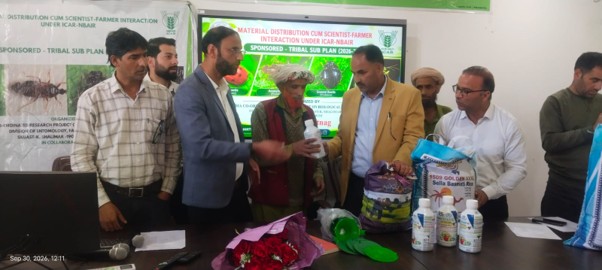
Anantnag : A Material Distribution-cum-Awareness Programme on Biological Control and Eco-friendly Pest Management was organized by AICRP-Biological Control, Division of Entomology, SKUAST-K, Shalimar, in collaboration with KVK Anantnag, under the Tribal Sub-Plan (TSP). The programme was attended by 50 farmers, along with Prof. Sajad Mohi-ud-Din, Principal Investigator, AICRP–Biological Control (Chief Guest) Dr.Ishtiyaq Ahmad Khan,Head, KVK Anantnag (Guest of Honour); Dr.MudasirGani Bhat, Co-Principal Investigator, AICRP-Biological Control; and scientists and technical staff of KVK Anantnag and the Division of Entomology, SKUAST-K and Officers of Department of Agriculture .
The programme focused on promoting biological control and eco-friendly approaches to crop protection and provided a platform for direct interaction between farmers and agricultural scientists. The participants were sensitized about insect pest identification, field surveillance, preventive measures, biological control, biopesticides and integrated pest management.
Dr.Ishtiyaq Ahmad Khan, Head, KVK Anantnag, emphasized the importance of adopting location-specific, affordable and environmentally compatible technologies for effective crop protection. He highlighted the role of farmer–scientist interaction in addressing pest problems and improving agricultural productivity.
Prof. Sajad Mohi-ud-Din, Principal Investigator, AICRP–Biological Control, highlighted the importance of biological control and integrated pest management in promoting sustainable crop production, conserving beneficial organisms and reducing unnecessary dependence on chemical pesticides. He stressed the need for wider adoption of biological and biorational pest-management technologies at the field level.
Dr.MudasirGani Bhat, Co-Principal Investigator, AICRP–Biological Control, emphasized the importance of regular pest surveillance, timely pest identification and need-based interventions. He also highlighted the significance of strengthening farmer–scientist linkages for effective adoption of sustainable pest-management practices.
During the technical sessions, farmers were briefed on major insect pests, pest identification, field monitoring, preventive measures, biological control, biopesticides and integrated pest management. An interactive session enabled farmers to discuss pest incidence, crop damage and practical management options with the scientists.
As part of the TSP intervention, neem oil, insect traps, vermicompost and quality potato seed were distributed among the 50 participating farmers. The distribution was aimed at facilitating field-level adoption of eco-friendly pest-management practices while promoting soil health and sustainable crop production.
The programme highlighted the importance of low-input, ecological and sustainable crop protection technologies and reinforced SKUAST-K’s commitment to taking practical agricultural technologies from research and extension platforms to farming communities.
The participating farmers appreciated the initiative and expressed interest in adopting biological control and other eco-friendly approaches for effective and sustainable management of insect pests.
The programme concluded with a vote of thanks proposed by Dr. Shabir Ahmad who acknowledged the participation and cooperation of the farmers, scientists, officers of Agriculture Department and technical staff of KVK Anantnagand the Division of Entomology, SKUAST-K