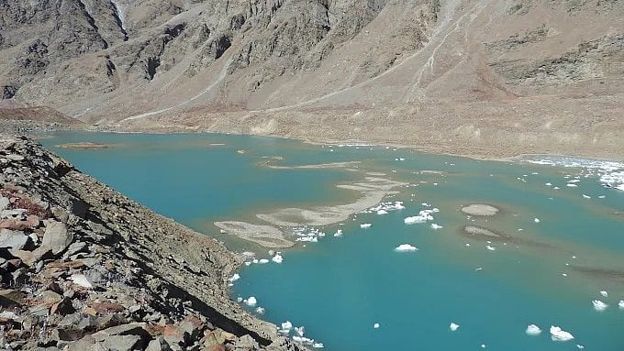
Early warning system planned to tackle threat of Glacial Lake Outburst Floods
Srinagar|Sept, 29: The Jammu and Kashmir Government has identified 68 potentially dangerous glacial lakes across 12 districts and is working on a GIS-based early warning system to reduce the risk of Glacial Lake Outburst Floods (GLOFs).
The information was given in the Legislative Assembly in response to a question raised by MLA Tanvir Sadiq.
According to the Department of Disaster Management, Relief, Rehabilitation and Reconstruction, the University of Kashmir has mapped 616 glacial lakes covering 28.62 sq km across 12 districts. Of these, 68 have been classified as Potentially Dangerous Glacial Lakes (PDGLs) based on criteria laid down by the National Disaster Management Authority.
The government said rising temperatures, rapid glacier melting and the expansion of glacial lakes have increased the risk of GLOFs in several areas, particularly Kishtwar, Ganderbal, Kulgam and Anantnag.
A dedicated core committee has been constituted to study high-risk glacial lakes and recommend mitigation measures. The committee has categorised 24 priority lakes into Categories A, B and C after assessing them on 17 risk parameters.
The Centre for Development of Advanced Computing (C-DAC) has been nominated as the lead technical agency for designing and implementing a GIS-based GLOF early warning system in J&K.
A UT-level Focused GLOF Monitoring Committee, headed by the Principal Secretary, Home Department, was constituted on April 4, 2024. It is responsible for glacial lake surveillance, satellite monitoring, field expeditions and risk mitigation.
District Disaster Management Authorities have been directed to prepare district-specific GLOF action plans, including downstream risk assessments, mitigation measures and emergency response mechanisms.
They have also been asked to identify vulnerable villages, hamlets and critical infrastructure, besides marking safe evacuation sites.
Tanvir Sadiq said the identification of 616 glacial lakes, including 68 potentially dangerous ones, highlighted the need for timely action and stronger preparedness.
He stressed the importance of real-time alert systems, satellite surveillance, automatic weather stations, water-level sensors and effective district-level response plans.
“Early warning can save lives,” Sadiq said, calling for time-bound implementation of measures to protect communities living downstream of vulnerable glacial lakes.