“This Is India’s Century, Time To Lead The World”
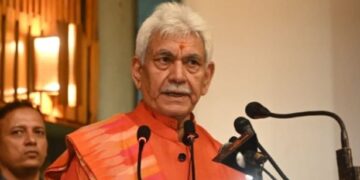
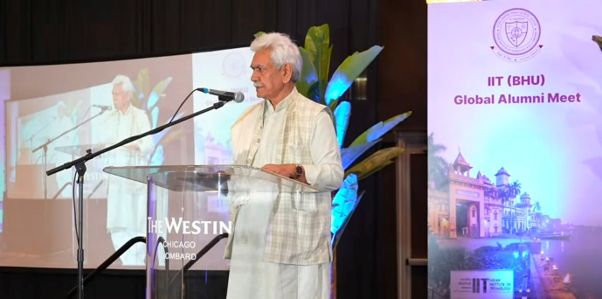
Srinagar| Sept, 12: This week Lieutenant Governor Manoj Sinha’s address at the IIT (BHU) Global Alumni Meet in Chicago placed India’s technological ambitions within a much broader civilisational narrative, linking the legacy of Mahamana Pandit Madan Mohan Malaviya with the country’s emerging role in artificial intelligence, innovation and global leadership. Addressing alumni of one of India’s most prominent technical institutions in the United States, Sinha argued that the next phase of India’s development will depend not merely on technological capability but on the ability to combine innovation with human values, institutional strength and global cooperation. His remarks also sought to position the Indian diaspora as an important partner in the country’s continuing economic and technological transformation. The Lieutenant Governor began by paying tribute to Malaviya, whose vision helped lay the foundation for modern technical education and industrial development in India. For Sinha, Malaviya’s legacy remains relevant at a time when India is once again attempting to expand its technological capabilities and create institutions capable of competing at the global level. Malaviya’s contribution, he said, was never confined to establishing an educational institution. His larger vision was to use education, science and technology as instruments of national reconstruction. That approach, Sinha suggested, carries particular significance today as India seeks to build an economy driven by knowledge, innovation and advanced technologies.
From Malaviya’s Vision To The Age Of Artificial Intelligence: The transition from Malaviya’s era of institution-building to the present age of artificial intelligence formed one of the central themes of Sinha’s address.AI, he said, has the potential to become a major driver of economic growth by bringing together human potential and machine intelligence. The significance of AI therefore extends beyond the technology sector. It has implications for manufacturing, healthcare, education, agriculture, governance, financial services, scientific research and almost every part of the modern economy. Yet Sinha placed an important qualification alongside this optimism: technological progress cannot be allowed to become detached from human responsibility.His emphasis on Responsible AI reflected a growing global debate over the implications of increasingly powerful technologies. Artificial intelligence can improve productivity and expand access to knowledge, but its impact will ultimately depend on how societies govern its use. Sinha stressed that AI must remain anchored in ethics, core values and strict human oversight. Technology, he said, must be proactively guided by humanity so that it serves the collective well-being of people. That argument provides an important counterpoint to the idea that technological advancement is an end in itself. For India, the challenge is not simply to become a major AI power but to develop technologies in ways that remain accountable to society. The message also carries particular relevance for India because of the scale and diversity of its population. A technology that is designed around inclusion, accessibility and public welfare could have consequences far beyond economic growth, potentially transforming the delivery of public services and creating new opportunities for communities that have historically remained outside advanced technology ecosystems.
A New India Confident At Home, Engaged With The World: Lt Governor Sinha’s larger political and economic argument was that India is entering a new phase in its history—one in which the country is increasingly confident about its place in the world.He described a new India as stronger at home, confident abroad and prepared to contribute to shaping what he called the new future of humanity. “Under the visionary leadership of Prime Minister Narendra Modi, India is building its own place in the world and preparing to lead it,” Sinha said, Declaring therein “This is India’s moment. This is India’s century.” For Sinha, this confidence is rooted in the convergence of several trends: technological advancement, economic expansion, institutional development and social welfare. He described the current phase as the rise of a civilisational power that is “confident, compassionate, innovative and unstoppable.” The formulation is significant because it presents India’s rise not simply as an economic story but as a broader national resurgence. The argument is that technological leadership, economic development and social welfare should advance together rather than in isolation. India’s challenge in the coming decades will therefore be to convert its large population, expanding technology ecosystem and growing global influence into sustainable institutional and economic strength.
Jammu Kashmir | A Story Of Transformation: Against this wider national backdrop, the Lieutenant Governor brought Jammu Kashmir into the narrative of India’s transformation. LG Sinha described the changes in Jammu Kashmir over the last six years as historic, arguing that the region has moved towards greater development, investment and opportunity. “Prime Minister has transformed the destiny of Jammu Kashmir with the abrogation of Article 370,” he said, adding that the region’s transformation represented “not just progress but a renaissance.”He characterised the change in contrasting terms—“from shadows of fear to the light of opportunity, from isolation to integration, and from despair to destiny.” The language reflects the administration’s broader effort to frame Jammu Kashmir’s recent trajectory through development and opportunity rather than conflict and instability. For a region that has historically been viewed internationally primarily through the prism of political conflict, the attempt to project a different narrative has significant implications. Development, investment, tourism, entrepreneurship, education and technology increasingly form part of the administration’s effort to redefine Jammu Kashmir’s public image. LG Sinha argued that this transformation has opened new avenues for development, investment and opportunity. The more difficult task now is to convert that opportunity into durable economic activity, employment and institutional capacity.In that context, technology and education could become particularly important.
The Diaspora As A Strategic Partner: The setting of Sinha’s address—Chicago—also gave his message a significant dimension.The Indian diaspora in the United States represents one of the country’s most important global networks of professional expertise, entrepreneurship, capital and institutional relationships. IIT alumni, in particular, occupy influential positions across technology, academia, business and research. Sinha urged IIT (BHU) Global Alumni to participate actively in India’s ongoing civilisational and economic resurgence.His appeal was not limited to financial investment. Instead, he outlined a four-point roadmap that placed knowledge, mentorship and institutional partnerships alongside capital. The first element was investment in India’s next-generation institutions through mentorship and capital. The second was building strategic partnerships between American and Indian institutions. The third involved sharing what Sinha described as an accurate narrative of India’s transformation. The fourth was reconnecting with roots by bringing back experience and knowledge gained abroad.Together, these priorities suggest a model of diaspora engagement that goes beyond conventional investment. Capital can help establish companies and infrastructure, but knowledge networks can help institutions develop expertise, research collaborations and international connections. Mentorship can help young entrepreneurs navigate global markets, while academic partnerships can strengthen research and innovation.For India’s technological ambitions, such connections could prove increasingly valuable.
Chicago, Vivekananda And The Global Indian Identity: Lt Governor Sinha also invoked another historic connection with Chicago by recalling Swami Vivekananda’s landmark address on September 11, 1893.The reference served to connect the contemporary Indian diaspora with a much longer history of India engaging with the world from American soil. More than a century after Vivekananda’s appearance in Chicago, the Indian presence in the United States has expanded dramatically across technology, medicine, academia, business, research and public life.Sinha’s message effectively positioned the diaspora as a bridge between India’s domestic transformation and its global aspirations.The four-point roadmap therefore becomes more than a call for investment. It is an invitation to build an institutional bridge between two knowledge ecosystems. India needs access to global expertise and markets. The diaspora, meanwhile, can contribute through professional networks, technology transfer, investment and mentorship while maintaining a connection with institutions and communities in India.
From Brain Drain To Knowledge Circulation: One of the most important implications of Sinha’s appeal is the changing understanding of the Indian diaspora. For decades, migration of highly educated Indians to Western countries was often discussed primarily through the lens of “brain drain.” Today, the relationship is increasingly being understood as one of knowledge circulation. Indian professionals abroad can contribute to institutions in India without necessarily relocating permanently. They can mentor students remotely, establish research partnerships, support start-ups, invest in companies and help Indian institutions access global networks. For a country seeking to become a technology leader, this distributed model of expertise can be particularly powerful. The IIT (BHU) alumni network provides an obvious platform for such engagement because its members are already connected through a shared educational heritage and professional experience.
The Larger Test| Turning Ambition Into Institutions: The most consequential part of Sinha’s message may ultimately be the challenge of implementation. India’s emergence as a technological power will not be determined by declarations alone. It will depend on universities capable of producing high-quality research, companies capable of commercialising innovation, institutions capable of regulating emerging technologies and a workforce equipped for rapidly changing industries. The same principle applies to Jammu Kashmir. If the region is to fully benefit from the transformation outlined by Sinha, investment will need to translate into jobs, stronger educational institutions, entrepreneurship, infrastructure and opportunities for young people. The emphasis on AI and responsible technology also suggests that Jammu Kashmir’s future development cannot be separated from the wider technological transformation taking place across India. The opportunity is to ensure that the region is not merely a consumer of new technologies but becomes a participant in their creation and application.
A Vision That Connects Past And Future: Lt Governor Sinha’s Chicago address ultimately brought together three different strands of India’s national journey: Malaviya’s institution-building vision, Vivekananda’s global engagement and the present push towards technological leadership. Malaviya represented the belief that education and technology could help build a stronger India. Vivekananda represented an India confident enough to introduce its civilisational voice to the world. The present moment, in Sinha’s formulation, is about combining those traditions with innovation, AI and global partnerships. The message to IIT (BHU) alumni was therefore straightforward but expansive: India’s next phase cannot be built by government alone. Universities, industry, innovators, professionals and the global Indian community all have a role. And the larger opportunity is not simply to make India a larger economy or a bigger technology market. It is to build institutions and technologies that combine ambition with responsibility and global influence with social purpose. For Jammu Kashmir, the challenge and opportunity are equally significant. If the region’s transformation is to become sustainable, the next chapter will have to be measured not only through infrastructure and investment but through the creation of knowledge, skills, enterprises and opportunities. From Malaviya’s vision of modern education to the possibilities opened by artificial intelligence, the central idea remains remarkably consistent: knowledge becomes meaningful when it is converted into national capability and social progress. In Chicago, Sinha presented that idea as part of a larger Indian moment—one in which technological confidence, global engagement and civilisational self-belief are increasingly being brought together. The ambition now is to turn that confidence into enduring institutions, partnerships and opportunities, ensuring that India’s technological rise remains firmly anchored in the human values that give progress its purpose.