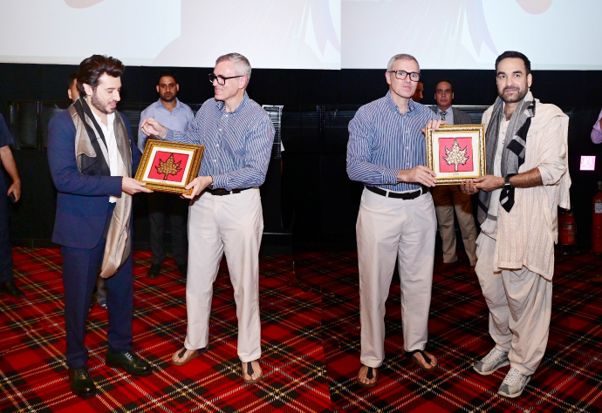
IFFJK brings filmmakers, actors and musicians together to explore Valley’s stories, culture and cinematic potential
Srinagar| Sept, 8: Kashmir’s vast reservoir of untold stories, rich cultural traditions and emerging local talent must find greater space in Indian cinema, filmmakers and actors said on Tuesday, calling for a shift from portraying the Valley merely as a picturesque backdrop to telling stories rooted in its people and culture.
Speaking on the sidelines of the first International Film Festival of Jammu and Kashmir (IFFJK) at the Sher-i-Kashmir International Convention Centre (SKICC), filmmaker Imtiaz Ali, actor Pankaj Tripathi, actor Divyenndu Sharma and playback singer Sunidhi Chauhan highlighted the Valley’s enormous cinematic potential while underlining the need for greater opportunities for local artists.
Ali, whose films include Jab We Met, Rockstar, Love Aaj Kal and Amar Singh Chamkila, said Kashmir had long fascinated filmmakers but that much of its human and cultural story remained unexplored.
“There are a lot of stories in Kashmir that have not surfaced,” Ali said, observing that the Valley had generally been viewed through limited narratives—as either a paradise of extraordinary beauty or through another dominant lens.
He said the “normal Kashmir” was equally compelling and could offer stories about ordinary people, their humour, relationships and everyday lives.
Ali said he remained fascinated by historical and cultural figures such as mystic poet Lal Ded and poetess Habba Khatoon. However, he acknowledged that making a film on Lal Ded would be particularly challenging given her stature and the reverence she commands across communities.
He said that if he could find the necessary “courage, capability and intellect”, he would definitely want to make something on such personalities.
The filmmaker also suggested that Kashmiri humour could lend itself particularly well to cinema.
“A comedy movie in Kashmir would be wonderful,” he said, noting that the Valley’s humour itself was an interesting and relatively unexplored aspect of its cultural identity.
Ali, who has shot extensively in Kashmir, including for Laila Majnu, described the Valley as one of the most cinematic places in the world.
“There is no place as cinematic as Kashmir in the whole world,” he said, recalling the positive experiences of shooting in the Valley.
But he said filmmakers needed to look beyond familiar destinations such as Pahalgam, Aru and Chandanwari. Referring to his visit to Gurez, Ali said many parts of Kashmir had barely been captured by cinema.
He said Kashmir’s cultural identity was also gradually finding greater representation, pointing to Kashmiri music and traditions as examples.
“Earlier, only the body of Kashmir was seen; now, gradually, the soul of Kashmir will also be seen,” he said.
Ali also called for smoother administrative procedures for filmmakers, including single-window clearances and government support, saying such measures would make shooting in the Valley easier.
On artificial intelligence, he said technology would remain another tool for filmmakers but should not replace the human creative process.
He said he would not want AI involved in scriptwriting or creative breakdowns, which, in his view, should remain human.
Actor Pankaj Tripathi said regional cinema had enormous potential and described IFFJK as an important beginning for showcasing stories from Jammu and Kashmir.
Tripathi said young people in Kashmir were already creating short films, often using mobile phones and uploading them to platforms such as YouTube, even if many of them had not yet found access to established film institutions or festivals.
He said a search for Kashmiri short films would reveal considerable work being produced by young filmmakers.
Actor Divyenndu Sharma said cinema should go beyond using Kashmir only for songs and scenic sequences and instead explore its people, food, folklore and traditions.
“I often wondered why films only came here for musical sequences instead of exploring stories about the local people, food, and culture,” Sharma said.
He argued that stories rooted in the soil, local folklore and regional flavour were what could give cinema greater authenticity.
Tripathi said the festival could serve as an opening for dialogue between local artists and filmmakers from outside the region.
As visitors interact with Kashmiris and experience the region themselves, he said, they would form their own impressions rather than relying on established narratives.
Both actors praised Kashmir’s hospitality and said they had enjoyed the region’s cuisine and warmth.
Sharma said he would encourage filmmakers to shoot in Jammu and Kashmir, provided adequate infrastructure and local administrative support were available.
Tripathi also highlighted the importance of experimentation for young actors, cautioning aspiring artists against repeatedly accepting similar roles after achieving success.
“Never fear experimentation,” he said, stressing that challenging oneself was fundamental to being an artist.
Asked about the possibility of another Mirzapur film, Sharma indicated that the strong response to the franchise could encourage another instalment, while suggesting that familiar characters could be placed in new situations.
Tripathi, meanwhile, said acting allowed artists to explore different facets of human nature, including emotions such as anger, love, jealousy, affection and greed.
Playback singer Sunidhi Chauhan said visiting Kashmir had been a childhood dream and expressed hope of holding a concert in the Valley.
Calling her first visit an overwhelming experience, Chauhan praised Kashmir’s beauty, hospitality, food and peaceful atmosphere.
She said she had first fallen in love with Kashmir through its portrayal on screen and that being physically present in the Valley had deepened that connection.
Chauhan also described IFFJK as a significant initiative because it provides a platform for films that may otherwise struggle to receive adequate attention.
She said film festivals could particularly benefit young people interested in acting, direction and music by exposing them to new ideas, filmmakers and possibilities.
The singer also linked the festival to Kashmir’s tourism potential, saying cinema had for years drawn people towards the Valley and that a dedicated international film festival could provide an additional boost.
The convergence of filmmakers, actors and artists at IFFJK, she said, could help the younger generation discover both the creative and natural wealth of the region.
Ali also stressed the importance of creating an ecosystem in which local artists could flourish alongside visiting filmmakers.
He said Kashmiris were “talented and sensitive” and might take time to open up, but possessed abundant creative potential.
“Local voices will also emerge,” he said, noting that social media had changed the way audiences and artists connect.
Ali urged Kashmiri families and communities to view cinema as a legitimate creative avenue and encourage children interested in acting, direction and music.
He said Kashmir had all the ingredients for a stronger filmmaking ecosystem—extraordinary landscapes, a distinctive culture, talented people and stories that had yet to reach mainstream audiences.
The festival, the artists suggested, could therefore become more than an event showcasing films: it could serve as a bridge between Kashmir’s local creative community and the wider film industry, while helping replace familiar stereotypes with more nuanced stories about the Valley and its people.