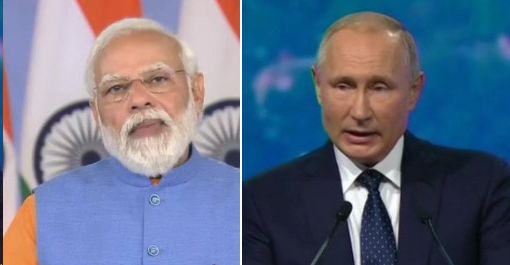
New Delhi: Prime Minister Narendra Modi on Monday delivered a pointed message on the Russia-Ukraine conflict during his meeting with Russian President Vladimir Putin in Bishkek, saying “every day of war sets humanity back” and calling on all sides to work towards ending hostilities, even as the two leaders discussed ways to further strengthen the India-Russia strategic partnership.
The meeting between Modi and Putin took place on the sidelines of the 26th Shanghai Cooperation Organisation (SCO) Summit in the Kyrgyz capital against the backdrop of continuing geopolitical tensions, instability in West Asia and mounting uncertainty in global energy markets.
“Every day of war sets humanity back. We must work towards ending hostilities,” Modi told Putin, reiterating India’s consistent position that conflicts should be resolved through dialogue, diplomacy and negotiations.
Reaffirming India’s broader approach to international crises, Modi said, “India advocates for resolving all problems peacefully, which is necessary for all of humanity.”
He stressed that dialogue and diplomacy remain the most effective means of addressing complex regional and global challenges.
Following the meeting, Modi posted on social media platform X: “Always a delight to meet President Putin.”
The talks covered the broad spectrum of the India-Russia Special and Privileged Strategic Partnership, with trade, economic cooperation, energy security, fertiliser supplies, defence cooperation and regional security featuring prominently in the discussions.
The two leaders reviewed ways to expand bilateral trade and diversify economic engagement. Bilateral commerce has crossed the $100-billion mark, but the trade balance remains heavily in Russia’s favour.
India has been seeking greater access for its goods and services in the Russian market as part of efforts to reduce the widening trade deficit.
The discussions also focused on strengthening supply chains and ensuring the continued flow of essential commodities. Energy security has emerged as a particularly important component of India’s engagement with Moscow since the Russia-Ukraine conflict began, with Russian crude becoming a significant source of India’s oil imports.
New Delhi has maintained that its energy procurement decisions are guided by national interests and the objective of ensuring affordable, stable and reliable supplies for the Indian economy. The issue has assumed greater importance amid heightened volatility in international energy markets and disruptions to traditional supply routes.
Fertiliser supplies from Russia also figured in the discussions, given their importance for India’s agricultural requirements. Both countries have sought to ensure continuity of supplies amid disruptions in global commodity markets and shipping networks.
Defence cooperation, another longstanding pillar of the bilateral relationship, was also reviewed. India remains heavily dependent on Russian-origin military platforms and equipment, even as it has diversified its defence procurement in recent years.
Ensuring timely deliveries, maintenance and availability of spares for existing systems remains an important component of the defence partnership. The two leaders also discussed wider strategic and security issues, including developments in the region and the evolving global geopolitical situation.
Connectivity and long-term economic cooperation were examined as part of efforts to deepen India’s engagement with Russia and the wider Eurasian region. The discussions included connectivity initiatives and cooperation involving the Arctic and the Vladivostok process, reflecting India’s interest in developing alternative trade and transport corridors linking it more closely with Russia and Central Asia.
Modi’s meeting with Putin came at a sensitive point in India’s relations with major global powers. While New Delhi has significantly expanded its strategic partnership with the United States and other Western countries, Russia continues to remain an important partner for India in defence, energy and strategic affairs.
India’s imports of Russian crude have been a major point of contention in its engagement with Washington, which has sought to constrain Moscow’s energy revenues following the outbreak of the Ukraine conflict.
New Delhi has consistently defended its right to pursue energy procurement based on national interest and economic considerations. The changing security situation in West Asia has further complicated the global energy landscape. Disruptions to oil flows and shipping routes have increased concerns over supply stability and prices, reinforcing India’s efforts to maintain diversified sources of energy.
Against this backdrop, the Modi-Putin meeting provided an opportunity to reaffirm the durability of the bilateral partnership while addressing immediate economic and strategic priorities.
At the same time, Modi’s emphasis on ending hostilities demonstrated that India’s close relationship with Moscow does not alter its longstanding advocacy of dialogue and diplomacy to resolve the Ukraine conflict. The interaction also reflected India’s broader policy of strategic autonomy as it engages with competing geopolitical powers and groupings.
New Delhi has continued to maintain active diplomatic channels with Russia, the United States, European countries, Iran and other major powers while stressing the need for peaceful resolution of conflicts.
The Bishkek talks were part of continued high-level engagement between Modi and Putin, with the Russian President expected to travel to New Delhi for the upcoming BRICS Summit.
Regular meetings between the two leaders have served as an important mechanism for reviewing bilateral ties as well as developments in the wider international system.
Modi’s participation in the SCO summit also underlined India’s expanding engagement with Central Asia and the wider Eurasian region. The grouping provides New Delhi a platform to pursue its economic, connectivity and security interests while maintaining dialogue with Russia, China, Iran and the Central Asian republics.
The Modi-Putin meeting, therefore, combined discussions on critical bilateral priorities such as trade, energy, fertilisers and defence with a wider exchange on regional and global security.
While reaffirming the importance of the India-Russia strategic partnership, Modi’s call for an end to hostilities reinforced India’s position that a durable settlement to the Ukraine conflict can emerge only through dialogue, diplomacy and peaceful negotiations.
CM Omar Unveils Rs 58.26-Cr Projects in G’bal, Inaugurates five projects worth Rs 16.72 crore, lays foundation for two others
Reviews Ring Road, Sindh River Front works; hears growers’ concerns at Zazuna Mandi Ganderbal|Oct, 15: Chief Minister Omar Abdullah on...
Read moreDetails