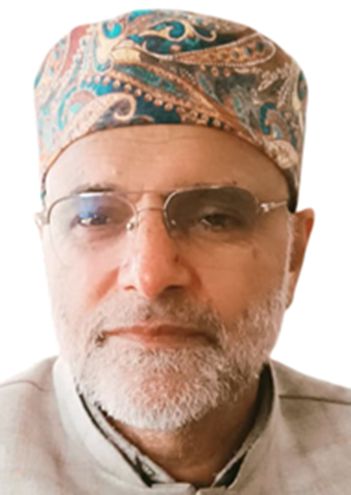
Prof. Ghulam Mohiuddin Hajni occupies a distinctive and enduring place in the intellectual, literary, cultural and social history of Kashmir. A scholar of remarkable versatility, he was at once a writer, poet, literary critic, teacher, researcher, translator, journalist and political activist. His intellectual personality cannot be confined to a single discipline or literary genre. He belonged to a generation that witnessed some of the most significant transformations in the social and political life of Kashmir, and his writings reflect the intellectual ferment, cultural consciousness and aspirations of that period. Born in 1917 at Hajin in the present-day Bandipora district of Jammu and Kashmir, Hajni grew up in an environment in which the Kashmiri language functioned not merely as a medium of everyday communication but as a repository of collective memory, folklore, spirituality and cultural identity. His later career was, in many ways, a sustained attempt to explore this inheritance, preserve it through scholarship and make it accessible to new generations. He wrote primarily in Kashmiri, but his intellectual horizons extended across Urdu, Persian and Arabic, while his education also brought him into contact with wider currents of modern Indian scholarship. His multilingual competence enabled him to approach Kashmiri language and literature comparatively and critically rather than in isolation.
Hajni’s educational journey was itself representative of the transition taking place in Kashmir during the first half of the twentieth century. He received his early education in Kashmir and pursued higher studies at Sri Pratap College, Srinagar, one of the principal centres of modern higher education in the region. He subsequently studied at Aligarh Muslim University, where he developed his command of Arabic and broadened his intellectual engagement with literature, language and the humanities. He also obtained legal and journalistic qualifications. This combination of literary, linguistic, legal and journalistic training helped shape the unusually broad character of his later scholarship. A Life Dedicated to Kashmiri Language and Literature The central concern running through Hajni’s intellectual life was the study and development of the Kashmiri language. At a time when Kashmiri literature was undergoing a process of modernisation, he recognised that the future of the language depended upon serious scholarship, critical editing, literary creativity, translation and the systematic documentation of its traditions. His contribution therefore went far beyond the production of individual poems or literary compositions. He worked to understand the structure, history and evolution of Kashmiri literary expression. He examined poetry, prose, folklore, cultural practices and the historical development of the language.
In doing so, he helped establish a more systematic and critical approach to Kashmiri literary studies. Among his important works is Kashir Shairi, published in 1960, a significant contribution to the study and presentation of Kashmiri poetry. The work helped bring together the poetic heritage of Kashmir and presented it within a framework accessible to readers and students of literature. It demonstrated Hajni’s awareness that a literary tradition could not survive merely through oral transmission; it required documentation, critical engagement and institutional recognition. Another important work was Kashiri Nasrach Kitab, which appeared in the early 1960s and became an influential literary and educational text. His writings of this period helped strengthen the position of Kashmiri as a language of serious literary and intellectual expression. His Gaman Manz Pheeri Pheeri is also significant in understanding his literary personality. The work reflects his interest in Kashmir’s villages, people, social conditions and everyday life. Hajni was not a scholar who remained detached from society. He travelled, observed and engaged with the world around him. His literary vision was therefore rooted in the actual experiences of Kashmiri society.
Maqalat|A Landmark In Kashmiri Literary Scholarship: Among Hajni’s most important scholarly contributions is Maqalat, a collection of essays dealing with different dimensions of Kashmiri language and literature. The work represents the scholarly side of his personality particularly well. It was not simply a literary collection but an expression of critical inquiry into the language, history and literary traditions of Kashmir. The importance of Maqalat was recognised at the national level when Hajni received the Sahitya Akademi Award in 1970. This was a major distinction for a Kashmiri writer and constituted an important recognition of his contribution to Indian literature. The award helped establish Hajni’s reputation beyond the geographical and linguistic boundaries of Kashmir and placed his scholarship within the broader framework of Indian literary studies.
The significance of this recognition should be understood in the context of Kashmiri literature’s position within India’s multilingual literary landscape. Kashmiri is one of the major literary languages of the subcontinent, possessing a rich tradition shaped by Shaivite, Sufi, Islamic, folk and modern literary influences. Hajni’s scholarship contributed to making this tradition more visible and intellectually accessible.
The Making Of A Modern Kashmiri Literary Consciousness: Hajni belonged to a generation of Kashmiri intellectuals who sought to move literature beyond purely conventional forms while remaining deeply conscious of the historical inheritance of the language. His work therefore combined tradition and modernity. He valued the classical and folk dimensions of Kashmiri culture, yet he was equally receptive to new literary forms, modern education, journalism and contemporary social questions. His approach can be understood as an effort to create a modern literary consciousness rooted in Kashmiri cultural experience. This is particularly evident in his engagement with prose, criticism, educational writing, translation and drama. He understood that a living language needs more than poetry. It requires textbooks, criticism, journalism, theatre, translation, historical research and new forms of prose. His literary activities thus contributed to the expansion of the functional range of Kashmiri. One of the works associated with his early literary career is Grees Sund Ghara (The Peasant’s House), a work connected with the emergence of modern Kashmiri dramatic and resistance literature.
Accounts of Kashmiri literary history identify it as an important early Kashmiri play and associate it with the political and social consciousness of the period. Its significance lies not merely in its dramatic form but also in the fact that Hajni used literary expression to engage with the realities of his society.
Hajni as a Translator and Cultural Mediator Another major dimension of Hajni’s contribution was translation. He translated the celebrated collection One Thousand and One Nights, popularly known as Alif Laila, into Kashmiri. This was an important cultural undertaking. Translation is never merely the substitution of words from one language into another. It is an act of cultural mediation. By bringing a major work of world literature into Kashmiri, Hajni expanded the literary horizons of Kashmiri readers and demonstrated the capacity of their language to accommodate complex narrative traditions.
His translation work also reflected his multilingual intellectual background. His familiarity with Arabic, Persian and Urdu provided him with access to a vast literary heritage, while his command of Kashmiri enabled him to transmit elements of that heritage to a regional readership. In this respect, Hajni should be remembered not only as a Kashmiri writer but also as a bridge between literary cultures.
The Teacher And Mentor: Hajni’s influence was not limited to his published writings. He was also a dedicated teacher, and his long association with S.P. College, Srinagar, gave him an opportunity to influence generations of students. Teaching, for Hajni, was an extension of scholarship. He was not simply transmitting information; he was cultivating intellectual curiosity. Students encountered in him a teacher who possessed knowledge of several languages and literary traditions and who could connect classroom learning with wider questions of culture, society and history. His multilingual scholarship was particularly valuable in an educational environment where Arabic, Persian, Urdu and Kashmiri traditions intersected. His academic personality represented the composite intellectual culture of Kashmir, in which classical Islamic learning, Persianate literary traditions, Kashmiri folklore and modern Indian education interacted with one another. The recollections of those who encountered him as a teacher testify to the lasting impression he made upon students and intellectual circles. His influence therefore extended beyond the books that bear his name.
Literature And Political Consciousness: Hajni’s intellectual career also developed against the backdrop of the political transformation of Kashmir. He came of age during the period of Dogra rule and witnessed the emergence of political consciousness among Kashmiris during the 1930s. Accounts of his life indicate that he participated in political activities during his youth and was associated with resistance to Dogra rule. He was reportedly arrested during the political agitation of that period. His early engagement with political and social questions later found expression in his literary work. This aspect of his personality is important because it demonstrates that Hajni did not regard literature as something completely detached from society. For him, language could express the aspirations, grievances and consciousness of a people.
At the same time, his later political views were not reducible to a single ideological position. Sources indicate that he was critical of political doctrines and personalities with which he disagreed, including aspects of the politics associated with Sheikh Abdullah. This intellectual independence is an important feature of his personality. Hajni was not merely a literary supporter of political movements; he was a critical observer of the political developments around him. His life therefore illustrates the complex relationship between literature and politics in twentieth-century Kashmir.
“Prof. Ghulam Mohiuddin Hajni (1917–1993) was a pioneering Kashmiri scholar, poet, critic, teacher, and translator. His multifaceted contribution to literature, language, and cultural activism leaves an enduring legacy that merits continued critical study within modern South Asian literary history.”
The Scholar Of Language, Culture And History: Hajni’s scholarship extended into the historical study of Kashmiri language and culture. He was interested in questions concerning the origins, development and evolution of the language and its literary traditions. His work on the historical background of Kashmiri language reflects this concern. He sought to understand Kashmiri not simply as a spoken vernacular but as a language possessing its own historical trajectory and literary personality. This approach was particularly significant during a period when questions of language were closely connected with questions of identity and cultural self-understanding. By studying Kashmiri systematically, Hajni contributed to the intellectual legitimisation of the language as a subject worthy of serious academic research. His writings also reveal an interdisciplinary inclination. He moved between literature, linguistics, history, culture and society. Such an approach is increasingly valued in contemporary humanities scholarship, but Hajni was practising it decades earlier.
The Intellectual Breadth Of Hajni: One of the most remarkable features of Hajni’s personality was the breadth of his interests. His known works and scholarly engagements indicate interests ranging from Kashmiri poetry and prose to language history, translation, religion, science and culture. This breadth should not be interpreted as lack of specialisation. Rather, it reflects a traditional conception of the scholar as a person whose intellectual curiosity crosses disciplinary boundaries. His knowledge of Arabic and Persian gave him access to classical Islamic and Persianate scholarship. His familiarity with Urdu connected him to modern South Asian literary culture. His engagement with Kashmiri enabled him to remain rooted in his own cultural environment. His legal and journalistic training added further dimensions to his intellectual outlook. Such a combination made Hajni a representative of Kashmir’s composite scholarly culture.
His Contribution To Kashmiri Prose: The development of modern Kashmiri prose is one area in which Hajni’s contribution deserves particular attention. Poetry had long enjoyed a central position in Kashmiri literary culture, especially through the traditions associated with Lal Ded, Sheikh-ul-Alam Sheikh Nuruddin Noorani and later poets. The modern period, however, required the development of prose capable of handling education, criticism, journalism, social commentary and scholarly discourse. Hajni was among those writers who helped strengthen this prose tradition. Through his essays, educational writings, literary criticism, travel-related observations and translations, he demonstrated the flexibility of Kashmiri prose. His language could address both literary and intellectual subjects. This helped broaden the possibilities available to subsequent Kashmiri writers.
A Cultural Nationalist In The Broadest Sense: Hajni’s commitment to Kashmiri language and culture may also be understood as a form of cultural nationalism—not necessarily in a narrow political sense, but as a sustained conviction that a people must know, preserve and develop their intellectual and linguistic heritage. His writings sought to rescue Kashmiri literature from neglect and place it within the wider map of Indian and world literature. His scholarship implicitly argued that Kashmiri culture was not a peripheral phenomenon but an integral component of the civilisational and literary heritage of the subcontinent. This makes his legacy especially relevant today. In an age of rapid globalisation and linguistic homogenisation, the work of scholars like Hajni reminds us that cultural diversity survives only when languages are studied, written, taught, translated and transmitted to new generations.
Recognition And Enduring Legacy: The Sahitya Akademi Award of 1970 remains the most prominent formal recognition of Hajni’s literary scholarship. Yet the true measure of his contribution lies beyond awards.
His books became part of the intellectual history of Kashmiri literature. His students carried his influence into subsequent generations. His writings helped shape the academic study of Kashmiri language and literature. His translation work expanded the literary world available to Kashmiri readers. His political and social engagement demonstrated the connection between intellectual life and the realities of his time. After his death in 1993, his memory continued to be invoked by Kashmiri literary and cultural organisations. His name has also been associated with educational institutions, reflecting the continuing recognition of his contribution to education and scholarship. The fact that a scholar from Hajin could become an important figure in the literary history of the entire region is itself significant. It demonstrates the intellectual vitality of Kashmir’s towns and villages and reminds us that great scholarship does not necessarily emerge from metropolitan centres.
Remembering Prof. Ghulam Mohiuddin Hajni: Prof. Ghulam Mohiuddin Hajni’s life represents a remarkable synthesis of scholarship, literary creativity, teaching, cultural commitment and social engagement. He was a man of letters, but he was also a man of his society. He wrote poetry, studied language, produced literary criticism, translated world literature, taught generations of students and participated in the political currents of his time.
His contribution to Kashmiri literature was therefore multidimensional. He helped preserve the past while opening the language to modern literary forms. He connected Kashmiri with Arabic, Persian and Urdu intellectual traditions and, through translation, with the wider world of literature. He helped develop modern Kashmiri prose and literary criticism and encouraged a more systematic academic approach to the study of Kashmiri language and culture.
Perhaps the most appropriate way to understand Hajni is to see him as a custodian and interpreter of Kashmir’s intellectual heritage. He inherited a rich literary tradition and worked to make it intelligible, accessible and relevant to modern readers. His scholarship was rooted in Kashmir but not confined by Kashmir. More than three decades after his death, his intellectual legacy remains relevant. Kashmiri language continues to face the challenges posed by changing educational patterns, linguistic shifts, technological transformation and the pressures of globalisation. In such circumstances, the work of Hajni acquires renewed significance. His insistence on scholarship, documentation, literary creativity and linguistic preservation provides an enduring lesson.
Prof. Ghulam Mohiuddin Hajni should therefore be remembered not merely as the recipient of the Sahitya Akademi Award or as the author of Maqalat. He deserves recognition as one of the important architects of modern Kashmiri literary consciousness—a scholar who understood that a language survives not simply because people speak it, but because generations continue to read it, write in it, study it, translate through it and think through it. His life was a testament to the intellectual possibilities of Kashmir. From Hajin to S.P. College and from the literary traditions of Kashmiri to the wider worlds of Arabic, Persian, Urdu and Indian literature, Hajni traversed several intellectual landscapes without losing his rootedness in his native culture.
In remembering him, we are not merely commemorating an individual writer. We are remembering an entire intellectual tradition: the tradition of Kashmir’s scholars who regarded knowledge as a form of service, language as a vessel of collective memory, literature as an expression of social consciousness, and education as a means of shaping future generations. Prof. Ghulam Mohiuddin Hajni remains, therefore, an important figure in the literary and cultural history of Kashmir. His writings, scholarship, teaching and public engagement together constitute a legacy that deserves renewed study, critical evaluation and wider dissemination. Future scholars of Kashmiri literature, language and intellectual history would do well to revisit his works, examine his methodology and place his contribution within the broader development of modern South Asian literary thought. Remembering Prof. Ghulam Mohiuddin Hajni (1917–1993)—a scholar, poet, critic, teacher, translator and pioneer of Kashmiri literary thought, whose life and work continue to illuminate the rich intellectual and cultural heritage of Kashmir.
(The author a veteran academician is a former Professor and Head Department of Islamic Studies, Kashmir University. The views, opinions and conclusions expressed in this article are those of the author and aren’t necessarily in accord with the views of “Kashmir Horizon”)