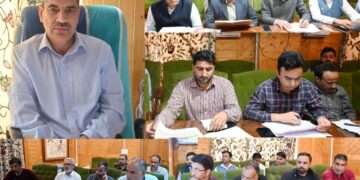
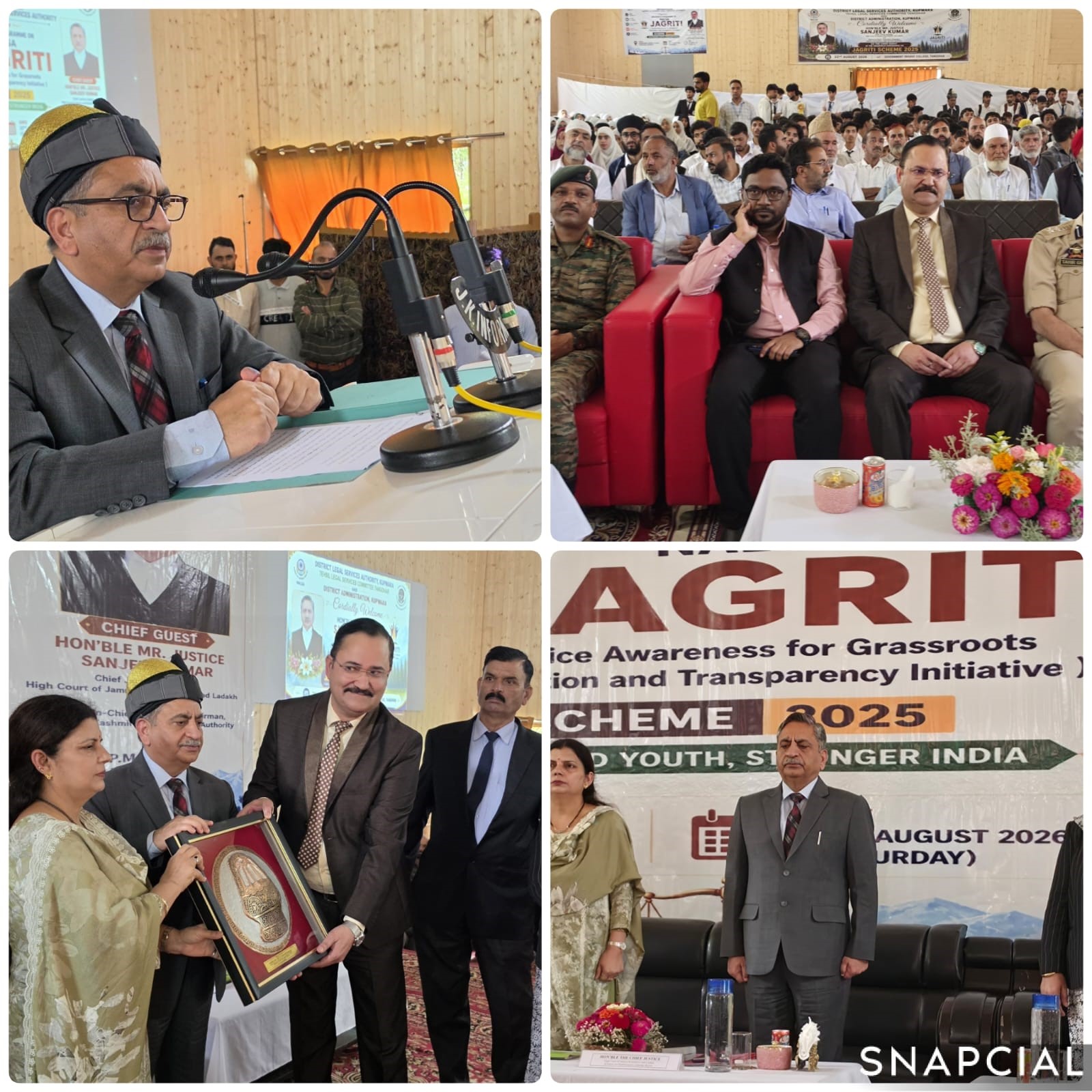
Kupwara :The District Legal Services Authority (DLSA), Kupwara, under the aegis of the Jammu & Kashmir Legal Services Authority (JKLSA) and in furtherance of the objectives of the National Legal Services Authority (NALSA), organised an awareness programme on the NALSA JAGRITI (Justice Awareness for Grassroots Information and Transparency Initiative) Scheme, 2025 at Government Degree College, Tangdhar.
Held under the theme “Empowered Youth, Stronger India,” the programme aimed to take legal awareness and access to justice to people living in remote and frontier areas.
Acting Chief Justice of the High Court of Jammu & Kashmir and Ladakh, Patron-in-Chief and Executive Chairman, J&K Legal Services Authority, Justice Sanjeev Kumar, was the chief guest.
The programme was attended by Registrar General M.K. Sharma, Member Secretary J&K Legal Services Authority Shazia Tabassum, Principal District & Sessions Judge Kupwara Manjeet Singh Manhas, Deputy Commissioner Kupwara Shrikant Suse and SSP Kupwara Syed Tahir Geelani, besides officers of the district administration, police and education departments, judicial officers, members of the Bar Association Tangdhar, faculty members, civil society representatives and students.
Addressing the gathering, Justice Sanjeev Kumar said legal awareness is an important instrument of empowerment and stressed that access to justice must remain available to every section of society. He said geographical distance and difficult terrain should never become barriers to justice, particularly for people living in remote and frontier areas.
He appreciated NALSA for introducing the JAGRITI Scheme and commended the J&K Legal Services Authority and DLSA Kupwara for taking the initiative to Tangdhar.
The Acting Chief Justice emphasised that rights and duties go hand in hand and called upon citizens to understand both their constitutional rights and responsibilities.
Speaking about youth empowerment, he said legal literacy enables young people to make informed decisions and become responsible citizens. He also stressed the need for a sensitive, child-friendly and rehabilitative approach towards children in conflict with law, emphasising counselling, education, parental care and rehabilitation.
Justice Sanjeev Kumar also highlighted the growing challenge of substance abuse and drug trafficking among youth, observing that the problem cannot be addressed through punitive measures alone. He called for greater focus on prevention, early identification, counselling, treatment and rehabilitation.
On mental health, he stressed that emotional and mental well-being deserves the same attention as physical health. He urged parents, teachers and society to create supportive environments where young people can discuss their concerns without fear or stigma.
He also highlighted risks associated with the digital environment, including cyber fraud, online harassment, identity misuse and misinformation, and stressed the importance of responsible and informed use of technology.
Encouraging girls and young women to pursue education and acquire skills, he said their equal participation in decision-making and public life was essential for societal progress.
The Acting Chief Justice called upon District Legal Services Authorities, Taluk Legal Services Committees, Panel Lawyers and Para-Legal Volunteers to proactively reach people requiring assistance rather than waiting for them to approach legal services institutions.
Earlier, the Principal District & Sessions Judge, Kupwara, welcomed the gathering and highlighted the importance of taking legal awareness and legal services to remote and frontier areas.
Speakers subsequently sensitised participants about the NALSA JAGRITI Scheme, its grassroots approach and the mechanisms envisaged for implementation through schools, colleges, Legal Literacy Clubs, Para-Legal Volunteers and local institutions.
Dr Adil from IMHANS-K also addressed the gathering on mental health and emotional well-being, sensitising participants about early identification of mental health concerns, timely professional assistance and the need for a supportive environment.
The programme also featured a cultural performance by artists and students. A skit on drug trafficking highlighted its harmful impact on individuals, families and society.
A medical camp was also organised for the local population, providing free medical consultations, treatment and medicines. The programme concluded with a vote of thanks by Professor Sadaf Rauf of Government Degree College, Tangdhar.