J&K-Ladakh allocation drops to 2,134 MW
Power shortfall falls to 19 MU in 2025-26
India exports power to four neighbours
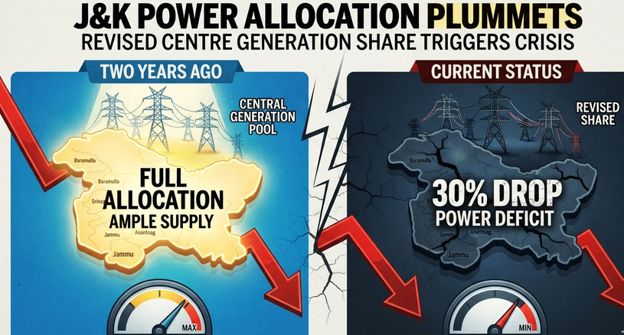
Srinagar: Jammu and Kashmir’s allocation from Central Generating Stations (CGS) has fluctuated significantly over the past five years, rising from 2,481.1 MW in March 2022 to 3,423 MW in March 2024, before declining to 3,020 MW in March 2026 and 2,134.1 MW as on June 30, 2026, the Centre informed the Rajya Sabha on Monday.
The figures were provided by Minister of State for Power Shripad Naik in response to Unstarred Question regarding inter-state electricity allocation, tariffs and cross-border power trade.
The government said that electricity allocation from Central Generating Stations is governed by revised guidelines issued by the Ministry of Power on July 31, 2024, with allocation based largely on regional and national energy requirements.
For J&K and Ladakh, the combined allocation stood at 2,481.1 MW as on March 31, 2022, increasing to 3,201.6 MW in March 2023 and 3,423 MW in March 2024. It stood at 2,623 MW in March 2025, rose to 3,020 MW in March 2026, and was 2,134.1 MW as on June 30, 2026.
Despite fluctuations in allocated capacity, the Union Territory has recorded a substantial improvement in its actual power supply position. J&K’s energy requirement was 19,957 MU in 2021-22, against supply of 18,434 MU, leaving 1,524 MU unsupplied, equivalent to a 7.6 per cent gap.
The gap narrowed to 317 MU in 2022-23, when demand stood at 19,639 MU and supply at 19,322 MU. In 2023-24, the requirement increased to 20,040 MU, while supply reached 19,763 MU, leaving 277 MU unsupplied.
In 2024-25, the gap declined further to just 90 MU, with 20,374 MU required and 20,283 MU supplied. During 2025-26, J&K’s requirement stood at 20,185 MU, of which 20,166 MU was supplied, leaving only 19 MU unsupplied.
For the first quarter of the current financial year, April-June 2026, J&K’s energy requirement was 4,769 MU, against supply of 4,739 MU, leaving a provisional gap of 30 MU, or 0.6 per cent.
The Centre said 15 per cent of power from Central Generating Stations is kept unallocated at the disposal of the Union Government to meet urgent and contingent requirements of beneficiary States and UTs. The remaining 85 per cent is distributed according to source-specific guidelines.
For thermal power plants, 10 per cent, or another percentage approved by the Ministry of Power, is allocated to the home State, while 75 per cent is distributed among States and UTs in the region based on their energy requirement during the preceding five years.
For hydro power projects, 12 per cent free power is allocated to States affected by submergence and displacement, one per cent is earmarked for the Local Area Development Fund and 72 per cent is allocated to States and UTs, including the home State, on an all-India basis according to their preceding five-year energy requirement.
For nuclear plants, 50 per cent of the power is allocated to the home State and 35 per cent to States and UTs in the region, excluding the home State, based on their energy requirements.
In joint ventures involving a Central Public Sector Undertaking, power allocation among partners is generally made in proportion to equity participation unless a specific agreement provides otherwise.
The government said Maharashtra had the highest energy consumption during the five-year period.
Its annual energy requirement rose from 172,823 MU in 2021-22 to 187,309 MU in 2022-23, 207,108 MU in 2023-24, before standing at 201,816 MU in 2024-25 and 202,867 MU in 2025-26.
In 2025-26, Maharashtra received almost its entire requirement, with 202,854 MU supplied against 202,867 MU, leaving only 13 MU unsupplied.
At the national level, energy requirement increased from 13,79,812 MU in 2021-22 to 17,07,493 MU in 2025-26. During the same period, energy supplied increased from 13,74,024 MU to 17,06,985 MU, while the national supply gap fell from 5,787 MU to only 508 MU.
The latest provisional figures for April-June 2026 show an all-India requirement of 4,83,117 MU, against supply of 4,82,435 MU, leaving 682 MU unsupplied.
The Central Electricity Authority publishes the All India Weighted Average Rate of Sale of Power (AI-WARSP) for Central Generating Stations of conventional generation sources with capacity of 25 MW and above.
The weighted average rate increased from 332.94 paise per kWh in 2020-21 to 357.29 paise in 2021-22, 422.12 paise in 2022-23, before moderating to 415.66 paise in 2023-24 and standing at 418 paise per kWh in 2024-25.
The government has also outlined a major expansion of the national transmission network.
Since 2014, the country has added 2.18 lakh circuit kilometres of transmission lines, 947 GVA of transformation capacity and 84 GW of inter-regional transmission capacity. The total inter-regional transmission capacity has now reached 120 GW as on June 30, 2026.
Under the National Electricity Plan (Transmission), 2024, the transmission network is projected to expand from 5.09 lakh circuit km in June 2026 to 6.48 lakh circuit km by 2032. Transformation capacity is planned to rise from 1,478 GVA to 2,345 GVA, while inter-regional transmission capacity is targeted to increase from 120 GW to 168 GW by 2032.
The government said the Green Energy Corridor is supporting new transmission lines and substations for evacuation of renewable power. Dynamic grid-support systems including Static VAR Compensators, STATCOMs and Synchronous Condensers are also being planned and implemented to improve voltage stability, power-transfer capability and grid resilience.
India is currently exporting electricity to Bhutan, Bangladesh, Nepal and Myanmar through power exchanges and bilateral arrangements.
Exports to Bhutan increased from 322 MU in 2021-22 to 2,115 MU in 2025-26. Exports to Bangladesh stood at 7,327 MU in 2021-22, peaked at 8,581 MU in 2022-23 and were 8,362 MU in 2025-26.