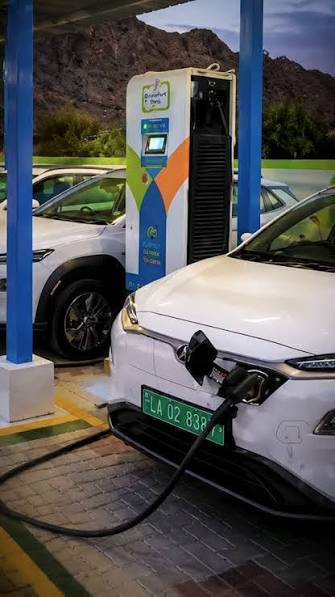
Srinagar | Aug. 07:Jammu and Kashmir now has 295 electric vehicle (EV) charging stations, the Union Government informed Parliament on Friday, indicating a gradual expansion of charging infrastructure in the Union Territory as India accelerates its transition towards electric mobility.
In a written reply to an unstarred question in the Rajya Sabha, Minister of State for Heavy Industries Bhupathiraju Srinivasa Varma said that 52,718 EV charging stations have been installed across the country as of July 29, 2026, with Jammu and Kashmir accounting for 295 charging stations, while neighbouring Ladakh has 25.
The Minister, however, said the Centre does not maintain a centralised record categorising charging stations into fast-charging and slow-charging facilities, making it difficult to assess the nature of charging infrastructure available in individual States and Union Territories, including Jammu and Kashmir.
The reply assumes significance as Jammu and Kashmir has been witnessing a steady increase in the adoption of electric vehicles, particularly in urban centres such as Srinagar and Jammu, alongside growing efforts to promote cleaner and sustainable modes of transport.
The Minister informed the House that the establishment of EV charging stations has been de-licensed, allowing private entities to install charging infrastructure in accordance with the Ministry of Power’s guidelines issued on September 17, 2024. This policy is intended to encourage greater private investment and accelerate the creation of a nationwide charging network.
He said that under the FAME-II (Faster Adoption and Manufacturing of Electric Vehicles) scheme, charging infrastructure has been implemented through three Oil Marketing Companies—Indian Oil Corporation Limited (IOCL), Bharat Petroleum Corporation Limited (BPCL) and Hindustan Petroleum Corporation Limited (HPCL)—along with Rajasthan Electronics & Instruments Limited (REIL), Convergence Energy Services Limited (CESL), Kerala State Electricity Board (KSEB), Surat Municipal Corporation (SMC) and POWERGRID.
The Minister further informed that under the PM E-DRIVE scheme, Government ministries, Central Public Sector Enterprises (CPSEs), States, Union Territories and their public sector undertakings are eligible to submit proposals for setting up EV Public Charging Stations. These agencies may establish and operate charging stations independently or engage private Charge Point Operators (CPOs) for implementation and maintenance.
According to the data placed before Parliament, Maharashtra leads the country with 6,985 EV charging stations, followed by Karnataka (6,805), Uttar Pradesh (4,493), Tamil Nadu (3,839), Telangana (3,739) and Kerala (3,399). Among the northern States and Union Territories, Punjab has 1,548 charging stations, Haryana 2,291, Himachal Pradesh 256, Delhi 2,370, Chandigarh 76, and Jammu and Kashmir 295.
The Minister’s reply came in response to a question seeking State-wise details of EV charging stations installed over the last five years, their classification into fast and slow chargers, the agencies responsible for their installation, and the implementation status of charging stations under various Central Government schemes.
While providing detailed information on Punjab under the FAME-I, FAME-II and PM E-DRIVE schemes, the Minister did not disclose a scheme-wise break-up of charging stations established in Jammu and Kashmir.