• Inaugurates engineering blocks, Law School at IUST; releases policy brief on anti-drug campaign
• Urges integration of AI, remote sensing and traditional knowledge in climate planning
• Says protecting forests, wetlands and watersheds is key to sustainable development
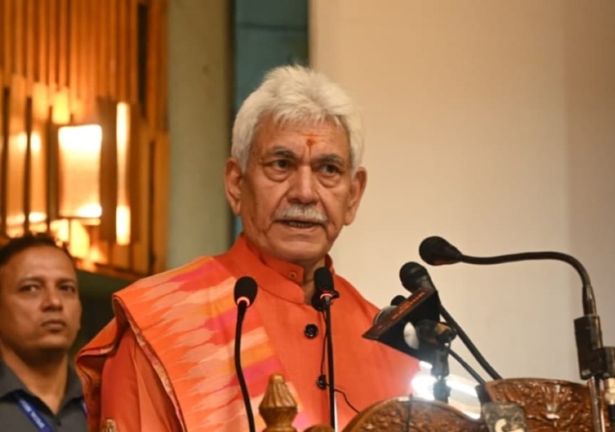
Awantipora:Lieutenant Governor Manoj Sinha on Monday called for placing nature-based solutions at the centre of development planning to strengthen climate resilience in the Himalayan region, saying conservation and development must go hand in hand to address the growing impact of climate change.
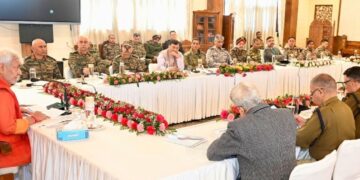
Addressing a conference on “Strengthening Climate Resilience and Livelihoods in the Himalayan Region through Nature-based Solutions” at the Islamic University of Science and Technology (IUST), Awantipora, the Lieutenant Governor said the Himalayas are witnessing an alarming rise in climate-related disasters and stressed the need for science-driven and community-led strategies to safeguard the fragile ecosystem.
The Lieutenant Governor also inaugurated the Civil and Mechanical Engineering Block at the university’s main campus, IUST’s Larmoo Campus and the Law School. He congratulated the university for its academic initiatives and lauded its policy brief on the Nasha Mukt Jammu Kashmir Abhiyan.
Highlighting the growing vulnerability of the Himalayan ecosystem, Sinha said the region witnessed nearly one natural disaster every day between January and August last year. Referring to Jammu and Kashmir, he said flash floods and cloudbursts have caused extensive damage to roads, water supply schemes and power infrastructure, underlining the urgency of adopting sustainable approaches to development.
“There is no contradiction between development and conservation. Nature itself is infrastructure,” he said, explaining that watersheds, wetlands and forests perform critical ecological functions, including flood control, groundwater recharge, water purification and protection against landslides.
The Lieutenant Governor warned that destroying natural ecosystems would have long-term consequences for future generations, while restoring them would strengthen the region’s resilience against climate change.
Calling upon scientists, engineers and policymakers to mainstream nature-based solutions, Sinha proposed a roadmap that includes the use of remote sensing, geospatial mapping and artificial intelligence to monitor glacier retreat, spring discharge, soil health and forest cover. He said scientific data should guide all development projects in the Himalayan region.
He also advocated integrating nature-based solutions into project planning, budgeting and monitoring while ensuring that farmers, shepherds, orchardists and tribal communities become equal stakeholders in environmental conservation by contributing their traditional knowledge.
The Lieutenant Governor further suggested that annual budget reviews should assess ecological indicators, including forest cover and ecosystem health, alongside financial performance. He also stressed the need for sustained collaboration between scientists, policymakers and local communities and called for restoring floodplains and wetlands alongside conventional engineering interventions.
Emphasising the role of higher educational institutions, Sinha urged universities to develop multidisciplinary academic programmes on nature-based solutions, covering ecology, hydrology, engineering, economics, disaster management and indigenous knowledge syste
Recalling the Green Jammu and Kashmir Drive launched in 2020, he said the initiative has helped increase the Union Territory’s forest cover to nearly 55 per cent and reiterated the importance of sustainable development for protecting the Himalayan ecosystem.
The Lieutenant Governor envisioned a future where healthy watersheds, thriving wetlands and free-flowing rivers continue to support biodiversity, livelihoods and the region’s cultural heritage.
On the occasion, he released a special edition of IUST’s monthly magazine Times Echo dedicated to the 100-day anti-drug campaign and a policy brief on the Nasha Mukt Jammu Kashmir Abhiyan, prepared by experts from Jammu and Kashmir. Certificates were also distributed among trainees under the Pradhan Mantri Kaushal Vikas Yojana (PMKVY).
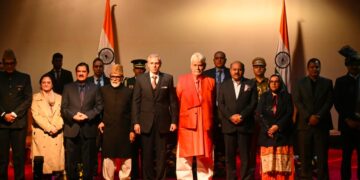
Acting Chief Justice of the High Court of Jammu & Kashmir and Ladakh Justice Sanjeev Kumar, IUST Vice-Chancellor Prof. Shakil A. Romshoo, Registrar Prof. Shamim Ahmad Shah, Conference Convener Prof. Javed Hussain Mir, along with scientists, academicians, senior officials, faculty members and students attended the event.