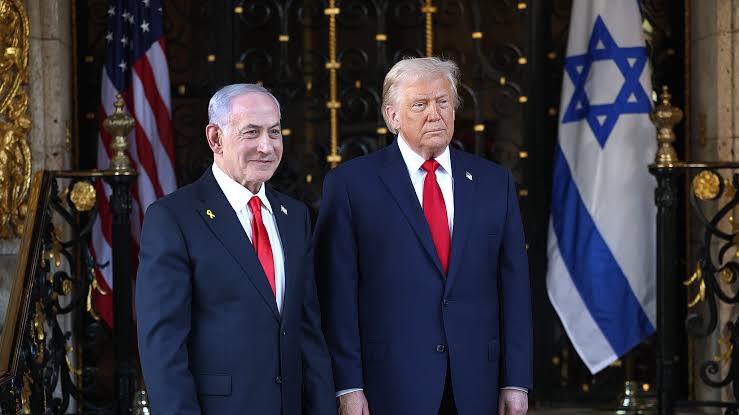
Washington, Jul 29 (UNI) Israeli Prime Minister Benjamin Netanyahu urged US President Donald Trump to maintain pressure on Iran during their White House meeting, making no secret of his scepticism regarding the ongoing negotiations and their ability to produce a lasting agreement.
Furthermore, the two leaders discussed options ranging from increased economic pressure to renewed military action, according to a senior Israeli official.
The 90-minute meeting on Tuesday, the first between the two leaders took place hours before Iran launched a missile attack on a US military base in Jordan, leading Trump to vow retribution.
According to the Israeli official, the two leaders discussed three possible paths: pursuing a diplomatic agreement with Iran, maintaining and strengthening economic pressure through the ongoing naval blockade, or resuming large-scale military operations, according to US and Israeli news sites.
Trump’s envoys, Steve Witkoff and Jared Kushner, are continuing negotiations with Iranian officials, although significant differences remain, the official said. Netanyahu reportedly told Trump he was doubtful that Tehran would agree to a satisfactory deal.
“We discussed all of those options at length and very candidly. Not as an attempt to promote one option over another, but to examine what the best outcome would be from each,” the official said.
The Israeli delegation said Trump expressed concern about the impact of prolonged conflict on global energy markets and the wider economy.
Netanyahu argued that Iran was attempting to use the Strait of Hormuz as leverage to extract concessions from Washington but said Tehran’s fragile economy left it vulnerable to further pressure.
According to the official, the leaders discussed increasing pressure on Iran “through both kinetic and non-kinetic means”, including continuing the naval blockade.
The official claimed divisions were emerging within Iran’s leadership between officials worried about economic collapse and hardliners focused on preserving the regime.
“They’re having fuel supply problems, long lines at gas stations, diesel shortages. There are small protests because the public is very frustrated. The regime is very worried about that. It’s concerned that people will rise up over the economic situation,” the official said.
The briefing also included claims regarding Iran’s leadership. The official alleged that Supreme Leader Mojtaba Khamenei remained alive but had not been seen publicly and continued to insist that major decisions required his personal approval.
Beyond Iran, Netanyahu presented Trump with maps of Syria, arguing that Ankara controlled a significantly larger area of Syrian territory than Jerusalem.
The official said Netanyahu insisted Israel would retain its military presence in a buffer zone in southern Syria for as long as it considered jihadist groups a threat.
The two leaders also discussed a potential US-Saudi civil nuclear agreement. According to the Israeli official, Trump views such a deal as part of a broader process that could eventually lead to Saudi Arabia normalising relations with Israel.
The meeting also touched on the future of US military assistance to Israel.
The official said Netanyahu told Trump, Vice President JD Vance and Steve Witkoff that he wanted to phase out US military aid over the next decade, arguing that Israel should become fully self-reliant in defence production.
According to the official, Netanyahu proposed negotiating a new memorandum of understanding that would provide $16 billion in direct military assistance, an additional $5-10 billion for joint missile defence programmes and establish a $16 billion joint research and development fund for advanced weapons systems during the transition.
The official added that Netanyahu had instructed Israel’s defence industry to begin work on developing a domestically produced next-generation fighter aircraft within the next decade, aiming to reduce dependence on future US combat aircraft supplies.