
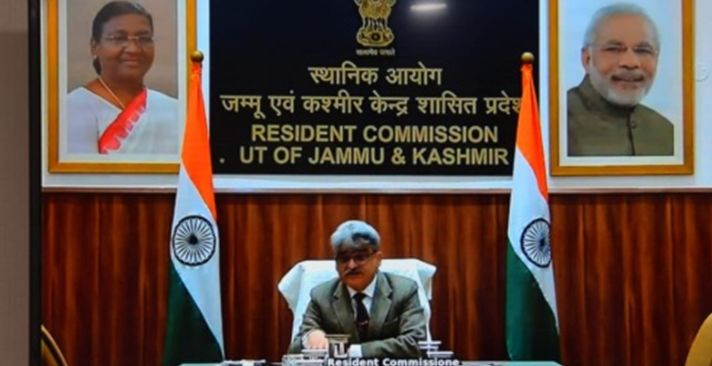
Srinagar: In a major step towards strengthening governance and ensuring time-bound execution of infrastructure projects in Jammu and Kashmir, Chief Secretary, Atal Dulloo, Monday chaired a high-level meeting with senior officers of the Project Monitoring Group (PMG), Department for Promotion of Industry and Internal Trade (DPIIT), Government of India, at New Delhi to deliberate upon the establishment of a Union Territory-level Project Monitoring Group (UT-PMG) on the lines of the Central PMG mechanism here.
The proposed JK-PMG aims to institutionalize a technology-driven project monitoring system for expediting implementation of major developmental projects across Jammu and Kashmir. The Central PMG is designed to facilitate milestone-based monitoring and resolution of regulatory bottlenecks in large infrastructure projects through coordinated engagement with Central Ministries and States.
Addressing the meeting Chief Secretary highlighted the rapid infrastructure development occurring in the region, necessitating the establishment of a robust institutional mechanism for monitoring project progress and addressing implementation challenges. The proposed Project Monitoring Group (PMG) aims to enhance transparency, accountability, and efficiency in project execution by providing senior officials with real-time data on project milestones, financial progress, and inter-departmental dependencies. Emphasizing technology-driven governance, the Chief Secretary advocated for the PMG portal to serve as a comprehensive decision-support system that generates analytical reports and monitors key performance indicators, facilitating evidence-based policy interventions. Regular review meetings at various administrative levels are to be institutionalized, with departmental reviews occurring bi-weekly, monthly meetings under the Chief Secretary, and periodic high-level reviews under the Chief Minister to address critical project bottlenecks. The PMG is designed to ensure seamless coordination among stakeholders by integrating departments and project implementing agencies on a unified digital platform, thereby enhancing accountability and minimizing procedural delays. A comprehensive presentation by the PMG team outlined the operational framework and technological capabilities of the portal, which is expected to transform project monitoring through real-time tracking and structured review mechanisms. The roadmap for operationalizing the JK-PMG includes issuing a Government Order to establish the group, appointing a dedicated team of experts, onboarding nodal officers, activating the portal with Central PMG support, and conducting extensive training for stakeholders. The PMG will also manage user groups, track issues and projects, and coordinate with the Central PMG. The Chief Secretary instructed officers to prepare a detailed proposal for the early establishment of the UT-level PMG, incorporating best practices from the national framework while tailoring it to the specific needs of Jammu and Kashmir. He expressed confidence that the JK-PMG would serve as a strong governance platform, ensuring timely project completion, improving inter-departmental coordination, and fostering socio-economic development in the region.