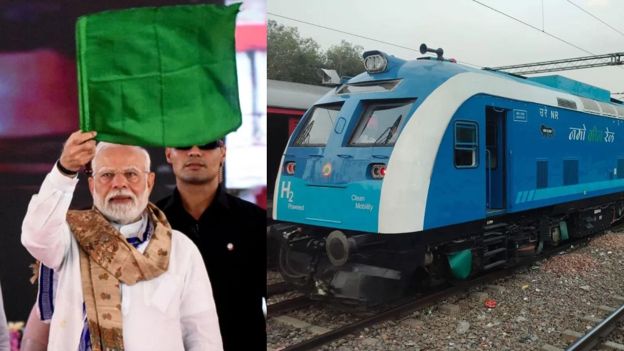
Jind( Haryana): Prime Minister Narendra Modi on Friday flagged off India’s first indigenous hydrogen-powered train between Jind and Sonipat at Jind railway station, marking an important step towards the adoption of clean and sustainable mobility in the railway sector.
Jind in Haryana on Friday witnessed a historic moment with the launch of India’s first indigenous 10-coach hydrogen train. India’s hydrogen train features a 10-coach configuration, making it among the longest hydrogen-powered passenger trains developed so far. It is powered by a 3,200 HP propulsion system, making it one of the most powerful hydrogen-powered trainsets in operation.
With an operational speed of 75 kmph on the Jind–Sonipat section and a design speed of 110 kmph, the train is not only safer but also faster on this 89 km route.
The Hydrogen Fuel Cell Powered Train will initially operate on the Jind–Sonipat section of Northern Railway, connecting Jind Junction, Gohana Junction, and Sonipat while serving intermediate stations and proposed halts including Jind City, Pandu Pindara Junction, Lalit Khera Halt, Bhambhewa, Isapur Kheri Halt, Butane Halt, Khandrai Halt, Rabrah Halt, Lath Halt, Mohana, Barwasni Halt, and Sonipat New.
Amid hot and humid conditions, just to catch a glimpse of the new hydrogen train, which commenced from Jind Railway station, people were standing in large numbers at every stoppage of the train and were clicking photos of the new train.
Interacting with this correspondent at Jind Railway station before the flagging off the train, a group of school children said they are very happy to be part of this historic journey, adding that the hydrogen train is environmental friendly train and does not cause pollution. “This is the country’s first pollution-free train,” the students said. “We feel proud to be travelling on it for the first time. It is a historic moment for us and a matter of immense pride,” they added.
Nitin Parikh, Train Manager of the hydrogen train, said, “This is the world’s longest hydrogen-powered train and one of the most pollution-free trains. It runs on hydrogen and emits only water, with no pollution of any kind. We have already had successful trials of electric, diesel, and CNG trains, but this is the first hydrogen train of its kind with 10 coaches.”
Designed, engineered, and integrated in India, the train has been developed using indigenous technology, reflecting the country’s growing capabilities in advanced railway engineering. With its introduction, India joins the select group of countries that have operational hydrogen-powered trains.
The train is powered by hydrogen fuel cell technology, which converts hydrogen into electricity to propel the train. The process produces only water vapour as a by-product, resulting in zero carbon emissions during operation.
Compared to diesel trains, they eliminate tailpipe emissions, lower dependence on fossil fuels and fossil fuel imports, and operate with significantly less noise. Unlike conventional electric trains, they do not require continuous overhead electrification infrastructure, as electricity is generated onboard through hydrogen fuel cells, making them a clean and efficient solution. The use of green hydrogen also reduces dependence on electricity generated from fossil fuel-based thermal power plants, supporting India’s transition to sustainable transport.
The train consists of two Hydrogen Driving Power Cars (DPCs) and eight Trailer Coaches (TCs). Each DPC houses fuel cells, lithium iron phosphate (LFP) batteries, and hydrogen storage cylinders that work together to provide traction power while ensuring reliable operation under varying operating conditions.
The two power cars, one at each end, produce 1,200 kW (1600 hp) of power per DPC, together enough to push the entire train up to 110 km/h.
Most hydrogen passenger trains currently operating globally comprise only two or three coaches and are primarily deployed on short regional routes. In contrast, the Indian Railways trainset has been configured as a 10-coach passenger train with a capacity of around 2,600 passengers, demonstrating the scalability of hydrogen-powered rail transport for high-capacity passenger operations.
LG Orders Tougher Counter-Terror Measures, Focus on Infiltration, Terror Networks

UHQ reviews J&K security, Sinha calls for choking terror financing, logistical support Srinagar | Oct 27:Lieutenant Governor Manoj Sinha on...
Read moreDetails