- Says “Infra Projects Driving Economic Growth, Tourism, Trade, Social Dev”
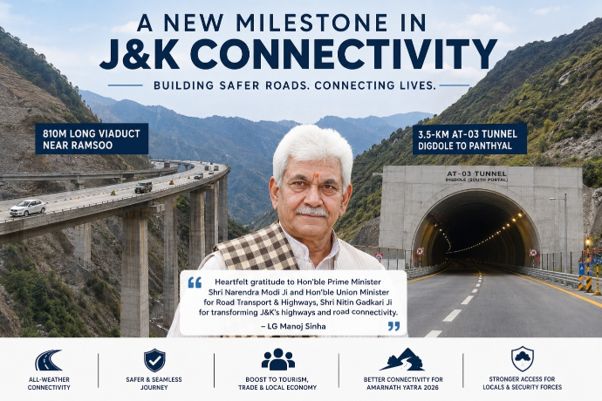
Srinagar: This week Lieutenant Governor Manoj Sinha expressed gratitude to Prime Minister Narendra Modi and Union Minister for Road Transport and Highways Nitin Gadkari for the completion of two major infrastructure projects on the strategically important National Highway-44—the 810-metre-long Viaduct near Ramsoo in Ramban district and the 3.5-kilometre AT-03 Tunnel connecting Digdole to Panthyal. Describing the projects as another milestone in Jammu and Kashmir’s infrastructure transformation, the Lieutenant Governor said the new road assets would significantly improve connectivity, ensure safer and more reliable transportation, and provide year-round access along one of the country’s most critical highway corridors. The projects, completed as part of the ongoing highway modernisation programme, are scheduled to be opened for traffic on July 3, 2026, offering major relief to commuters, transporters, tourists, pilgrims and security forces travelling between Jammu and the Kashmir Valley.
LG Thanks PM Modi, Nitin Gadkari: In a statement, the Lieutenant Governor said the completion of the viaduct and tunnel reflects the Central Government’s sustained commitment towards strengthening infrastructure in Jammu and Kashmir. “Heartfelt gratitude to Hon’ble Prime Minister Shri Narendra Modi Ji and Hon’ble Union Minister for Road Transport & Highways, Shri Nitin Gadkari Ji, for transforming J&K’s highways and road connectivity. The completion of the 810-metre-long Viaduct near Ramsoo in Ramban district and the 3.5-km AT-03 Tunnel connecting Digdole to Panthyal on NH-44 is yet another monumental feat,” the Lieutenant Governor said. He noted that under the leadership of the Prime Minister and with the guidance of the Ministry of Road Transport and Highways, Jammu and Kashmir has witnessed unprecedented investment in roads, tunnels, bridges and highways over the past few years. According to the Lieutenant Governor, these transformative infrastructure projects are not only improving connectivity but are also driving economic growth, tourism, trade and social development across the Union Territory.
Major Boost To NH-44 Connectivity: National Highway-44 serves as the lifeline connecting the Kashmir Valley with the rest of the country. The highway carries thousands of passenger vehicles, commercial trucks, defence convoys and essential supplies every day. However, several stretches, particularly in Ramban district, have historically remained vulnerable to landslides, shooting stones, flash floods and adverse weather conditions, often resulting in prolonged traffic disruptions. The newly completed Ramsoo Viaduct and the AT-03 Tunnel are expected to substantially improve traffic flow by bypassing some of the most vulnerable sections of the highway. Officials said the projects have been designed to enhance operational efficiency, reduce travel time and minimise disruptions caused by natural hazards that frequently affect the Jammu-Srinagar National Highway.
Ramsoo Viaduct To Improve Traffic Flow: The 810-metre-long viaduct near Ramsoo has been constructed to facilitate uninterrupted traffic movement through one of the highway’s most challenging stretches. The elevated structure will help vehicles avoid sections that are frequently affected by landslides and road blockages during heavy rainfall and winter weather. Officials believe the viaduct will significantly improve road safety by reducing exposure to accident-prone areas while ensuring smoother movement of passenger and commercial vehicles. The project also incorporates modern engineering standards aimed at increasing durability and resilience against difficult geological conditions.
AT-03 Tunnel Bypasses Vulnerable Stretches: The newly completed 3.5-kilometre AT-03 Tunnel, connecting Digdole and Panthyal, is another major addition to the highway corridor. The tunnel has been designed to bypass landslide-prone stretches that have historically witnessed frequent closures due to falling rocks and unstable slopes. Once operational, the tunnel is expected to provide faster, safer and more reliable travel between the two points while substantially reducing the risk posed by adverse weather and geological disturbances. Officials said the tunnel forms an integral part of the broader highway upgradation programme aimed at converting the Jammu-Srinagar National Highway into a modern all-weather transport corridor.
Relief For Amarnath Yatra Pilgrims: The Lieutenant Governor emphasised that the timing of the completion is particularly significant as it coincides with the commencement of Amarnath Yatra-2026. He said the newly developed infrastructure will greatly benefit thousands of pilgrims travelling from Jammu towards the twin base camps at Baltal and Pahalgam. According to the Lieutenant Governor, safer roads and uninterrupted highway connectivity are essential for ensuring the smooth movement of yatri convoys during the annual pilgrimage. He said the projects will help pilgrims avoid hazardous stretches, reduce travel-related delays and improve the overall pilgrimage experience. “These key infrastructures secure smooth and all-weather movement for locals, tourists, freight and security forces, while ensuring a safer and seamless journey for the pilgrims of Shri Amarnath Ji Yatra-2026 by bypassing landslide-prone stretches,” he said.
Strengthening Economic Growth: Improved road connectivity is expected to deliver substantial economic benefits across Jammu and Kashmir. The highway serves as the principal transport corridor for the movement of fruits, vegetables, handicrafts, industrial products and essential commodities between the Valley and the rest of the country. Frequent highway closures in the past have often disrupted supply chains, increased transportation costs and affected trade. With the completion of the new tunnel and viaduct, freight movement is expected to become more reliable, helping businesses, transport operators and farmers. Officials believe improved logistics will strengthen economic activity by reducing delays and transportation expenses. The enhanced connectivity is also expected to support industrial growth by facilitating easier movement of raw materials and finished goods.
Boost To Tourism: Tourism remains one of Jammu and Kashmir’s most important economic sectors, attracting millions of visitors every year. Reliable road infrastructure plays a crucial role in encouraging tourist arrivals by ensuring safe and comfortable travel. The upgraded highway corridor is expected to benefit visitors travelling to destinations such as Srinagar, Gulmarg, Pahalgam, Sonamarg and other tourist attractions. Better roads are also likely to encourage greater private investment in tourism infrastructure, hospitality and related services. Officials said improved connectivity will particularly benefit domestic tourists travelling by road during peak holiday seasons.
Strategic Importance: Apart from its civilian significance, NH-44 holds immense strategic value as it serves as the primary surface link between the Kashmir Valley and the rest of India. The highway supports the movement of defence personnel, security forces and essential logistics required for maintaining operational readiness in the region. The completion of resilient infrastructure capable of withstanding adverse weather conditions is expected to further strengthen logistical capabilities and improve mobility for security agencies. The Lieutenant Governor said the projects reinforce the government’s commitment to building infrastructure that serves both developmental and strategic objectives.
Engineering Transformation In J&K: Over the past several years, Jammu and Kashmir has witnessed an unprecedented pace of infrastructure development, particularly in the road and tunnel sector. Several major highway projects, tunnels, bridges and expressway components have either been completed or are currently under construction as part of the Centre’s long-term vision to improve connectivity in the Union Territory. Modern engineering techniques, advanced tunnelling technologies and climate-resilient designs are being employed to address the region’s difficult terrain and geological challenges. Officials say these projects are gradually transforming travel in Jammu and Kashmir by making journeys safer, faster and more dependable throughout the year.
All-Weather Connectivity A Priority: Ensuring uninterrupted all-weather connectivity has emerged as one of the government’s primary infrastructure priorities for Jammu and Kashmir. Heavy snowfall, landslides, flash floods and shooting stones have traditionally affected road connectivity, disrupting transport and economic activity. Projects such as the Ramsoo Viaduct and the AT-03 Tunnel represent long-term solutions aimed at reducing the impact of natural disasters on highway operations. The improved corridor is expected to enhance emergency response capabilities, facilitate disaster management operations and ensure the uninterrupted movement of essential supplies during adverse weather.
Projects to Open For Traffic: Officials said both the 810-metre Ramsoo Viaduct and the 3.5-kilometre AT-03 Tunnel will be opened for public traffic on July 3, 2026. Their commissioning marks another important milestone in the ongoing transformation of Jammu and Kashmir’s transport infrastructure. The projects are expected to immediately improve travel conditions for commuters while contributing to the long-term development of the Union Territory.