Says hotspots to be turned drug-free zones’
‘Families must become first line of defence’
‘Community vigilance key to ending drug menace’
‘No let-up in crackdown on drug networks’
‘We must treat addiction with dignity, not stigma’:
‘Religious institutions must lead awareness push’
‘Collective action needed to defeat drugs’
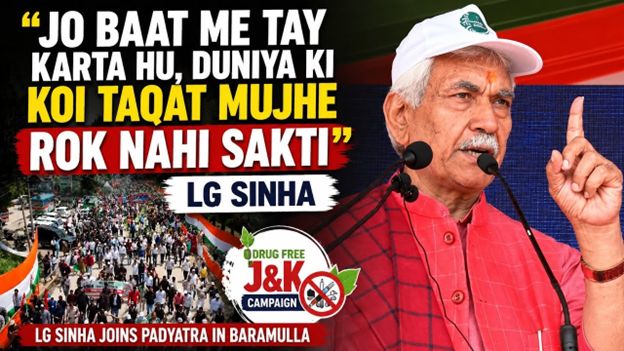
Srinagar: Lieutenant Governor Manoj Sinha on Tuesday declared an all-out offensive against narcotics networks, vowing to “chase every rupee” of drug cartels and dismantle their financial backbone, while announcing a fresh push to target drug hotspots and mobilise families and communities in the fight.
Launching the next phase of the Drug-Free Jammu and Kashmir campaign in Baramulla, where he participated in a padyatra and interacted with citizens,
LG Sinha announced two key initiatives, a ‘Community Immunisation’ programme to turn identified hotspots into drug-free zones, and a ‘Family Fortress’ model positioning households as the first line of defence.
Detailing the strategy, the Lieutenant Governor said the ‘Community Immunisation’ initiative would be rolled out in 5–10 high-risk areas in each district, in partnership with religious leaders and social organisations.
Drawing a parallel with public health campaigns, he said communities would be “trained and sensitised” to act as an early warning system, monitoring vulnerable zones and gradually transforming them into drug-free pockets.
Calling for wider participation, Sinha urged schools, mosques, temples, gurdwaras and NGOs to dedicate at least one hour every week for awareness programmes. “Community vigilance is key to ending the drug menace,” he said, stressing that sustained local engagement would deliver long-term results.
The second pillar, the ‘Family Fortress Initiative’, seeks to leverage strong family and community bonds to counter addiction. Under this programme, every school, college and place of worship across Jammu and Kashmir will host weekly family dialogues over the next 69 days. These discussions, he said, must be “open and honest”, complemented by local audits to identify gaps in the campaign and strengthen intervention mechanisms.
Highlighting the scale of ongoing efforts, the Lieutenant Governor said that in the past 31 days alone, over 2.35 lakh awareness and outreach events have been conducted across the Union Territory. More than 44,000 patients have received treatment through OPD services, while nearly 700 drug smugglers and peddlers have been arrested as part of intensified enforcement.
He said the crackdown has specifically targeted the financial networks of drug cartels, with properties worth crores seized from major smugglers. “We will chase every rupee, every asset and every shell company linked to drug trafficking,” Sinha asserted, adding that strict action would continue against those “destroying the future of our youth”.
Enforcement agencies have also recommended cancellation of around 300 driving licences and over 400 vehicle registrations linked to drug-related activities. More than 3,300 drug stores have been inspected across Jammu and Kashmir, with around 150 licences suspended for violations. Surveillance has been strengthened with the installation of nearly 3,000 CCTV cameras at pharmacies, while over two dozen smugglers have been booked under the PIT-NDPS Act.
Describing the campaign as a “people’s movement”, Sinha said it has witnessed unprecedented public participation. Authorities have received nearly 3,000 calls on tele-mental health helplines in the past month, indicating growing outreach and awareness.
Emphasising a balanced approach, the Lieutenant Governor said the response to drug abuse must be rooted in science and compassion. “We do not shame patients suffering from diseases like diabetes or cancer. Similarly, those battling addiction must be treated with dignity, not stigma,” he said, underlining the need for rehabilitation and reintegration into society. LG Sinha urged government agencies and citizens alike to unite in surveillance, awareness and enforcement efforts.
“Religious institutions must lead the awareness push, families must become the first line of defence, and communities must stay vigilant,” he said, adding that only a coordinated, society-wide response can ensure drug-free villages and towns across Jammu and Kashmir.