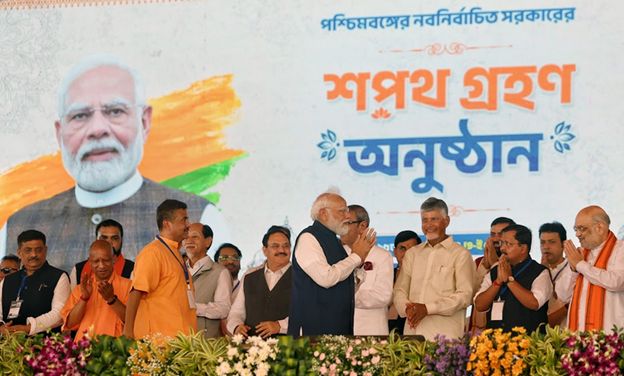
“The swearing-in of Suvendu Adhikari as West Bengal’s Chief Minister marked a historic shift, with the Bharatiya Janata Party forming its first government in the state. Held at Brigade Parade Ground, the ceremony, attended by Prime Minister Narendra Modi, Amit Shah, and Rajnath Singh, symbolised the end of long-standing dominance of the All India Trinamool Congress led by Mamata Banerjee.”
Mohammad Irfan
In a moment that will be remembered as a watershed in India’s political history, Suvendu Adhikari took oath as the ninth Chief Minister of West Bengal, ushering in the first-ever government of the Bharatiya Janata Party in the state. The swearing-in ceremony at Brigade Parade Ground was not merely a constitutional formality—it was a powerful political statement, rich in symbolism, layered in strategy, and reflective of a dramatic shift in Bengal’s electoral and ideological landscape.
The presence of Prime Minister Narendra Modi, Union Home Minister Amit Shah, Defence Minister Rajnath Singh, and a host of senior leaders transformed the event into a national spectacle. Thousands of supporters thronged the venue, which was draped in saffron hues and echoed with traditional drum beats, creating an atmosphere that blended political triumph with cultural expression. The sheer scale of the gathering reflected not only the magnitude of the victory but also the expectations that now rest on the new government.
A Political Earthquake In West Bengal: The 2026 Assembly election results marked a decisive break from the past. For over a decade and a half, West Bengal’s political narrative had been dominated by the All India Trinamool Congress under Mamata Banerjee. The BJP’s emphatic victory, securing more than 200 seats, represents a structural transformation rather than a routine electoral shift. It signals the rise of a new political force that has successfully penetrated grassroots networks, mobilised voters across regions, and reshaped the contours of political competition in the state. At the heart of this transformation stands Suvendu Adhikari, whose political journey reflects both personal resilience and strategic calculation. His victory over Mamata Banerjee in Bhabanipur, coupled with his success in Nandigram, carries deep symbolic weight. These constituencies were not merely electoral battlegrounds; they were arenas where narratives of legacy, leadership, and legitimacy were contested. Adhikari’s triumph in these high-profile contests has elevated him from a regional leader to a central figure in Bengal’s political reconfiguration.
Symbolism, Spectacle At Brigade Parade Ground: The swearing-in ceremony itself was carefully choreographed to project both authority and humility. Prime Minister Narendra Modi’s arrival in Kolkata and his subsequent open jeep ride alongside Adhikari and BJP state president Samik Bhattacharya set the tone for the event. As they waved to the crowd, the visual imagery reinforced the idea of leadership that is both accessible and commanding. The roadshow-like procession through the venue underscored the connection between the leadership and the masses—a theme that has been central to the BJP’s political messaging. The vibrant cultural displays, traditional drum performances, and sea of supporters created an atmosphere that went beyond politics. It resembled a public celebration of change, a collective expression of aspiration, and a visual affirmation of a new political order taking shape in the state.
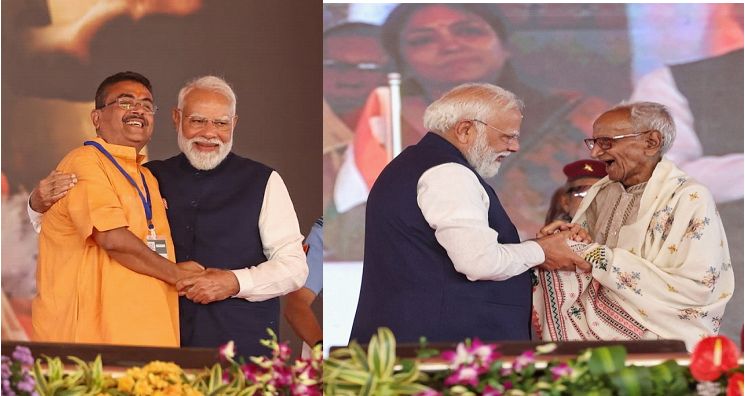
A Gesture That Defined The Moment: Yet, it was a quieter moment that perhaps carried the deepest significance. On the stage, Prime Minister Modi approached Makhanlal Sarkar, a 98-year-old veteran of the party, presented him with a shawl, and sought his blessings. In an era often defined by high-decibel politics, this gesture stood out for its simplicity and depth. It connected the present moment of triumph with decades of organisational effort and ideological commitment.
Makhanlal Sarkar’s Life History: His association with Syama Prasad Mookerjee, his arrest during early nationalist movements, and his role in building the BJP’s base in North Bengal—serves as a reminder that political victories are rarely instantaneous. They are built over years of perseverance, sacrifice, and grassroots engagement.
Cultural Continuity, Political Messaging: This emphasis on legacy and continuity was further reinforced through the ceremony’s cultural elements. The event coincided with the birth anniversary of Rabindranath Tagore, and the leadership paid tribute to the Nobel laureate, symbolically aligning political change with Bengal’s rich cultural heritage. Bengal has long prided itself on its intellectual and artistic traditions, and any political transformation in the state must engage with this legacy. By invoking Tagore, the leadership signalled that the new government seeks not to disrupt Bengal’s cultural identity but to integrate it within a broader narrative of national development. This careful balancing of tradition and transformation reflects a deeper understanding of Bengal’s socio-cultural fabric.
Leadership Vision, Governance Narrative: Prime Minister Narendra Modi’s remarks following the ceremony further clarified the direction of this new political phase. He described Suvendu Adhikari as a leader deeply connected to the people, someone who understands their aspirations and challenges from close quarters. This portrayal is significant because it frames Adhikari’s leadership as rooted in grassroots realities rather than abstract political rhetoric.
Modi’s congratulatory message extended beyond the Chief Minister to include newly inducted ministers such as Dilip Ghosh, Agnimitra Paul, Ashok Kirtania, KshudiramTudu, and NisithPramanik. By highlighting their grassroots work, the Prime Minister emphasised the importance of organisational strength and local engagement in governance.
Central Leadership, Strategic Coordination: Union Home Minister Amit Shah’s role in formally announcing Adhikari as the legislative party leader underscores the strategic coordination between the central leadership and the state unit. This alignment is likely to play a crucial role in the government’s functioning, ensuring that policy priorities are implemented effectively while maintaining political cohesion. Defence Minister Rajnath Singh’s presence, along with other senior leaders, further reinforced the sense of collective responsibility and national importance attached to the event. It signalled that the Bengal transition is not merely a state-level development but a key component of a broader national political strategy.
Governance Challenges, Expectations: However, beyond the celebration and symbolism lies the reality of governance. West Bengal presents a complex set of challenges that will test the new administration’s capabilities. Economic revitalisation, industrial growth, job creation, infrastructure development, and social cohesion are among the key issues that demand immediate attention. The expectations from the new government are high, and the margin of error is limited. The BJP’s promise of “good governance” will now be evaluated not through rhetoric but through results. Delivering tangible improvements in people’s lives will be essential to sustaining political support and building long-term credibility.
Emotional Undercurrents, Political Sacrifice: The emotional dimension of the political transition was also evident in the Prime Minister’s interaction with the families of slain BJP workers, including Debasish Mondal, Soumitra Ghoshal, and Ananda Paul. These meetings highlighted the human cost of political struggle and reinforced the narrative of sacrifice that often accompanies major political shifts. In politically charged environments, such gestures carry deep significance. They acknowledge the contributions of grassroots workers and strengthen the emotional bond between leadership and supporters.
National Implications Of Bengal’s Shift: The implications of this political transformation extend far beyond West Bengal. The BJP’s success in the state strengthens its position in eastern India and signals its ability to expand into regions that were once considered politically resistant. For the opposition, particularly the Trinamool Congress, the defeat represents a moment of introspection and recalibration. It raises important questions about leadership, strategy, and voter engagement in an evolving political landscape.
A New Political Narrative Takes Shape: At a broader level, the swearing-in ceremony reflects the changing nature of Indian politics. It demonstrates how electoral victories are increasingly accompanied by narratives that combine governance, identity, and national integration. The BJP’s approach in Bengal appears to be aimed at creating a synthesis between regional aspirations and national priorities, between cultural heritage and developmental goals. This emerging narrative will play a crucial role in shaping the state’s political discourse in the years ahead.
The Road Ahead For The New Government: As Suvendu Adhikari assumes office, the focus will inevitably shift from celebration to performance. The real measure of this political transformation will lie in its ability to deliver tangible improvements in people’s lives. The government will need to balance political consolidation with inclusive governance, ensuring that development reaches all sections of society. Administrative efficiency, transparency, and responsiveness will be key factors in determining its success.
A Turning Point In Bengal’s History: The events at Brigade Parade Ground on May 9, 2026, will likely be remembered as a defining moment in West Bengal’s political history. The rise of Suvendu Adhikari, backed by the national leadership of Narendra Modi and Amit Shah, signals the beginning of a new chapter—one defined by ambition, transformation, and high expectations.
For the BJP, this is a moment of achievement. For Bengal, it is a moment of transition. The real test, however, begins now. Electoral victories create opportunity—but governance defines legacy.
As the new government takes charge, the people of West Bengal will be watching closely—not just for change, but for delivery. A new era has begun, and its success will depend on how effectively promise is translated into performance.
The formation of the new government under Suvendu Adhikari marks the beginning of a crucial phase where expectations will quickly shift from political victory to governance delivery. The immediate priority for the Bharatiya Janata Party government will be to translate its strong mandate into visible development on the ground. Economic revival remains central to this effort. West Bengal has long struggled with industrial stagnation and limited job creation, and the new administration will need to attract investment, boost infrastructure, and revive key sectors to generate employment and growth.
Administrative reforms will also be essential. A responsive and transparent governance system can strengthen public trust and ensure that welfare schemes reach the intended beneficiaries efficiently. Leveraging technology and improving bureaucratic coordination can help streamline service delivery and reduce inefficiencies.
Equally important is maintaining social harmony. A major political transition often brings heightened sensitivities, and the government must ensure inclusive development that benefits all sections of society. Strengthening law and order, building trust among communities, and ensuring fair governance will be key to long-term stability.
The support and coordination with central leadership, including Narendra Modi, can further accelerate development initiatives. Aligning state policies with national programs can unlock resources and create new opportunities for growth. Ultimately, the success of the government will depend on its ability to deliver consistent, inclusive, and result-oriented governance.
Kashmir Horizon View: The swearing-in of Suvendu Adhikari represents a historic turning point in West Bengal’s political journey. It signals not just a change in leadership, but a shift in the state’s broader political and governance narrative. The rise of the Bharatiya Janata Party in Bengal reflects evolving voter aspirations and a desire for new direction and development. The grand ceremony at Brigade Parade Ground symbolised both achievement and responsibility. While the victory is significant, the real challenge lies ahead. Governance, not politics, will now define the government’s legacy. The people of West Bengal have placed their trust in the new leadership, and meeting their expectations will require strong vision, effective implementation, and sustained commitment. This transition also highlights a broader shift in Indian politics, where regional dynamics are increasingly shaped by national narratives. The BJP’s success in Bengal demonstrates its expanding reach and ability to connect with diverse sections of society. As the new government begins its journey, the focus must remain on inclusive growth, stability, and development. The coming years will determine whether this historic political change can deliver lasting transformation. West Bengal now stands at a decisive moment, and the path chosen will shape its future for years to come.
(“Team Kashmir Horizon” is committed to continuous improvement and invites feedback and suggestions from readers and its followers on social media sites. Reader insights are considered vital for enhancing content quality and empowering the community. The team encourages open communication and values the thoughts and ideas of its audience, believing that such input will enable them to serve the public more effectively. The initiative aims to ensure that readers have the best possible experience with “Kashmir Horizon”. Interested individuals can reach out to us via email at [email protected].)