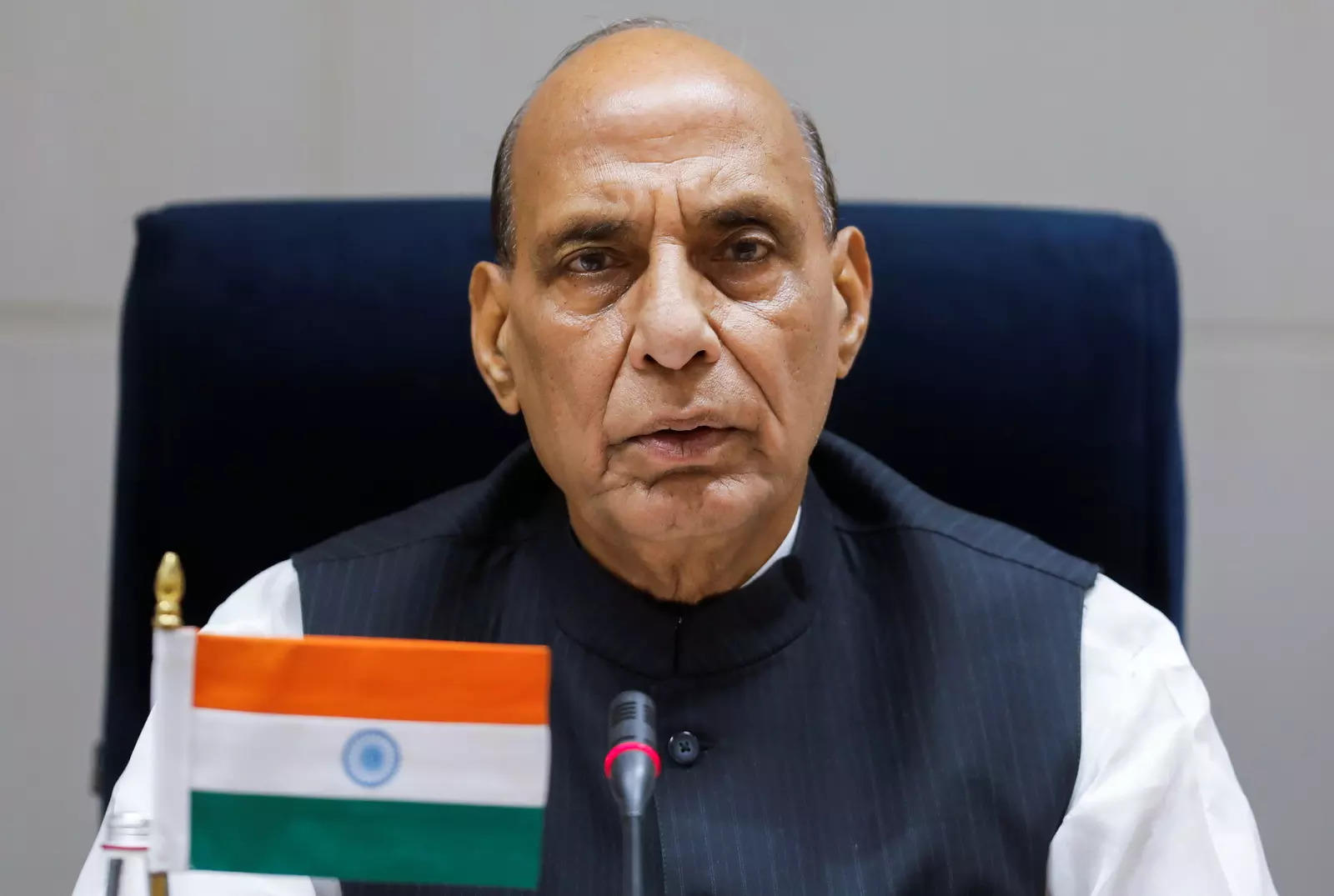
New Delhi, Apr 23 (UNI) Defence Minister Rajnath Singh has invited the German industry to co-develop and co-produce with India, particularly in the field of niche technologies, as he underscored the need to forge partnerships based on reliability and shared interests, terming them as indispensable in the current shifts in geopolitical alignments, disruptions in supply chains, rapid technological transformations, and increasing global uncertainties.
Singh was addressing Indian and German defence industry leaders during the Defence Investor Summit in Munich on the final day of his maiden visit to the European nation today.
He asserted that nations and industries are re-evaluating their dependencies, diversifying their supply chains, and seeking reliable partners who ensure resilience, continuity and mutual trust. He stated that India, in this scenario, offers an expanding market, young and skilled workforce, and a rapidly evolving industrial ecosystem, coupled with stability, predictability, and a commitment to the rule of law. These are the critical factors for long-term investment decisions in an uncertain world, he said.
Referring to the significant untapped potential under the ReArm Europe and Aatmanirbhar Bharat initiatives, the Defence minister reiterated that Indian companies are keen to engage with German companies for co-development and co-production in areas including advanced radar and sensor technology, multi-sensors, AI-enabled Unmanned Aerial Systems, Sonobouys and High-Power Low Frequency Underwater Transmitters.
Singh described India’s pursuit of self-reliance as not inward-looking, but about opening new pathways of partnership. “We see self-reliance as the ability to design, develop, and produce in India, in collaboration with trusted partners. We are moving towards a model where India is not merely a buyer of defence equipment, but a partner in design, development, and production. This shift creates new opportunities for global industry. In today’s interconnected and interdependent world, partnerships are not optional, they are essential. Our engagement with Germany is rooted in mutual respect and shared interests. It is a partnership that offers mutual benefit, shared growth, and long-term value creation,” he said.
The Defence minister pointed out that India recognises the significant role of the defence sector in the journey towards becoming a developed nation, and has placed it at the heart of its industrial and technological strategy.
“Defence industrial ecosystem encourages collaboration among industry, academia, and research institutions. This leads to the creation of start-ups, the development of niche technologies, and the strengthening of supply chains. In this sense, a strong defence industrial base contributes not only to national security but also to economic resilience and global competitiveness. We aspire to build a strong, modern, and a self-reliant defence industrial base. It is essential for strategic autonomy, and economic future,” he said.
On India’s defence industrial sector, Singh said, “As a market, India’s defence requirements are substantial and will continue to grow in the coming decades. As a manufacturing base, we offer cost-effective production, a skilled workforce, and access to a large ecosystem of suppliers. As a hub for innovation, our start-up ecosystem, engineering talent, and digital capabilities create fertile ground for co-development of new technologies. Our start-up ecosystem is among the largest in the world, with vibrant centres in cities like Bengaluru, Hyderabad, and Pune. Initiatives such as Start-Up India, Digital India, and Skill India have created an enabling environment for innovation and entrepreneurship. As a partner in global supply chains, collaboration with India can help diversify risks and build resilience. This is not a short-term opportunity. It is a long-term strategic proposition.