“The 77th Republic Day marks a new phase for Jammu and Kashmir, as the Union Territory moves from recovery to sustained growth and stability. He said J&K recorded around 11 percent economic growth despite challenges, with GSDP estimated at ₹2.62 lakh crore, while tourism remained resilient with 1.61 crore visits. He added that youth empowerment, transparent governance, and accelerated infrastructure development are driving inclusive progress.”
Mohammad Irfan
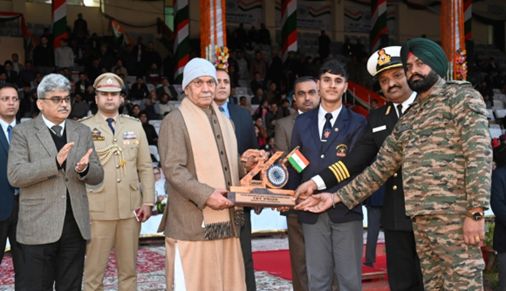
As the Tricolour unfurled against the winter sky at the historic MA Stadium, Jammu and Kashmir’s 77th Republic Day celebrations symbolised far more than a ceremonial reaffirmation of constitutional values. They marked a decisive moment in the Union Territory’s evolving journey—one defined by strengthened national security, accelerated economic growth, institutional reforms, and an expanding promise of inclusive development. Lieutenant Governor Manoj Sinha unfurled the National Flag at the UT-level Republic Day function and took the salute after inspecting the parade contingents, setting the tone for a celebration that blended solemn remembrance, administrative resolve, and forward-looking optimism.
A Ceremony Rooted In Discipline, Diversity: The Republic Day parade at MA Stadium presented a disciplined and meticulously coordinated march-past featuring contingents from the Army, Border Security Force (BSF), Central Reserve Police Force (CRPF), Sashastra Seema Bal (SSB), Jammu and Kashmir Police, India Reserve Police (Men and Women), Jammu and Kashmir Armed Police (JKAP), UT Disaster Response Force, Fire and Emergency Services, Forest Protection Force, Excise and Taxation Department, Ex-Servicemen, National Cadet Corps (Boys and Girls), Bharat Scouts and Guides, and school contingents. The presence of both uniformed services and youth groups highlighted a crucial narrative: Jammu and Kashmir’s security architecture and civic society are not parallel structures but interlinked pillars of stability. Brass and Pipe Bands from the Army, BSF, and J&K Police, along with school band troops, added musical grandeur to the display. The crowd responded enthusiastically to the motorcycle acrobatics performed by the Jammu and Kashmir Police Dare-Devils. This event has become both a crowd favourite and a symbol of professional skill, confidence, and courage.
Cultural Expression The Mirror Of Identity: The Republic Day celebrations also served as a vibrant platform to showcase Jammu and Kashmir’s cultural richness. Cultural pageantry featuring folk dances, regional music, and traditional costumes represented the UT’s pluralistic identity and civilisational continuity. Tableaux presented during the parade encapsulated the administration’s development priorities and social messaging. Themes such as Operation Sindoor, Mission YUVA, Nasha Mukt J&K, Road Safety, Shram ko Samman, Saral Kar, Sashakt Bharat, and Food Safety illustrated how governance in the UT has increasingly focused on linking security, social discipline, economic opportunity, and public awareness. These visual narratives were not merely symbolic; they reflected a governance model attempting to communicate policy goals directly to the people through public engagement.
Paying Tribute To Sacrifice : Earlier in the day, Lieutenant Governor Manoj Sinha visited the Police Martyrs Memorial and Balidan Stambh, where he laid wreaths and paid homage to personnel of the Police, Army, and Central Armed Police Forces who laid down their lives in the service of the nation. This act of remembrance carried special significance in Jammu and Kashmir, a region that has borne the brunt of terrorism for decades. The tribute reinforced the administration’s stated position that peace, development, and democratic stability are inseparable from the sacrifices of the security forces.
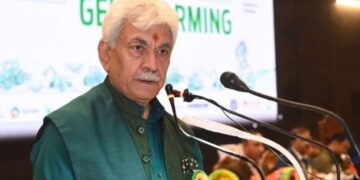
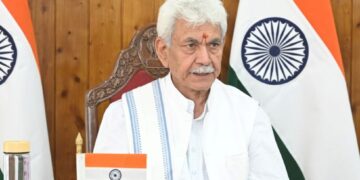
Republic Day Address | A Statement Of Transition: In his address, the Lieutenant Governor described the 77th Republic Day as a moment of transition—from recovery to resurgence, from vulnerability to resolve. He asserted that Jammu and Kashmir had entered a “new era of growth and national confidence,” underpinned by an 11 percent economic growth rate and a strengthened security posture. The address positioned 2025 as a defining year—one that tested the UT through security challenges and natural adversities, but ultimately reinforced institutional capacity and administrative clarity.
Security Doctrine|The Impact Of Op Sindoor: A central theme of the address was the evolving security doctrine following the Pahalgam terrorist attack in April 2025. The Lieutenant Governor highlighted Operation Sindoor as a watershed moment in India’s strategic response. Described not merely as a military operation but as a doctrine of deterrence, Operation Sindoor sent a clear message that any attack on Indian soil would be treated as an act of war. Complementing this kinetic response, the administration underscored the termination of the Indus Water Treaty as a non-kinetic signal that violence and cooperation cannot coexist. The successful execution of Operation Mahadev, which neutralised the perpetrators of the Pahalgam attack, was cited as evidence of intelligence-led precision and accountability. Together, these actions marked a shift from reactive security measures to proactive deterrence, reinforcing the UT’s position within the national security framework.
“The response to the Pahalgam terror attack reflected a new security doctrine. He described Operation Sindoor as a firm message that attacks on Indian soil will not be tolerated, adding that decisive action against terrorism, along with measures to curb social evils like drug abuse, is essential for lasting peace and development in Jammu and Kashmir.”
Economic Resurgence Amid Challenges: Despite the turbulence of the previous year, Jammu and Kashmir’s economy demonstrated resilience and recovery. The Gross State Domestic Product (GSDP) is estimated to reach ₹2,62,458 crore in 2024–25, reflecting sustained momentum across multiple sectors. Tourism, often the first sector impacted by security concerns, showed remarkable resilience. Although visitor numbers dipped temporarily after April 2025, the UT recorded 1.61 crore tourist visits up to November 2025. The administration announced that nine international-standard tourist destinations are under development, signalling long-term confidence in the sector. Industrial growth also continued steadily. Since 2020, over 2,200 industrial units have commenced production, and investments worth ₹27,613 crore are currently at the groundwork stage. This reflects the impact of policy stability, improved infrastructure, and streamlined approvals.
Mission YUVA| Investing In Youth Aspirations: Youth empowerment emerged as a cornerstone of the UT’s socio-economic strategy. The Mission YUVA programme aims to establish 1.35 lakh entrepreneurial units, fostering self-employment and enterprise-driven growth. In its first year alone, over 1.51 lakh youth registered under the mission. The administration also emphasised merit-based recruitment, noting that 7,650 government appointments were completed in 2025, with nearly 24,000 more in the pipeline. This shift toward transparent, merit-driven employment was framed as a decisive break from past practices, restoring faith among young aspirants.
Infrastructure| Reconnecting A Region: Infrastructure development was presented as the backbone of economic integration. The long-cherished dream of full railway connectivity to Kashmir has now been realised, fundamentally altering mobility and logistics. An investment of ₹61,528 crore is powering the construction of national highways, including the Delhi–Amritsar–Katra Expressway, alongside strategic tunnels such as the Zojila Tunnel. These projects are expected to reduce travel time, improve supply chains, and enhance all-weather connectivity. In the power sector, four major hydropower projects—including Pakal Dul and Kiru—are under rapid execution, adding over 3,000 MW to the grid. Rural connectivity has also expanded, with 2,400 habitations being linked under PMGSY-IV.
Social Justice, Inclusive Governance: The address underscored a governance philosophy centred on inclusion and equity. Tribal communities have been mainstreamed through institutional measures such as the Tribal Research Institute in Srinagar and the observance of Janjatiya Gaurav Divas. For Kashmiri migrants, the resettlement process continues, with over 3,700 flats completed for migrant employees and thousands already allotted. In agriculture, initiatives like the “Yellow Revolution” have doubled oilseed production, while GI tags for products such as Mushkbudji rice and Bhaderwah Rajma are strengthening farmers’ global identity.
Women-Led Development, Rural Transformation: Women’s empowerment featured prominently in the address. Under the Rural Livelihood Mission, nearly 8 lakh women are now part of over 94,000 Self Help Groups. The UT has already created 2 lakh Lakhpati Didis, achieving 86 percent of the target, with 50 women emerging as “Millionaire Didis.” Advanced training was provided to 5,000 women entrepreneurs, and 3,000 micro-startups were supported during the year.
Digital Governance, Financial Transparency: Jammu and Kashmir’s digital transformation has accelerated rapidly. Over 1,500 public services are now available online, and citizens conducted 82 crore e-transactions in the past year. With 100 percent Aadhaar seeding, ₹9,000 crore was transferred directly to 80 lakh beneficiaries through DBT. An auto-appeal system now ensures the timely delivery of 391 services, while 128 services are integrated with DigiLocker. A comprehensive AI strategy has also been introduced, targeting efficiency in healthcare, agriculture, and law enforcement.
Strengthening Financial Institutions: Financial indicators reflect improving fiscal health. GST collections rose to ₹8,586 crore, power tariff revenue increased by 16 percent, and Jammu and Kashmir Bank recorded a significant turnaround. Between March 2019 and September 2025, Net NPAs fell from 4.89 percent to 0.85 percent, while capital adequacy improved to 14.99 percent—signalling restored institutional credibility. Looking ahead, the Republic Day message outlined a clear roadmap for Jammu and Kashmir, one anchored in sustained security vigilance, accelerated economic growth, and deeper social inclusion. With a firm security doctrine in place, the focus now shifts to converting stability into lasting prosperity through youth-led entrepreneurship, women-driven livelihoods, and infrastructure that connects the remotest regions to national markets. Continued emphasis on transparent governance, digital delivery of services, and merit-based opportunities is expected to strengthen public trust, while targeted action against drug abuse and the terror ecosystem remains crucial for preserving social discipline.
Kashmir Horizon View: Concluding the address, the Lieutenant Governor called for collective action against drug abuse and the terror ecosystem, stressing that development cannot thrive without social discipline and unity.
Beating Retreat|A Fitting Finale: The four-day celebrations culminated on January 29 with the traditional Beating Retreat Ceremony at MA Stadium. Lieutenant Governor Manoj Sinha graced the occasion as Chief Guest. Brass and Pipe Bands of the Armed Forces and J&K Police captivated the audience with patriotic compositions, including the soul-stirring “Ae Mere Watan Ke Logon.” Outstanding performers, parade contingents, cultural troupes, daredevils, and tableaux were felicitated. The ceremony concluded with “Saare Jahan Se Achha,” accompanied by a spectacular sound-and-light display and fireworks, followed by the National Anthem—bringing the Republic Day celebrations to a solemn and inspiring close. As Jammu and Kashmir commemorated the 77th Republic Day, the celebrations reflected a region redefining itself—not by rhetoric alone, but through measurable progress, institutional reform, and renewed confidence in the future. The message was unambiguous: a fearless, developed, and inclusive Jammu and Kashmir is no longer an aspiration—it is a work in progress, unfolding with resolve.
(“Team Kashmir Horizon” is committed to continuous improvement and invites feedback and suggestions from readers and its followers on social media sites. Reader insights are considered vital for enhancing content quality and empowering the community. The team encourages open communication and values the thoughts and ideas of its audience, believing that such input will enable them to serve the public more effectively. The initiative aims to ensure that readers have the best possible experience with “Kashmir Horizon”. Interested individuals can reach out to us via email at [email protected].)