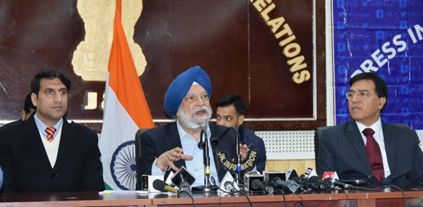
Hardeep S Puri
As 2025 draws to a close, the loud headlines are easy to spot, but what is easier to miss is the quieter work of governance, the steady, week after week clearing of bottlenecks – the cumulative push is what I mean by Reform Express 2025. India crossed about USD 4.1 trillion in nominal GDP and overtook Japan as the world’s 4thlargest economy. Standard and Poor’s upgraded India’s sovereign rating to BBB after 18 years, signalling that the macro story has acquired durability, not just speed. In an uncertain world where political churn has become the norm, India’sstable leadership makes reforms credible, and credible reforms convert private caution into private investment. I have seen, across negotiating tables from the GATT and WTO system to multilateral forums, that rules are only as good as the incentives they create. When procedures are opaque, discretion expands, and then even well-intentioned policy ends up discouraging enterprise. When procedures are clean and time bound, competition thrives, investment plans get executed, and jobs follow. India’s total exports hit USD 825.25 billion during the 2024-25, representing an annual growth of over 6%. To support this volume of trade, the government introduced several digital tools such as The Trade Connect ePlatform, a single digital window for exporters, and the Trade Intelligence and Analytics (TIA) portal for providing real-time market data.
The India UK Comprehensive Economic and Trade Agreement signed in July 2025 created a stronger platform for Indian exporters, with wide duty-free access and clearer pathways for services and skilled mobility. In December 2025, India signed a Comprehensive Economic Partnership Agreement with Oman, strengthening a strategic economic corridor for goods, services, and investment. India also concluded negotiations for a free trade agreement with New Zealand, expanding India’s reach into high value markets and setting a template for disciplined, commercially meaningful agreements. India’s startup sector expanded to include over 2 lakh government-recognized startups, which helped create more than 21 lakh jobs.The Open Network for Digital Commerce (ONDC) processed over 326 million orders, averaging more than 5.9 lakh daily transactions. Additionally, the Government e-Marketplace (GeM) saw its cumulative transaction value cross Rs 16.41 lakh crore, with 11 lakh micro and small enterprises receiving orders worth over Rs 7.35 lakh crore. India also improved its position in the Global Innovation Index, rising to 38th place among 139 economies. Efforts to simplify business operations resulted in the reduction of over 47,000 compliances and the decriminalisation of 4,458 legal provisions. By late November, the National Single Window System processed more than 8.29 lakh approvals. Infrastructure planning also saw changes as the PM GatiShakti National Master Plan opened to the private sector, and Project Monitoring Group portal has onboarded over 3,000 projects valued at more than Rs 76 lakh crore. Embracingtrust-based governance, the Parliament passed the Repealing and Amending Bill 2025, clearing out 71 obsolete Acts that had outlived their purpose. Ease of doing business also moved closer to the entrepreneur through district level reform frameworks, including the District Business Reform Action Plan 2025, which seeks to make local administrations more responsive, predictable, and accountable. A modern labour regime matters for scale, for manufacturing, and for a services economy that wants to formalise jobs while expanding social security coverage. With the 4 labour codes coming into effect from 21 November 2025, 29 central labour laws have been consolidated into a simpler framework covering wages, industrial relations, social security, and workplace safety. The Securities Markets Code Bill was introduced to modernise securities law and strengthen SEBI’s investigative and enforcement capacity, with proposals for specialised market courts, stronger information sharing with regulators, and time bound grievance redressal.
“In 2025, Prime Minister Narendra Modi introduced the “Reform Express” as a comprehensive national mission aimed at transitioning India from a control-based economy to a facilitation-based one. The strategy focuses on de-risking investments and modernizing governance to ensure long-term, double-digit productivity growth.”
At a moment when retail participation has expanded and India is drawing larger global portfolio interest, regulatory clarity becomes part of national competitiveness, helping savings flow into productive investment. Logistics is where reform becomes visible in costs, and 2025 saw a push to modernise the maritime backbone of trade. Nearly 95% of India’s trade by volume and about 70% by value moves through maritime routes, so port and shipping efficiency is a competitiveness issue. The Indian Ports Act 2025 replaced a colonial era framework and introduced modern governance tools, including state level dispute resolution, a statutory coordination council, and stronger norms on safety, disaster readiness, and environmental preparedness. The Merchant Shipping Act 2025 and the Carriage of Goods by Sea Act 2025 further modernised shipping law, updating rules, liabilities, and dispute frameworks to reflect contemporary commerce. The Cabinet approved a package of ₹69,725 crore to strengthen shipbuilding, including a Maritime Development Fund of ₹25,000 crore and components for financial assistance and development, points to a larger ambition: build industrial depth, reduce dependence, and keep freight value within India over time. This is industrial policy in the classic sense, creating an ecosystem where private capital can enter with a clearer risk framework, and where jobs are created not only in ports but across shipyards, components, engineering, and services.
Energy reforms, too, were designed for long cycle investment. The Oilfields amendment and the new Petroleum and Natural Gas Rules 2025 sought to reduce investor risk by emphasising stability of terms during the life of a lease, moving toward a single petroleum lease across the project life cycle, and putting clearer timelines on approvals. The Open Acreage Licensing Policy continued widening the exploration map, with Round X offering 25 blocks across about 0.2 million square kilometres, predominantly offshore, including deepwater and ultra deepwater opportunities. Alongside this, the National Deep Water Exploration Mission signalled a strategic focus on domestic resources, technology, and capability in complex exploration. Reform Express 2025 also carried a strategic energy and technology dimension. Budget 2025 set out a Nuclear Energy Mission with an outlay of ₹20,000 crore to accelerate small modular reactors and other advanced designs, aligned with the national objective of reaching 100 GW of nuclear capacity by 2047, and a target of 5 indigenously designed operational small modular reactors by 2033. The SHANTI bill is a huge leap for modernising India’s civil nuclear framework and opening a pathway for carefully regulated private participation. Nuclear energy adds firm, low carbon power to the grid, and strengthens India’s ability to build advanced manufacturing, data infrastructure, and energy intensive industry with greater confidence. Put together, these reforms show a pattern: clean up the statute book, decriminalise the trivial, modernise labour compliance, strengthen market governance, digitise trade processes, fix logistics, and de risk long cycle energy investment. Prime Minister Narendra Modi has consistently argued that the state’s job is to reduce the burden on entrepreneurs so that productivity can compound. That is the strategic meaning of Reform Express 2025. The seeds of the next phase of double-digit growth are sown in this quiet, cumulative work, and India is doing it with a steadiness that many economies have lost.
(The author is Union Minister for Petroleum & Natural Gas, Govt of India. Press Information Bureau-PIB Srinagar has mailed this article to “ Kashmir Horizon” for publication in this newspaper. The views, opinions and conclusions expressed in this article are those of the author and aren’t necessarily in accord with the views of “Kashmir Horizon”)