

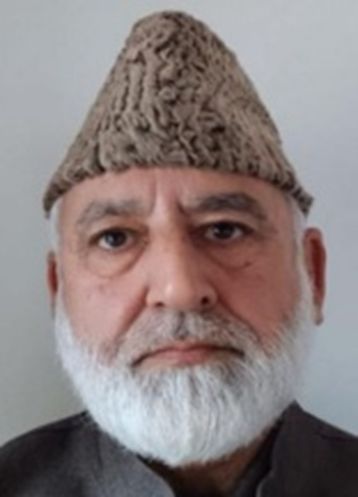
S G M Anrabi
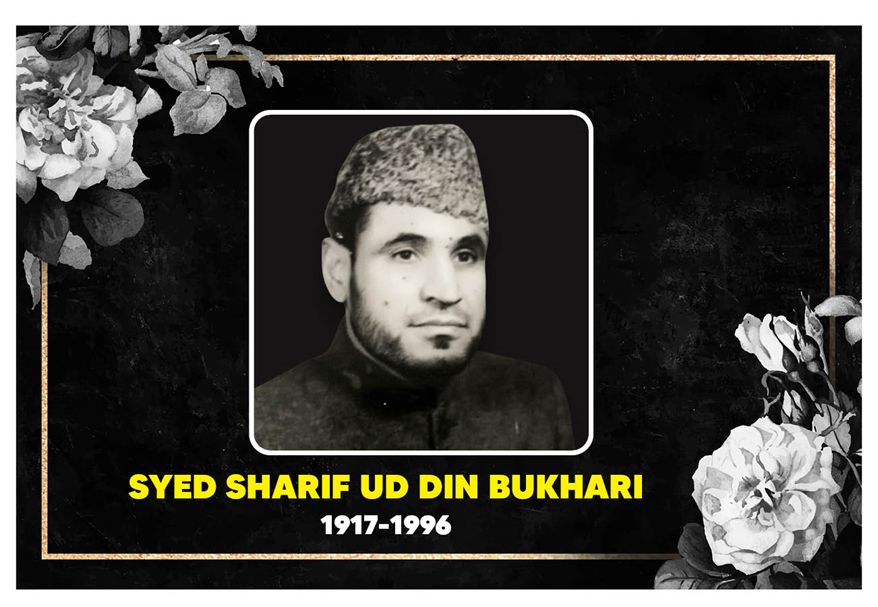
As we mark the 29th anniversary of his passing on 13 December 1996, it is fitting to recall the remarkable life and service of Syed Sharif Uddin Bukhari of Kreeri, a man whose contributions to education, social reform, and institution-building left a lasting imprint on North Kashmir. Born in November 1917, Mr Bukhari belonged to the revered lineage of Hazrat Syed Haji Murad Bukhari (RA). He was the eldest of three brothers and was adopted by his uncle, Moulana Syed Attaullah Bukhari, a respected spiritual figure whose home at Wazir Bagh, Srinagar, was a vibrant centre of social, political, and spiritual activity from 1915 onwards. Dignitaries from the court of Maharaja Hari Singh, including Revenue Minister Thakur Janak Singh, routinely visited for guidance and healing. Growing up in this environment deeply shaped Mr Bukhari’s personality, intellect, and commitment to public service.
He completed his Matriculation from SP High School Srinagar (1937), FA from Punjab University Lahore, and a degree in Urdu and Persian (Munshi Fazil) from Aligarh. These were politically charged decades in Kashmir, with leaders of both the Indian National Congress and All-India Muslim League frequently visiting Srinagar. As a young man in his twenties, he was deeply aware of the socio-economic struggles of the people. Amid the political rift between the National Conference and Muslim Conference in the early 1940s, Mr Bukhari sought employment and joined the government service as a teacher in Muzaffarabad in 1944. A severe malaria attack forced him to return to Srinagar in 1946. During the upheaval of 1947, he assisted his great uncle in helping distressed families and played a key role in protecting Sikh families of Dardpora, Kreeri, many of whom were sheltered in Muslim homes.
“Sharief Sahb Bukhari of Kreeri a great reformist of his youthful times was on 13th December 1996 laid to rest near Ziarat Sharif Kreeri. He was highly regarded for his exceptional command of English, service rules, Persian/Urdu literature and poetry (including Rumi, Jami, Khusrau, and Iqbal), and his ability to dictate with precision. He also had a spiritual allegiance with Hazrat Jamat Ali Shah Sahb of Alipore Punjab. His significant societal contributions and impact on institutions and families warrant formal documentation.”
After resuming service in Srinagar, he later joined the Health Department, where his command over drafting, rules, and procedures earned him immense respect. Directors and senior officers relied on his expertise for planning, recruitment, and modernization of health services. His efforts opened avenues for scores of young men from Kreeri to secure jobs in health and education, a development that transformed the socioeconomic landscape of the region. Mr Bukhari played a pivotal role in upgrading Government High School Kreeri in 1959, one of only five such schools in North Kashmir, turning it into an educational beacon for Bangil and Khuhin Parganas. He was instrumental in establishing the Primary Health Centre Kreeri (1969) and facilitating the opening of a J&K Bank branch (1976–77) through his personal rapport with senior bank officials.
His institutional contributions were equally significant. In 1960, he helped formalize the management of Ziarat Sharif Kreeri by forming a committee of six stakeholders and introducing a secure, six-key safe system for donations—an arrangement that brought financial discipline and transparency. When the shrine came under the management of the J&K Muslim Auqaf Trust in 1976, Mr Bukhari became an active member of its Executive Committee. Recognizing his administrative acumen, Sheikh Mohammad Abdullah appointed him Controller of Auqaf at the shrine of Baba Payam-ud-Din Reshi (RA) in 1978, where he earned wide appreciation for improving facilities, revenue systems, and services for devotees. After 1984, he devoted himself to the religious and social affairs of Kreeri. The death of his wife in 1987 deeply affected him, turning him increasingly towards prayer, study, and solitude. His health declined in the early 1990s, leading to a quiet final phase of life until his passing on 13 December 1996. Mr Bukhari was laid to rest in his ancestral graveyard near Ziarat Sharif Kreeri . Known widely as Sharief Sahb Bukhari of Kreeri, he possessed exceptional command over English, service rules, Persian literature, Persian and Urdu poetry, and Iqbal’s Kalam. He could dictate pages with coherence and precision, and quote Rumi, Jami, Khusrau, and Iqbal with effortless ease. He was known for also having spiritual allegiance with Hazrat Jamat Ali Shah Sahb of Alipore Punjab. His contributions to society deserve formal documentation, for his life shaped not only institutions but the destinies of hundreds of families.
(The author is a retired senior officer of Jammu & Kashmir Police Service. The views, opinions and conclusions expressed in this article are those of the author and aren’t necessarily in accord with the views of “Kashmir Horizon”)





