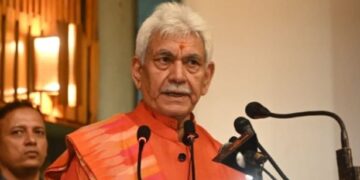
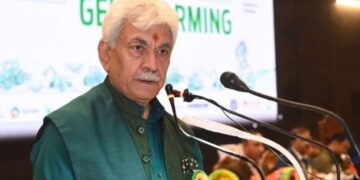
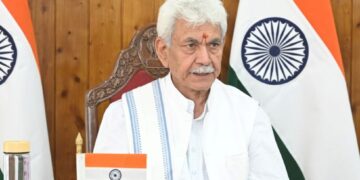
“LG Manoj Sinha joined the Sardar@150 Unity March at Vadodara, highlighting Sardar Patel’s role in uniting India and promoting equality, social justice, and decisive leadership. He praised PM Modi’s initiatives like One Nation, One Tax and One Nation, One Ration Card for strengthening national unity.”
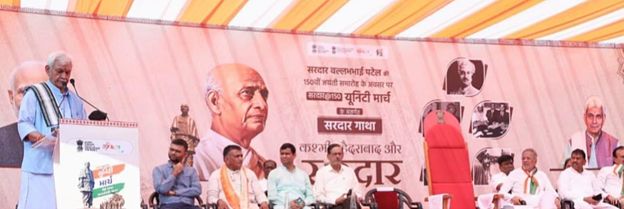
This week Lieutenant Governor Manoj Sinha participated in the “Sardar@150 Unity March (Padyatra)” at Vadodara, Gujarat, a nationwide initiative commemorating the 150th birth anniversary of Sardar Vallabhbhai Patel. Speaking on the theme “Kashmir, Hyderabad and Sardar”, LG Sinha highlighted the towering role of Sardar Patel in the integration of princely states, particularly Hyderabad, and emphasized how Patel’s foresight and decisiveness could have shaped the history of Jammu and Kashmir differently in 1947. The National Padyatra, which began at Sardar Patel’s family home in Karamsad, will cover nearly 190 kilometers over 11 days, culminating at the iconic Statue of Unity on December 6, 2025. The event has been designed to showcase Sardar Patel’s enduring legacy, reaffirm the ideals of unity and social justice, and instill the values of integrity and nation-building among India’s youth.
Sardar Patel |Architect Of A Unified India: In his keynote address, LG Sinha elaborated on Sardar Patel’s contribution as a firm and decisive architect of modern India. “History of Jammu and Kashmir would have been different if Sardar Patel had been given full responsibility for its integration in 1947,” the Lieutenant Governor asserted, underlining the missed opportunities in handling Jammu and Kashmir’s accession post-independence. Despite not directly managing Kashmir’s integration, Sardar Patel’s vision ensured that the region remained an integral part of India. LG Sinha noted, “From the very beginning, Sardar Patel had stated that we would not give even an inch of Jammu and Kashmir to Pakistan.” He highlighted that Patel opposed then-Prime Minister Jawaharlal Nehru’s policy towards the state and objected to taking the matter to the United Nations, advocating instead for decisive national action. According to Sinha, Patel’s public pronouncements and firm stance symbolized his commitment to India’s unity and territorial integrity, demonstrating a brand of leadership rooted in courage, pragmatism, and national interest.
Lessons In Unity, Governance: LG Sinha’s address was not merely a historical recount but also an analytical exposition of Patel’s enduring influence on contemporary governance and national cohesion. He underscored that Sardar Patel’s ideals of unity, equality, and social justice continue to shape India’s growth trajectory, particularly in consolidating the diverse cultural, linguistic, and political landscape of the nation. Patel’s emphasis on decisiveness, integrity, and selfless service provides a blueprint for modern leadership, Sinha explained, asserting that these qualities are essential for sustaining India’s development in the 21st century. As an architect of a modern and self-reliant India, Sardar Patel symbolized the nation’s self-confidence, self-respect, and bravery, LG Sinha remarked. His ability to navigate complex political scenarios, manage princely states, and maintain the coherence of a newly independent country underscores a leadership style that blends vision with action a template that continues to inspire policymakers and citizens alike.
Kashmir & Hyderabad| Revisiting Historical Decisions: Addressing the historical dimension of his theme, LG Sinha reflected on Patel’s role in integrating Hyderabad into the Indian Union in 1948. By exercising political acumen combined with administrative resolve, Patel successfully negotiated Hyderabad’s accession, ensuring political stability, social cohesion, and national security. Sinha juxtaposed this success with the handling of Jammu and Kashmir, suggesting that Patel’s direct involvement could have led to a more decisive integration strategy in 1947. “Sardar Patel had opposed Nehru’s decision to take the Kashmir issue to the United Nations, advocating instead for national solutions,” Sinha noted. This observation sparked discussion among historians and political analysts about the nature of leadership and decision-making during India’s formative years. According to Sinha, Patel’s approach reflected a clear-eyed understanding of geopolitical realities, a pragmatic methodology that could have altered the trajectory of the nation’s territorial consolidation.
PM Modi’s Initiatives|Fulfilling Patel’s Vision: LG Sinha drew a clear line connecting Sardar Patel’s ideals with contemporary policy initiatives under Prime Minister Narendra Modi, asserting that the government’s focus on unity, national integration, and development reflects Patel’s enduring legacy. Highlighting key programs, Sinha listed:
- One Nation, One Tax
- One Nation, One Ration Card
- One Nation, One Health Card
- One Nation, One Grid
- National Education Policy
- PM Gati Shakti
- Kashi-Tamil Sangamam
According to Sinha, these initiatives have not only strengthened administrative cohesion but also reinforced India’s socio-economic unity, promoting seamless integration of diverse regions, communities, and institutions. The Lieutenant Governor argued that these policies reflect Patel’s philosophy that national integration must be both political and developmental, extending beyond mere territorial consolidation to encompass the welfare, equality, and opportunities for all citizens.
Youth As Custodians Of Unity: A central theme of LG Sinha’s address was the role of youth in sustaining national unity. He called upon young Indians to embrace the three pillars of unity—shared values, shared identity, and common purpose—as guiding principles for nation-building. “These pillars act as a unifying force, essential for sustained progress and development,” Sinha emphasized. He urged the youth to internalize Sardar Patel’s values of integrity, decisiveness, and selfless service and apply them in contemporary contexts—whether in governance, social reform, entrepreneurship, or public service. Sinha suggested that the youth must see themselves as active contributors to India’s unity, rather than passive inheritors, noting that the strength of a nation is measured not only by its institutions but also by the civic responsibility of its citizens.
Cultural, Civilisational Significance: The Sardar@150 Unity March itself symbolizes a larger cultural and civilisational narrative. Starting from Karamsad, Patel’s birthplace, and culminating at the Statue of Unity, the padyatra traverses historically significant locations, connecting communities and reinforcing shared heritage. LG Sinha observed that such initiatives not only commemorate historical figures but also serve as platforms for dialogue, reflection, and the reaffirmation of national ideals. Sinha also highlighted that Sardar Patel’s ethos of integration was not merely political but deeply civilisational, respecting the pluralism of Indian society while forging a unified national identity. This dual emphasis on cultural inclusivity and political cohesion, according to Sinha, remains critical in addressing contemporary challenges such as regional disparities, communal tensions, and the pressures of globalization.
Leadership, Decision-Making: Lessons From Patel : Throughout his speech, LG Sinha repeatedly underscored the importance of decisive and visionary leadership. Patel’s handling of the princely states exemplified firm yet balanced decision-making, combining negotiation, strategy, and moral authority. Sinha drew parallels to modern governance challenges, suggesting that India’s policymakers today can draw lessons from Patel’s approach in areas such as:
- Federal Integration And Centre-State Coordination
- Conflict Resolution , Crisis Management
- Policy planning with long-term national interest in mind
- Balancing Assertiveness With Diplomacy
These lessons, Sinha argued, are especially relevant in a rapidly changing global environment, where India must navigate economic, security, and social imperatives simultaneously.
Statue of Unity: Symbol of National Integration: The Statue of Unity, where the padyatra concludes, serves as both a physical and symbolic reminder of Sardar Patel’s vision. Standing as the world’s tallest statue, it represents India’s strength, unity, and determination to uphold its democratic and civilizational ideals. LG Sinha linked the statue to contemporary nation-building initiatives, arguing that commemorating historical icons is crucial not just for memory but also for inspiring future generations. The padyatra, in this sense, is more than a ceremonial march—it is a nationwide exercise in civic education, emphasizing Patel’s philosophy that political unification must go hand-in-hand with social and economic integration.
Constitutional Integration OF J&K | Reflecting on Alternative Histories: LG Sinha’s reflections on Jammu and Kashmir elicited broader debate about alternative historical trajectories. He emphasized that Patel’s direct involvement in 1947 might have ensured irreversible integration, potentially averting decades of conflict and international dispute. While acknowledging Nehru’s contrasting approach, Sinha maintained that Patel’s strategic decisiveness provides a benchmark for assessing crisis management and national security decision-making in India’s formative years. This historical analysis also underscores the continuing relevance of Patel’s principles in current national policies, particularly in the context of Article 370 abrogation and integration of Union Territories. According to Sinha, contemporary initiatives echo Patel’s philosophy: “One flag, one constitution, one nation”, ensuring cohesion, equality, and national integrity.
“Calling on youth to uphold shared values and common purpose, LG Sinha said Patel’s legacy inspires a strong, self-reliant India. The padyatra from Karamsad to the Statue of Unity symbolizes Patel’s vision and encourages citizens to contribute to nation-building.”
Linking Past With Present |Governance, Development, Unity: LG Sinha drew explicit connections between Patel’s vision and ongoing national programs under Prime Minister Modi. Initiatives such as PM Gati Shakti and National Education Policy exemplify a strategic vision where unity, infrastructure, and human development are intertwined. By presenting a unified framework for governance, these initiatives aim to strengthen social cohesion, boost economic productivity, and ensure equitable development, mirroring Patel’s ideals of inclusive nation-building. Similarly, digital governance initiatives like One Nation, One Ration Card and One Nation, One Health Card demonstrate the contemporary application of centralized efficiency with decentralized accessibility, a principle that Patel himself championed in integrating India’s diverse regions and communities.
Call To Action|Building A Self-Reliant India: In conclusion, LG Sinha’s keynote was both a celebration of historical legacy and a clarion call for civic engagement. He urged citizens, particularly youth, to internalize Sardar Patel’s values, embrace shared identity and purpose, and actively participate in nation-building efforts. Patel’s ideals of self-reliance, decisiveness, and service to the nation were presented as guiding principles for India’s trajectory toward becoming a strong, developed, and inclusive country. The padyatra, culminating at the Statue of Unity, serves as a platform to educate, motivate, and unite citizens around shared values, reminding the nation that political unification, social justice, and developmental progress are inseparable pillars of a resilient India.
Kashmir Horizon View: Looking ahead, India’s leadership and youth are tasked with translating Patel’s legacy into practical outcomes. Strengthening governance, expanding infrastructure, promoting equitable social programs, and fostering national cohesion remain key priorities. The integration of technology and human resources, guided by shared values and common purpose, will ensure that India not only honors its past but also builds a future-ready nation. The Sardar@150 Unity March reaffirmed that Sardar Patel’s vision of unity, equality, and decisiveness remains relevant for contemporary India. As LG Sinha emphasized, connecting historical lessons with modern governance initiatives strengthens both the nation’s identity and its global standing. By inspiring youth and consolidating social, political, and economic cohesion, Patel’s legacy continues to serve as a guiding beacon for a united, self-reliant, and developed India. The march, policies, and public engagement collectively underscore the enduring power of leadership rooted in integrity, vision, and service.
(“Team Kashmir Horizon” is committed to continuous improvement and invites feedback and suggestions from readers and its followers on social media sites. Reader insights are considered vital for enhancing content quality and empowering the community. The team encourages open communication and values the thoughts and ideas of its audience, believing that such input will enable them to serve the public more effectively. The initiative aims to ensure that readers have the best possible experience with “Kashmir Horizon”. Interested individuals can reach out to us via email at [email protected].)