“In Rajouri, 19 NoKs of terror-affected families have been provided government jobs, while Poonch has seen 9 similar appointments so far. The initiative reflects a sustained effort by the administration to support families who have endured years of conflict and loss. LG directive to identify any remaining eligible families underscores a commitment to inclusivity, ensuring that no victim is left out of the welfare process.”
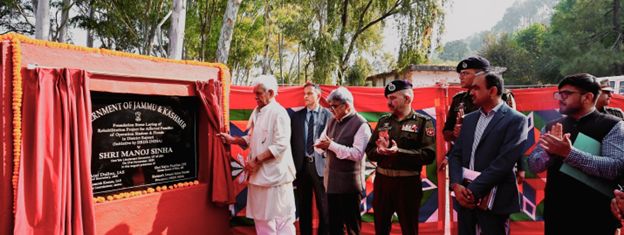
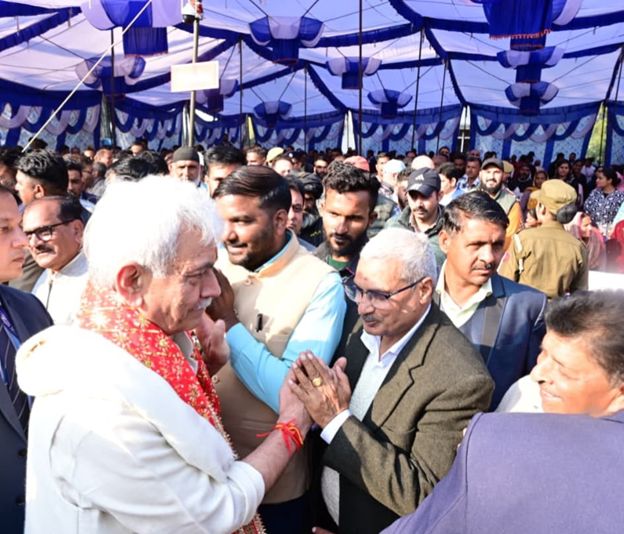
This week, Poonch and Rajouri—two frontier districts that have borne the brunt of natural calamities and unprovoked Pakistani shelling for decades—witnessed a significant turning point as Lieutenant Governor Manoj Sinha laid the foundation stone for new homes meant to rehabilitate families devastated during recent flash floods and cross-border firing incidents under Operation Sindoor. The ceremony, held across both districts, was not merely a formality; it was a moment symbolising the transition from despair to hope, from destruction to reconstruction, and from fear to stability. In a region where families have often lived under the shadow of sudden loss—of homes, livelihoods, and lives—the initiation of this large-scale housing project marked a rare and concrete assurance of safety and renewal. The foundation stone laid by the Lieutenant Governor sets in motion the construction of 133 new houses in Poonch and 388 houses in Rajouri, all entirely free of cost. These homes—built with the support of the High Range Rural Development Society (HRDS India)—signal a decisive governmental push to provide immediate and tangible relief to families whose houses had been destroyed by natural disasters and persistent shelling. The magnitude of the tragedy became evident in the sheer number of completely damaged structures, and the government’s intervention now attempts to compensate for years of loss and vulnerability.
HRDS India Steps In For A Humanitarian Partnership Backed By Action: One of the most defining features of the project is the involvement of HRDS India, an organisation known for disaster rehabilitation, rural transformation, and tribal empowerment. Their commitment to constructing more than 500 new prefabricated smart homes in these border districts marks one of their largest interventions in Jammu and Kashmir. The partnership goes beyond reconstruction—it extends to maintenance, social dignity, and long-term sustainability. HRDS India has pledged to maintain the newly constructed houses for five years, offering a sense of continuity and care that government-aided rehabilitation projects often lack. These houses will include modern design elements, three-bedroom layouts, dedicated cowsheds for agrarian families, and, in the second phase, solar panel installations to encourage energy independence. The cumulative cost of the houses being constructed in the first phase at Poonch and Rajouri is pegged at around Rs 51 crore, entirely borne by HRDS India. This infusion of external support, combined with the administrative backing of the Jammu and Kashmir Government, underscores a collaborative model that could potentially be replicated across other vulnerable border districts.
A Renewed Push Towards Comprehensive Rehabilitation: In his address, the Lieutenant Governor reiterated that the Government of India, led by Prime Minister Narendra Modi, is committed to ensuring complete rehabilitation of every affected family in Poonch and Rajouri. This includes not only compensation and homes but restoration of dignity, economic opportunity, and long-term settlement. The LG recalled earlier interventions—particularly ex-gratia relief and employment assistance provided to Next of Kin (NoKs) of civilians martyred during shelling, as well as those who lost their lives in flash floods. Across Poonch and Rajouri, the numbers reflect a wide-reaching support system. In Poonch alone, 13 NoKs were provided government jobs, while 14 NoKs received ex-gratia relief. Additionally, 160 owners of kachcha houses and 425 owners of pucca houses received financial support to rebuild their homes. Under Security Related Expenditure (SRE) and other central schemes, Poonch district alone received more than Rs 10 crore in relief for housing reconstruction. The breadth of the compensation underscores the scale of destruction these districts faced, and the state’s acknowledgment of their hardships. In Rajouri, families affected during Operation Sindoor received specific relief packages. One NoK of a civilian martyred was offered a government job, while 465 damaged houses received funds for reconstruction. The families whose houses were destroyed due to natural calamities also benefited from dedicated allocations, ensuring that the losses caused by unpredictable environmental disasters were not left unaddressed.
Ensuring No Family Is Left Behind: A recurring theme of the Lieutenant Governor’s speech was the assurance that every affected family—whether hurt by nature’s fury or Pakistan’s guns—would be rehabilitated. “Not a single family will be deprived of their rights and fundamental needs,” he declared, emphasising the government’s mission of inclusive welfare. The LG directed district administrations in both Rajouri and Poonch to carefully verify and include all genuine beneficiaries in the project. He highlighted that there is no cap on the number of houses to be built, signalling an open-ended commitment where welfare outweighs bureaucratic limits. This assurance comes at a time when trust between border residents and the state apparatus has historically fluctuated due to prolonged conflict, delayed relief processes, and structural neglect. The LG’s promise echoed a deliberate attempt to bridge that trust deficit. By prioritising economically weaker families—often the worst-hit in calamities—the project aims to present a realistic model of equitable rehabilitation, one where assistance is need-based rather than numerically confined.
Rebuilding Lives, Restoring Security|A New Blueprint For The Border: The initiative also reflects a broader national strategy to stabilise border regions that have endured the impact of terrorism, infiltration, and shelling for years. The Lieutenant Governor stressed that the most urgent requirement for the affected families is a safe roof—a permanent structure that can replace decades of temporary shelters, bunkers, and makeshift dwellings. The new houses, designed to be handed over within six months of construction commencement, will offer stability in regions where uncertainty has historically been part of everyday life. Beyond individual homes, the government has taken several security-centric steps to protect border communities. In Poonch, 1,125 bunkers have already been completed in recent years, while proposals for 5,693 additional bunkers await approval. Rajouri has seen 2,923 bunkers constructed in the last five years, offering immediate relief to residents living along the Line of Control. These bunkers—now a permanent symbol of life along the volatile border—will continue to play a critical role even as new houses bring stability to civilian populations.
Transformational Development|From Neglect to Governance: The Lieutenant Governor’s address also underscored a deep sentiment shared by many in Poonch and Rajouri—the feeling of decades-long neglect by successive governments. Residents of these districts have often complained about poor connectivity, bureaucratic indifference, weak infrastructure, and the absence of long-term developmental strategies. For years, the narrative of border areas revolved solely around conflict and security. Economic empowerment, education, healthcare, and infrastructure remained secondary. But according to the LG, the trajectory of the last few years has marked a dramatic shift. The pace and scale of development witnessed across Jammu and Kashmir—and especially in Poonch and Rajouri—has no precedent. Road infrastructure has improved, educational institutions have expanded, and border residents have been provided consistent relief during crises. New investment corridors, tourism circuits, and schemes for tribals and rural households have added a new dimension to development. The LG reiterated that this momentum will not be disrupted; instead, it will be intensified to ensure that border districts are no longer synonymous with backwardness or insecurity.
Administrative, Community Solidarity|A Unified Response To Crisis : The Lieutenant Governor expressed profound gratitude to the district administration, police forces, army units, Central Armed Police Forces (CAPFs), emergency responders, civil society, and volunteers who acted swiftly during recent calamities and shelling incidents. Their collective efforts played a crucial role in evacuating families, providing temporary shelter, delivering medical assistance, and preventing casualties during some of the most dangerous episodes. This administrative coordination often overlooked outside the region—is essential to disaster and conflict management. Rajouri and Poonch have witnessed a complex intersection of natural disasters, firing incidents, restricted mobility, and border tensions. That the administration managed to save lives and offer immediate relief during these crises underscores not only operational preparedness but also the emotional and psychological commitment of those working on the ground.
“The housing initiative in Poonch and Rajouri forms part of a larger 1,500-unit rehabilitation plan aimed at offering border residents safer, modern, and resilient homes. Utilizing prefabricated smart technology, the houses are designed for rapid construction, durability, and resistance to harsh weather conditions. This project represents one of the largest housing interventions in the area since Independence and reflects a long-term commitment to improving living conditions and fostering stability in conflict-affected districts.”
Identifying Terror Victim Families|Expanding The Welfare Net : Another significant directive from the Lieutenant Governor pertained to the identification of terror-affected families in both districts. While many families have already received government assistance, the LG urged the police and district administrations to identify any remaining NoKs or victims who might have been left out of benefits. This directive reflects the administration’s attempt to fill welfare gaps and ensure that families suffering from conflict-related tragedies receive not just relief but long-term state support. In Rajouri, 19 NoKs of terror-affected families have received government jobs, while in Poonch, 9 such appointments have been made so far. The LG’s push to identify any remaining victims highlights the principle of inclusivity and signals a renewed administrative commitment to healing conflict-affected societies through socioeconomic support.
A 1,500-House Vision|The First Phase of a Massive Rehabilitation Prog: The LG highlighted that the construction of houses in Poonch and Rajouri forms part of a broader vision—a 1,500-house project designed to offer border residents dignified living conditions. These houses will be built in multiple phases, with the first phase focusing on works already initiated. The project is among the largest housing interventions in the region since Independence and aims to offer long-term, conflict-resistant living solutions. With prefabricated smart housing technology, the government plans to deliver these structures faster, sturdier, and more efficiently than traditional methods would allow. The houses are engineered to withstand harsh weather conditions, reduce repair costs, and offer stability in sensitive zones. Their three-bedroom design ensures adequate space for large rural families, while the inclusion of cowsheds acknowledges the agricultural lifestyle dominant in these districts.
Kashmir Horizon View: As the foundation stones were laid, residents of Poonch and Rajouri witnessed more than a ceremony—they witnessed a renewal of the social contract between the state and its citizens. The project, rooted in compassion and long-term planning, is a reassurance to families who have endured the trauma of displacement, loss, and violence. Its implementation will test administrative efficiency, government-community trust, and the ability of authorities to deliver on ambitious promises. For decades, the people of these districts have lived with uncertainty—about the next shelling, the next storm, the next loss. With the launch of this reconstruction programme, the government seeks to replace that uncertainty with predictability, safety, and human dignity. The road ahead will require consistent monitoring, timely completion, expansion of welfare schemes, and constant engagement with border communities. If executed effectively, the project could become a model for rehabilitation in conflict-prone regions across India.
(“Team Kashmir Horizon” is committed to continuous improvement and invites feedback and suggestions from readers and its followers on social media sites. Reader insights are considered vital for enhancing content quality and empowering the community. The team encourages open communication and values the thoughts and ideas of its audience, believing that such input will enable them to serve the public more effectively. The initiative aims to ensure that readers have the best possible experience with “Kashmir Horizon”. Interested individuals can reach out to us via email at [email protected].)