By Mohammad Irfan
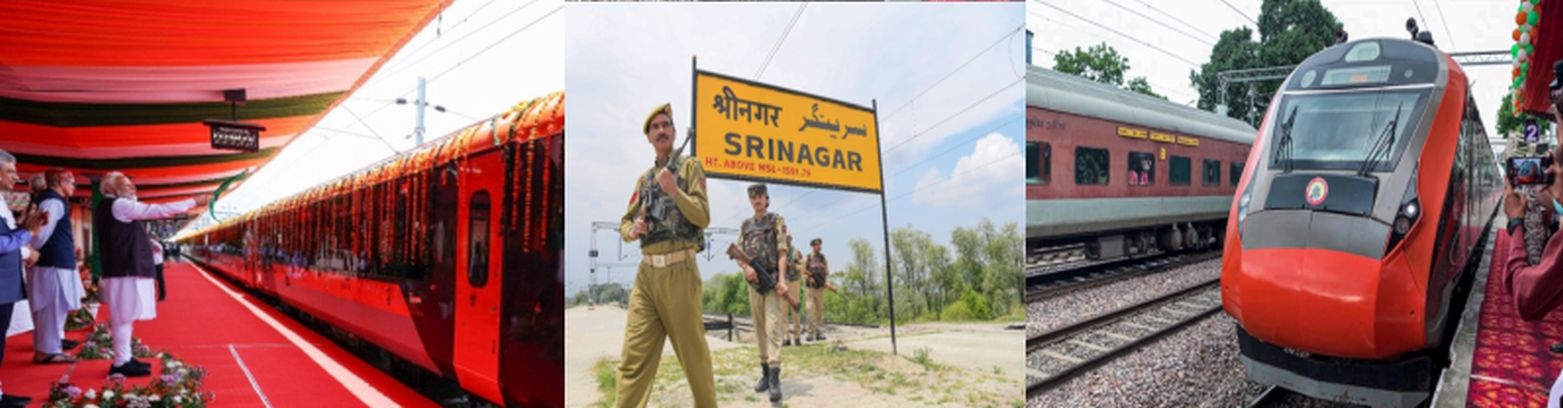
Srinagar: After successfully launching twin Vande Bharat Express trains on the Srinagar–Katra route — a move that marked the completion of the long-awaited Udhampur–Srinagar–Baramulla Rail Link (USBRL) in June — the Northern Railways is now preparing to take the next historic step: direct rail connectivity between the Kashmir Valley and the rest of India. Officials say the initiative, which follows decades of engineering challenges, security obstacles, and logistical hurdles, will complete what they describe as “a dream project to bring Kashmir on the railway map of India in the truest sense.”
Operational, Security Readiness Underway: Confirming the development, Senior Divisional Commercial Manager (DCM) of the Jammu Division, Uchit Singhal, said that groundwork is underway to address operational and security challenges that remain before long-distance passenger trains can run directly from Kashmir to major Indian cities such as Delhi and Mumbai. “The Katra–Srinagar Vande Bharat Express, inaugurated by Prime Minister Narendra Modi on June 6, marked a historic milestone as the first semi–high-speed rail service connecting Kashmir with Kanyakumari,” Singhal said. “The work is progressing smoothly to address the operational and security hassles so that we can soon provide direct train service between Kashmir and other parts of the country,” he added. Singhal was speaking to media after introducing a two-minute stoppage at Reasi station for both the Vande Bharat trains running between Katra and Srinagar on Wednesday morning. He described the inclusion of the stop as “a gesture towards improving accessibility and passenger convenience,” particularly in light of growing tourist and pilgrim traffic through the district.
Reasi Gets Its First Vande Bharat Stop : Starting the Srinagar–Katra Vande Bharat Express (Train Nos. 26401/26402) will stop at Reasi station for two minutes each way — a move hailed by residents, traders, and public representatives. According to the new schedule, Train No. 26401 will depart from Katra at 8:10 am, reach Reasi at 8:28 am, and continue towards Srinagar. In the return direction, Train No. 26402 will arrive at Reasi at 4:34 pm, before terminating at Katra. Singhal explained that the decision to introduce the Reasi stoppage was taken on an experimental basis for one month after approval from the Railway Board. “Reasi station is located at the district headquarters and holds great strategic and tourist importance. The continuation of the stoppage will depend on passenger response and commercial viability,” the DCM said. Earlier, the only stop on this high-speed corridor was at Banihal, a crucial trans-shipment point located at the mouth of the Banihal tunnel. The new addition marks a symbolic expansion of accessibility deeper into the Jammu hills.
Local Demand, Political Support: The decision came after persistent demand from locals and political representatives, including BJP MLA Kuldeep Raj Dubey of Reasi, who formally flagged off the inaugural stoppage at the station and then boarded the train to Srinagar. Expressing gratitude, Dubey said the new halt was “a long-pending demand of the people of Reasi,” and thanked Prime Minister Narendra Modi and Railway Minister Ashwini Vaishnaw for their intervention. “The Reasi stoppage will benefit thousands of passengers, pilgrims visiting Mata Vaishno Devi, and tourists heading toward Chenab Bridge and Anji Bridge. It is another milestone in J&K’s connectivity journey,” he said. BJP District President Rohit Dubey echoed the sentiment, expressing hope that the Railway Ministry would soon approve a special tourist train between Reasi and the iconic railway marvels — the world’s tallest railway bridge over the Chenab and India’s first cable-stayed railway bridge at Anji. “These structures are engineering landmarks. Connecting them through a dedicated tourist train could transform Reasi into a global destination and open employment avenues for the youth,” he added.
Kashmir’s Direct Link On The Horizon: The completion of the USBRL in June 2025 was one of the most celebrated infrastructure achievements in independent India, bringing an end to decades of geographical isolation for the Valley. The 272-km-long engineering marvel connected Baramulla in North Kashmir with Udhampur in Jammu region, passing through some of the world’s most challenging terrain and featuring 37 bridges and 20 tunnels — including the Chenab Bridge, which stands 359 metres above the riverbed. With the operational link now in place, the next phase focuses on direct long-distance connectivity — enabling trains such as Rajdhani, Humsafar, and express services to travel seamlessly between Srinagar and major Indian cities. “Our technical and safety teams are working to ensure that the alignment, signaling, and security systems meet national standards for long-distance operations,” Singhal said. “Once these are certified, Kashmir will finally have direct access to India’s mainstream rail grid — something unimaginable even a few years ago.”
Boost to Pilgrimage, Tourism: Officials believe that the direct connectivity and intermediate stoppages such as Reasi will significantly boost religious tourism and regional trade. Reasi district is home to the Mata Vaishno Devi shrine, one of the most visited pilgrimage sites in India, drawing more than 80 lakh devotees annually. The region also houses the Chenab Bridge — the tallest railway bridge in the world — and the newly commissioned Anji Bridge, India’s first cable-stayed rail bridge. “Adding Reasi as a stopover will strengthen regional connectivity, benefiting pilgrims and adventure tourists alike,” Singhal said. “It will also encourage local entrepreneurship in transport, hospitality, and handicrafts.”
Resilience Amid Weather Disruptions : The Northern Railways’ efforts to maintain seamless travel have been tested repeatedly by extreme weather and landslide disruptions in the Jammu–Banihal corridor. During the August–September rainfall, when portions of the Jammu–Srinagar National Highway were blocked, the Railways operated special trains between Katra and Banihal for one month to ensure that passengers and goods could move without interruption. “Railways stepped up when road connectivity was disturbed by heavy rains. The special train helped maintain essential travel and supplies,” Singhal recalled. “This experience reaffirmed why the railway line is not just a development project, but a lifeline for the people of Jammu and Kashmir.”
Public Response, Symbolism : The Vande Bharat Express, known for its speed, comfort, and punctuality, has already earned public appreciation. Passengers have praised its design, modern interiors, and scenic journey through tunnels, bridges, and snow-clad valleys. Railway staff at Reasi reported enthusiastic crowds as the train made its first official halt. Local traders distributed sweets, while schoolchildren waved tricolours as passengers peered out to capture the moment.
“It feels like the world is getting closer to us,” said a shopkeeper near the station. “Reasi has waited for this day for decades.” Beyond the celebration, the development carries deep symbolic weight for Jammu and Kashmir — signalling stability, integration, and a renewed focus on equitable growth.
Engineering Marvel, National Pride: The Udhampur–Srinagar–Baramulla Rail Link Project, conceived in the early 1990s, faced some of the most daunting geological and climatic challenges ever encountered in Indian railway history. The Chenab Bridge, at 1,315 metres in length and 359 metres in height, surpasses the Eiffel Tower, while the Anji Bridge connects Katra and Reasi through complex steel cables designed to withstand high winds and seismic activity. Together, these structures stand as testaments to India’s engineering prowess and determination to connect every part of its territory through modern infrastructure. “From dream to design to delivery — this has been a story of perseverance and pride,” said a senior railway engineer involved in the project. “When the first direct train from Srinagar to Delhi runs, it will mark a new chapter in national integration.”
A Dream Nears Fulfillment: For the people of Jammu and Kashmir, direct rail connectivity promises more than convenience — it represents economic opportunity, social inclusion, and psychological integration with the rest of India. Traders foresee reduced transport costs and easier access to national markets. Students and patients anticipate faster travel to educational and medical hubs. Tour operators expect tourism to multiply. As dusk settled over Reasi station on Wednesday, the Vande Bharat glided in with its signature blue-and-white sheen, paused for two minutes, and continued its journey through the Chenab Valley towards the north — a symbol of progress in motion. “We are almost there,” Singhal said, watching the train disappear into the hills. “Direct connectivity will happen soon — and when it does, Kashmir will truly be connected to India, heart to heart and track to track.”