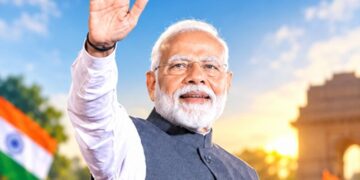
Standing before the towering Statue of Unity, Prime Minister Narendra Modi invoked the unyielding spirit of Sardar Vallabhbhai Patel — the man who turned 562 fragments of princely India into one nation. His words were not merely a tribute but a reckoning with history. By claiming that Jawaharlal Nehru prevented Patel from fully integrating Jammu and Kashmir, Modi reignited a decades-old debate that has shaped the soul of Indian politics — the question of who truly defined India’s unity.
By Mohammad Irfan
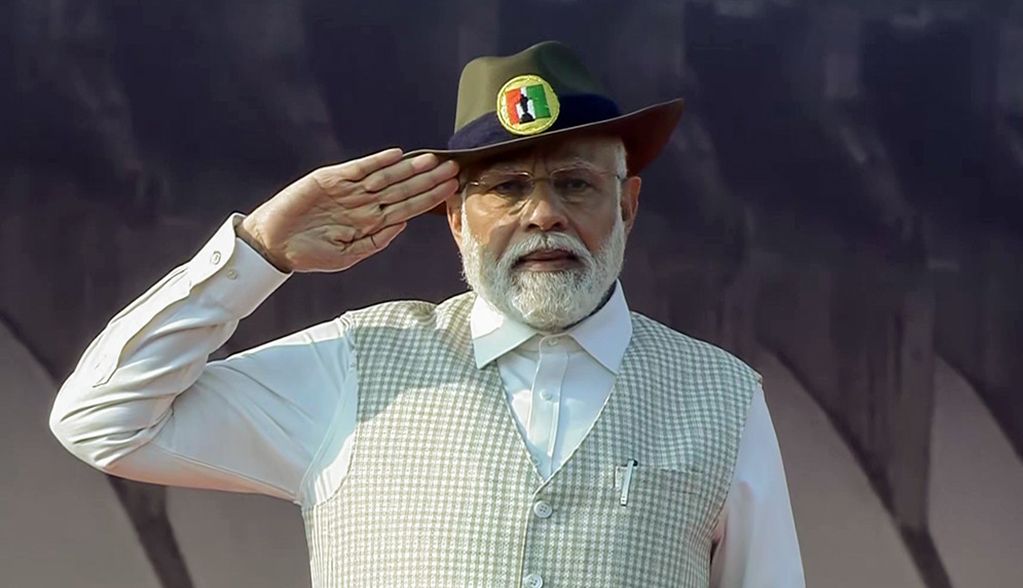
On a bright morning at the foothills of the colossal Statue of Unity in Gujarat’s Ekta Nagar, Prime Minister Narendra Modi turned the 150th birth anniversary celebrations of Sardar Vallabhbhai Patel into a moment of sharp historical reflection and political reckoning. Addressing a large national gathering at the world’s tallest statue — the monument to the “Iron Man of India” — the Prime Minister launched one of his most scathing critiques yet of India’s first Prime Minister, Jawaharlal Nehru. PM Modi claimed that Nehru prevented Sardar Patel from fully integrating Jammu and Kashmir into the Indian Union in 1947–48 — a “historical blunder,” he said, that plunged the region into decades of turmoil and bloodshed. “Many in today’s younger generation may not know that Sardar Patel wished for the complete integration of Kashmir, just as he had successfully merged hundreds of princely states,” Modi said, his voice echoing through the sprawling grounds. “But that wish remained unfulfilled due to the then Prime Minister’s decision, and the nation paid a heavy price.” As thousands of school children, NCC cadets, and visitors from across India watched, Modi’s address oscillated between a tribute to Patel’s statesmanship and a political critique of what he called “weak, Congress-era policies” that, according to him, undermined India’s unity and sovereignty.
Remembering The Architect Of Modern India: Sardar Vallabhbhai Patel’s 150th birth anniversary, celebrated nationwide as Rashtriya Ekta Diwas (National Unity Day), has become an annual reaffirmation of India’s commitment to unity, security, and national integration. The Prime Minister described Patel as the architect of modern India, whose grit and administrative acumen integrated over 550 princely states into the Union after independence — a task the world once thought impossible. Patel’s diplomatic tact and firmness convinced rulers from Junagadh to Hyderabad, Travancore to Bhopal, to accede to India. The integration of these diverse territories shaped the political geography of India as it stands today. “Patel’s life teaches us that history is not written by those who complain, but by those who act,” Modi told the gathering. “He did not waste time writing history — he worked hard to create it.” However, the Prime Minister noted, Kashmir became the exception. “Due to the Congress’s weak policies, a part of Kashmir went under Pakistan’s illegal occupation, and the region was engulfed in decades of terrorism and bloodshed,” he asserted. “If Patel had handled Kashmir, the story would have been different.”
A ‘Mistake’ That Cost Generations: In his speech, Modi said the “wish of the then-Home Minister” — Sardar Patel — to integrate Kashmir was not fulfilled because of Nehru’s differing approach. That, he said, “divided” the region with a separate constitution, flag, and emblem, sowing seeds of separatism. “The mistake of not allowing Patel to handle Kashmir engulfed the nation in turmoil for decades,” Modi said. “Kashmir and the country paid a heavy price, yet Congress continued to bow down to terrorism.” This was not merely a historical critique. Modi’s tone was forward-looking — aimed at presenting his government’s 2019 decision to abrogate Article 370 as the final act of integration that Patel could not complete. “Today, Kashmir has broken free from the shackles of Article 370 and has been fully integrated into the mainstream,” he declared, drawing loud applause. “Pakistan and the masterminds of terrorism have realized the true strength of India.”
Security, Infiltration, National Unity : The Prime Minister also broadened his address to national security and demographic concerns, calling infiltration by illegal immigrants a “grave threat” to national integrity. “These infiltrators are disturbing India’s demographic balance and occupying the country’s resources. For the first time, India has decided to fight a decisive battle against this big threat,” Modi said. He reminded the audience that he had announced the creation of a National Demography Mission from the Red Fort earlier this year to tackle infiltration and demographic manipulation. “We will ensure that every illegal immigrant living in India is expelled,” he declared. While the Prime Minister did not name specific states, his message resonated with recent debates over illegal immigration in border regions. He accused previous governments of ignoring the issue for “vote bank politics,” alleging that national security had been “sacrificed for electoral gains.” “For political interests, the Congress risked the unity and security of the nation,” Modi said. “Some people still prioritise their own interests over national interest. They forget that if the country’s identity is endangered, every citizen will be at risk.”
Operation Sindoor | A Message Of Strength : In an apparent reference to recent counter-terrorism operations and cross-border strikes, Modi cited “Operation Sindoor,” asserting that India will “strike within enemy territory” if challenged. “The world has seen that this is the India of the Iron Man, Sardar Patel,” Modi said. “We will never compromise on our security and honour.”
His comments reinforced his government’s narrative of a strong, self-reliant India, willing to act decisively on security matters, echoing Patel’s “steely resolve” from the post-independence years.
The Iron Man’s Legacy And Post-Patel Governments: The Prime Minister lamented that after Patel’s demise in 1950, subsequent governments “did not demonstrate the same seriousness towards national sovereignty.” He blamed “weak governance” for the spread of Naxal-Maoist extremism and challenges in the Northeast. “Had Sardar Patel’s vision been followed, these issues might never have arisen,” he said. Modi positioned his own government as the one reviving Patel’s ideals after decades of neglect. “After 2014, the nation once again witnessed a steely resolve inspired by Sardar Patel,” he said. “We have corrected historical wrongs — from Article 370 to strengthening our borders and internal security.”
Congress’s ‘Colonial Mindset’ And Historical Neglect : Modi also accused the Congress of carrying forward a “colonial mentality” by removing part of the national song Vande Mataram on religious grounds. “That act laid the foundation for the partition of India,” he said, calling it a “sin” that fractured the nation’s soul. He expanded his criticism to what he termed “political untouchability,” alleging that Congress sidelined or ignored stalwarts like Patel, B. R. Ambedkar, and Jayaprakash Narayan. “Every person and idea outside one party and one family was made untouchable,” he charged. “This mindset of attacking the country’s unity for political interests is part of a slave mentality.” To contrast that, Modi highlighted his government’s initiatives to honour national figures across ideologies — from constructing the Statue of Unity to establishing the Panchteerth in Ambedkar’s memory and building the Pradhanmantri Sangrahalaya (Prime Ministers’ Museum) in Delhi to celebrate all past PMs.
Languages As Symbols Of Unity: Amid recent debates over language imposition in some states, Modi also used the occasion to assert that “every language in India is a national language.” India’s linguistic diversity, he said, reflects its inclusive spirit. “No community or group has ever used language as a weapon in India,” the PM said. “There has never been an attempt to impose one tongue on others. That is why India is the most linguistically rich nation in the world.” He said the government encourages education in mother tongues under the National Education Policy and urged citizens to learn other Indian languages to strengthen cultural unity. “We proudly say that India has Tamil, one of the world’s oldest languages, and Sanskrit, a treasure of knowledge. Every Indian language has its own unique qualities — we celebrate all,” he said.
A Call For National Resolve : Concluding his address, Modi urged the 140 crore citizens of India to stay united against divisive forces and work towards a Viksit Bharat — a developed and self-reliant India. “On National Unity Day, we must reaffirm our resolve to protect India’s integrity,” he said. “Let us ensure that every conspiracy to divide the country fails, and let us build an India that Sardar Patel once dreamt of.”
Amit Shah|‘Modi Fulfilled Sardar Patel’s Dream’: While Modi spoke at the Statue of Unity, Union Home Minister Amit Shah led the Run for Unity from Major Dhyan Chand National Stadium in New Delhi. Thousands of participants, including athletes, students, and paramilitary personnel, joined the symbolic event that has become a national ritual since 2014. In his address, Shah echoed Modi’s sentiments, crediting the Prime Minister for fulfilling Sardar Patel’s “unfinished task” by abrogating Article 370 in 2019. “The only task that remained incomplete was Kashmir’s full integration due to Article 370,” Shah said. “But Prime Minister Modi fulfilled that unfinished task of Sardar Patel — and today, we have before us a truly unified India.” He reminded the audience of Patel’s monumental achievement in integrating 562 princely states after independence. “The entire world thought it impossible, but Patel proved them wrong,” Shah said. “The map of modern India that we see today is the result of his vision and determination.”
“For PM Modi, Patel’s story is not confined to the pages of post-independence history; it is a living symbol of courage, vision, and national resolve. The Prime Minister’s message from Ekta Nagar was clear — the “unfinished dream” of Sardar Patel has finally found closure through the abrogation of Article 370, marking what he called the completion of India’s integration. In blending history with political conviction, Modi sought to transform remembrance into resolve — turning Patel’s legacy into the moral spine of a New India.”
Delayed Recognition And The Statue Of Unity: Shah lamented that Congress governments did not accord Patel the respect he deserved. “A great personality like Sardar Patel was awarded the Bharat Ratna after a delay of 41 years,” he said. “Neither a memorial nor a monument was built in his honour.” It was only when Narendra Modi became Gujarat’s chief minister, Shah said, that the idea of the Statue of Unity was conceived. The 182-metre-tall statue, now a global landmark, was completed in 57 months using around 25,000 tonnes of iron collected from farmers across India. “Sardar Patel was a farmer’s leader,” Shah reminded. “The iron from farmers’ tools was melted and used to build his statue — a tribute from the soil he loved and served.” Since its inauguration in 2018, over 2.5 crore people have visited the monument, making it a symbol not only of unity but also of India’s engineering and cultural achievement.
Sardar Patel’s Legacy And The Farmer’s Cause: Recalling the 1928 Bardoli Satyagraha, Shah described how Patel’s leadership transformed a local agrarian protest into a national movement that compelled the British to reduce unfair land taxes. “From that moment, Patel became the voice of India’s farmers,” he said. In his morning message on social media platform X, Shah paid floral tributes to the Iron Man, calling him a “symbol of national unity, integrity, and empowerment of farmers.” “Sardar Sahab strengthened the unity and security of the country by integrating princely states and connecting farmers and the deprived to cooperatives,” Shah wrote. “He believed that the axis of India’s development lies in the prosperity of farmers.”
Kashmir Horizon View: As the day’s celebrations drew to a close, from Kevadia’s grand parade to events across India’s districts, a single theme reverberated — unity as the bedrock of India’s strength. For the Modi government, the day was not only about honouring Sardar Patel’s memory but also about drawing a direct line between Patel’s integration of princely states and the government’s modern-day efforts to consolidate India’s sovereignty and social fabric. From Kashmir to Kanyakumari, from linguistic diversity to demographic integrity, the Prime Minister’s message was clear: the idea of India that Patel built — one united, strong, and self-reliant nation — continues to guide the country’s path forward. “Let us walk together with one spirit, one purpose, and one heart,” Modi said in closing. “Let us build a Bharat that will make Sardar Patel proud.”
(“Team Kashmir Horizon” is committed to continuous improvement and invites feedback and suggestions from readers and its followers on social media sites. Reader insights are considered vital for enhancing content quality and empowering the community. The team encourages open communication and values the thoughts and ideas of its audience, believing that such input will enable them to serve the public more effectively. The initiative aims to ensure that readers have the best possible experience with “Kashmir Horizon”. Interested individuals can reach out to us via email at [email protected].)