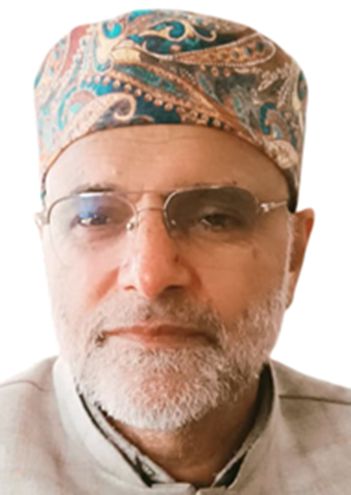
Prof. Hamid Naseem Rafiabadi
In the Indian subcontinent, the reverence for scholars often diminishes with age. Once retirement arrives, many distinguished academics who have spent decades shaping young minds and producing valuable research find themselves marginalized, their intellectual capital underappreciated, and their lifelong devotion to learning quietly forgotten. This unfortunate trend stands in sharp contrast to practices prevalent in many Western countries, particularly in Europe and the United States, where the scholarly value of an individual is not measured by the calendar of life but by the continuing vigor of the mind, the depth of wisdom, and the richness of experience. In those societies, retirement does not signify an intellectual sunset; instead, it marks a new dawn for reflection, mentorship, and higher levels of contribution. The journey of legendary scholars like Professor C. R. Rao stands as a brilliant testimony to the timeless value of intellect, the indomitable spirit of inquiry, and the triumph of wisdom over age.
Born on September 10, 1920, in Huvinahadagali, Karnataka, Calyampudi Radhakrishna Rao—affectionately known as C. R. Rao—rose to become one of the greatest statisticians the modern world has ever seen. His life and work embody the enduring power of scholarship. He earned his M.A. in Mathematics from Andhra University and subsequently pursued another M.A. in Statistics from Calcutta University. His intellectual journey began at the Indian Statistical Institute under the mentorship of P. C. Mahalanobis, where his contributions transformed the very foundations of statistical theory. In the early decades of his career, he developed several groundbreaking concepts such as the Cramér-Rao Bound, the Rao-Blackwell Theorem, and Multivariate Analysis of Variance (MANOVA)—cornerstones of modern statistical science. These achievements alone would have sufficed to immortalize his name in academic history, yet what makes C. R. Rao truly remarkable is his unyielding pursuit of knowledge even after what most would call “retirement.”
After moving to the United States in 1965, Rao continued his academic odyssey with unmatched zeal. He served as a professor at the University of Pittsburgh and later as the head of the Department of Statistics at the University of Pennsylvania. Astonishingly, at an age when most individuals prefer quiet repose, Rao’s intellectual productivity only increased. He continued publishing influential papers, mentoring doctoral students, and speaking at global forums. At 82, he was awarded the National Medal of Science by the U.S. government—an acknowledgment of his lifetime of contributions. And incredibly, at the age of 102, he received the International Prize in Statistics, regarded as the “Nobel Prize of Statistics.” Reflecting on his journey, Rao once lamented, “No one asks after retirement in India. Colleagues respect power, not scholarship.” His words capture the stark reality of a cultural mindset that often prioritizes administrative power over intellectual legacy. C. R. Rao’s life is not just an academic chronicle; it is a moral lesson—a reminder that wisdom never retires and that societies flourish when they value knowledge beyond age.
This reverence for lifelong scholarship finds another powerful embodiment in Professor Osman Bakar, a distinguished Malaysian philosopher and academic leader. Born on December 18, 1946, in Temerloh, Malaysia, Bakar’s career epitomizes the harmonious blend of traditional Islamic scholarship and modern intellectual rigor. After completing his M.Sc. in Mathematics from the University of London, he redirected his intellectual pursuits toward Islamic philosophy. Under the mentorship of the renowned Professor Seyyed Hossein Nasr, Bakar earned his Ph.D. in Islamic Philosophy of Science from Temple University, Philadelphia. His scholarship demonstrates how one can bridge the rational and the spiritual, the scientific and the metaphysical, without compromising intellectual integrity.
Over the decades, Bakar has produced more than 300 scholarly articles and 18 books, among them Islamic Civilisation and the Modern World and The History and Philosophy of Islamic Science—works that have significantly influenced Islamic intellectual discourse in the contemporary world. Beyond writing, his leadership has been equally transformative. Serving as the Deputy Vice Chancellor at the University of Malaya and later, in 2024, being appointed as Rector of the International Islamic University Malaysia (IIUM) at the age of 78, Bakar’s career challenges the very notion of age as a limitation. His appointment symbolizes an institutional recognition that wisdom seasoned by time is an invaluable asset, particularly in nurturing future generations of scholars who must balance faith and reason in a rapidly changing world.
Professor Bakar’s story, much like C. R. Rao’s, resonates with the idea that intellectual vitality can flourish across decades when societies respect and sustain their scholars. Both figures highlight a truth that transcends geography and discipline: the human mind, when disciplined by knowledge and driven by purpose, does not succumb to the frailties of time. History is replete with examples of individuals whose greatest achievements occurred well past the conventional age of retirement. Laura Ingalls Wilder, who published her first book Little House in the Big Woods at the age of 65, went on to write several more that became timeless American classics, teaching generations the values of simplicity, perseverance, and family. Colonel Harland Sanders, the founder of Kentucky Fried Chicken, began franchising his recipe at 65 and built one of the world’s largest food empires. Peter Roget published the first edition of his Thesaurus of English Words and Phrases at 73, revolutionizing the English language and enriching global communication. The celebrated artist Grandma Moses began painting in her late seventies and continued creating art until her nineties, proving that creativity can bloom long after youth fades. Diana Nyad, the legendary swimmer, achieved her dream of swimming from Cuba to Florida at age 64, embodying the spirit of persistence and human endurance. And Nola Ochs, the world’s oldest college graduate, earned her bachelor’s degree at 95 and later a master’s degree at 98, demonstrating that learning truly knows no age. These global examples are not isolated curiosities; they reflect a universal principle—the power of sustained intellectual engagement and the indomitable human will.
“Instead of viewing retirement as an end to utility, universities ought to honor older professors by maintaining their involvement. The essential value of a scholar is not defined by age but by their unwavering commitment to lifelong learning, evidenced by their constant curiosity and ongoing contributions. This demonstrates the enduring power of knowledge and experience.”
Whether in the sciences, arts, or humanities, such achievements reveal that passion, purpose, and perseverance transcend the boundaries of age. Yet, within the Indian subcontinent, there remains a paradox. Despite its ancient civilization that revered teachers as near-divine—Acharya Devo Bhava—modern academic structures often fail to honor senior scholars once they retire. Instead of being treasured as reservoirs of wisdom, they are frequently marginalized, deprived of meaningful platforms to share their insights. This systemic undervaluing of experience not only demoralizes individuals but also impoverishes the intellectual life of institutions. What is often forgotten is that a university thrives not merely through infrastructure, funding, or youth enthusiasm but through an ecosystem of intellectual continuity, where experience informs innovation and tradition inspires reform. The most dynamic institutions in the world—Oxford, Harvard, or Tokyo University—succeed because they integrate the old and the young. Senior scholars act as intellectual anchors, mentoring the next generation, while young academics bring fresh energy, ideas, and technological fluency. Together, they form a living continuum of knowledge, ensuring both depth and dynamism. Professor Afzal Zargar recently emphasized this very synergy by pointing to the successful academic collaboration between senior and junior faculty at the Central University of Kashmir (CUK), where assistant professors work productively alongside experienced professors. Such examples demonstrate that when institutions cultivate intergenerational cooperation, they not only enhance research quality but also build sustainable academic cultures.
In this context, I wholeheartedly agree with Professor Mattoo’s insightful observation that younger academics must be given the freedom to express themselves, experiment, and assume leadership roles. Yet, this freedom must be tempered and guided by the wisdom of the elders, for unbridled enthusiasm without experience can easily lose direction. The most progressive institutions are those where youthful dynamism is shaped and refined under the mentorship of seasoned scholars. The role of elders in academia should therefore be envisioned not as administrative or ceremonial but as fundamentally pedagogical and advisory. Their life experiences embody the philosophy of ilm (knowledge) as both a trust and a journey—values deeply rooted in the Islamic intellectual tradition as well. The Qur’an repeatedly emphasizes the virtue of knowledge and wisdom, describing them as divine gifts bestowed upon those who reflect deeply. In Surah Al-Mujadilah (58:11), Allah says, “Allah will raise those who have believed among you and those who were given knowledge, by degrees.” This verse serves as a reminder that knowledge matures over time, and respect for the learned is a mark of spiritual civilization. Similarly, the Prophet Muhammad (SAW) said, “He is not of us who does not show mercy to our young ones and respect to our elders.” (Tirmidhi, Hadith 1921). Such timeless principles underscore the necessity of valuing senior scholars not just for their past contributions but for their ongoing role as custodians of intellectual and moral wisdom.
In the rapidly evolving landscape of modern education—dominated by metrics, rankings, and publish-or-perish culture—the human dimension of scholarship is often neglected. Institutions must rediscover the art of valuing mentorship, reflection, and cumulative wisdom. One possible model is the establishment of “Emeritus Councils,” comprising retired professors who can advise on academic policy, mentor research projects, and guide ethical standards in teaching and administration. Another approach could be to create intergenerational research clusters, where senior scholars collaborate with younger colleagues on contemporary issues—combining experience with innovation, prudence with passion. Such initiatives would not only rejuvenate academia but also restore dignity to those who have dedicated their lives to knowledge. The triumph of wisdom over age is not merely an inspirational slogan; it is a moral imperative for societies seeking intellectual and cultural renewal. When nations honor their thinkers, they honor themselves. When universities cherish their elder scholars, they create legacies of excellence that transcend generations. The stories of C. R. Rao and Osman Bakar, alongside countless others across the globe, remind us that scholarship is not bound by time or title. True learning is a lifelong voyage, and those who continue to contribute well into their later years embody the noblest ideals of human endeavor. As we look to the future, let us aspire to create academic cultures where age brings honor, not exclusion; where retirement signifies recognition, not redundancy; and where every scholar, young or old, finds a place within the ever-expanding circle of learning. Age is, after all, but a number—what truly defines a scholar is the timeless flame of curiosity, the humility to learn, and the courage to keep contributing long after the applause has faded. In celebrating lifelong scholarship, we celebrate the triumph of wisdom over age and reaffirm our collective faith in the enduring power of knowledge as the light that guides humanity forward.
(The author a veteran academician is a former Professor and Head Department of Islamic Studies, Kashmir University. The views, opinions and conclusions expressed in this article are those of the author and aren’t necessarily in accord with the views of “Kashmir Horizon”)