- LG’s Big Push For Balancing Security With Border Development
“LG Sinha laid out a clear articulation of India’s evolving security doctrine and development strategy in Jammu and Kashmir, during interactions with a visiting delegation of National Defence College officers and later at a Unified Headquarters (UHQ) meeting in Srinagar. He highlighted India’s resolve under Prime Minister Narendra Modi’s leadership to treat any future terror attack as an “act of war,” vowing decisive retaliation while rejecting nuclear blackmail from adversaries. By expanding electricity, connectivity, and digital access to long-neglected communities, the administration seeks to strengthen both national security and grassroots integration.”
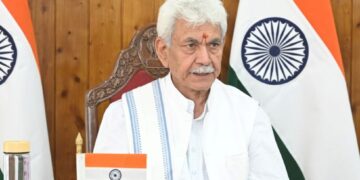
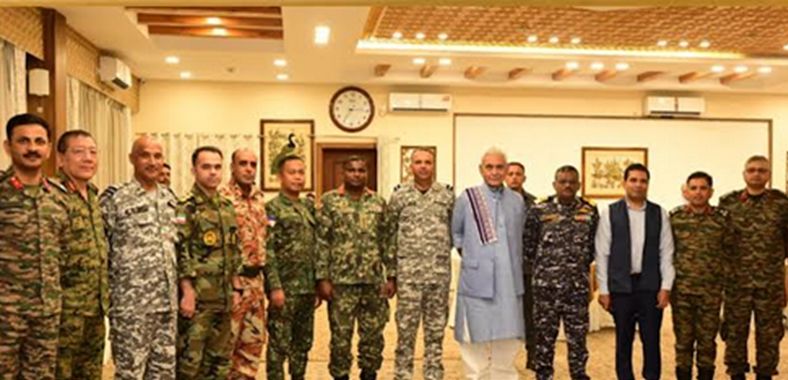
Lieutenant Governor of Jammu and Kashmir, Shri Manoj Sinha, on Friday sent out a strong message on India’s evolving security posture and Jammu and Kashmir’s ongoing transformation. Speaking to a delegation of senior officers from the Indian Armed Forces, Civil Services, and friendly foreign countries attending a course at the National Defence College, and later chairing a Unified Headquarters (UHQ) meeting in Srinagar, Sinha outlined India’s approach of combining assertive counter-terror measures with comprehensive border development.
‘Op Sindoor Reflected New India’s Resolve’: Interacting with the National Defence College delegation, the Lieutenant Governor recalled Operation Sindoor, describing it as one of India’s boldest military responses in recent history under the leadership of Prime Minister Narendra Modi. “Operation Sindoor showcased India’s balanced strategic restraint combined with assertive action. It drew a new red line against terrorism,” Sinha said. He emphasized that India’s security doctrine has undergone a decisive shift. “If there is a terrorist attack on India in the future, it will be seen as an act of war and a fitting reply will be given,” the Lieutenant Governor asserted. Rejecting the long-standing specter of nuclear blackmail from adversaries, Sinha said: “India has also made it clear that it will not tolerate any nuclear blackmail and it will strike precisely and decisively at terrorist hideouts.”
India’s Evolving Security Doctrine: India’s earlier responses to terror incidents, ranging from the Parliament attack in 2001 to the Mumbai carnage in 2008, were often criticized for being limited to diplomatic protests and defensive measures. However, the 2016 surgical strikes and the 2019 Balakot airstrikes marked a watershed, where New Delhi demonstrated its willingness to take military action across the border. Sinha’s remarks reinforced this trajectory. Analysts note that India’s message is clear: terrorism will no longer be treated as a low-intensity, deniable conflict but as a direct challenge to national sovereignty, warranting strong retaliation.
Border Villages The ‘First Line Of Defence’: Shifting focus from strategic deterrence to grassroots development, Sinha highlighted the government’s priority of transforming border villages. Referring to Prime Minister Modi’s directive, he said forward villages are to be treated as the first villages of the nation, not the last. “The change in terminology emphasized their importance as the nation’s first line of defence and our priority on the comprehensive development of border villages,” Sinha said. He elaborated that the administration had adopted a strategic approach balancing economic growth, security, and socio-cultural integration.
Connectivity, Power, Digital Integration: Listing initiatives, Sinha said border areas that had remained cut off since 1947 were now connected through roads, electricity, and internet. Robust connectivity has facilitated trade, tourism, and troop movement, Electricity supply was extended to villages that had never been electrified in 75 years, Digital infrastructure provided internet access, improving education, healthcare, and livelihoods. “This has significantly improved quality of life for residents, strengthening both security and integration with the national mainstream,” the LG stated.
Cultural Integration, Security: LG Sinha emphasized that development was not just about physical infrastructure but also about ensuring communities in sensitive zones felt part of the national fabric. “We adopted a strategic approach to balance economic growth, security, and socio-cultural integration while developing border areas here in Jammu and Kashmir,” he said.
Message Of Vasudhaiva Kutumbakam: Expanding the scope to global values, Sinha invoked India’s civilizational ethos: Vasudhaiva Kutumbakam (the world is one family). “India’s ancient mantra and motto will show the way to universal brotherhood and global unity,” he said, positioning India as both a firm defender of sovereignty and a proponent of global peace.
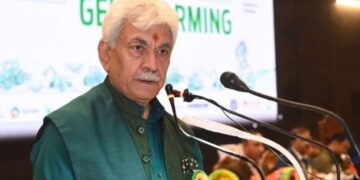
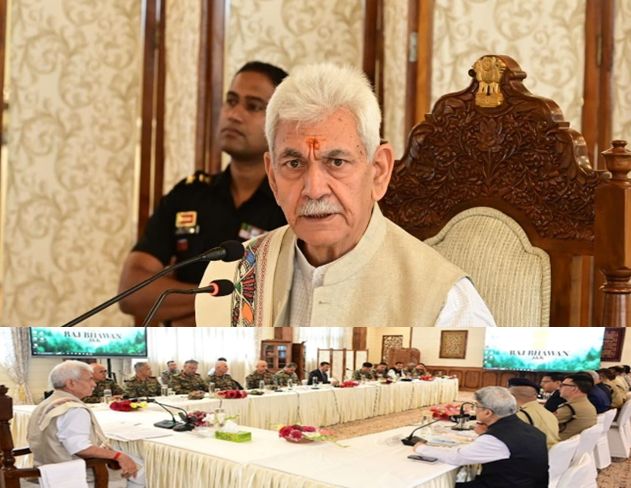
J&K Security Review At UHQ Meet: Later on Friday LG Sinha chaired the Unified Headquarters (UHQ) meeting at Raj Bhawan, Srinagar, to review the prevailing security scenario in Jammu and Kashmir. The meeting was attended by Northern Army Commander Lt Gen Pratik Sharma, Chief Secretary Atal Dulloo, DGP Nalin Prabhat, Corps Commanders of 15, 16 and 9 Corps, Air Vice Marshal Vikas Sharma, senior police and intelligence officers, and top officials of civil administration. The UHQ is the apex security coordination body in J&K, where the Army, paramilitary forces, police, intelligence agencies, and civilian officials meet under the LG’s leadership.
Praise For Security Forces: The Lieutenant Governor congratulated the Army, J&K Police, and intelligence agencies for the recent successful counter-terror operations in the Union Territory. However, he cautioned against complacency. “War against terrorism is not over yet. Kinetic and non-kinetic operations must continue. We must maintain the momentum and take stringent action against terrorism and its entire ecosystem,” he told the officers.
Adapting To Emerging Threats: Sinha directed security agencies to ensure continuous improvement in tactics and technologies to stay ahead of adversaries. He stressed the need for proactive adaptation to evolving threats, including infiltration, drone-based smuggling of arms and narcotics, and online radicalization.
Whole-of-Government Approach: Highlighting the need for comprehensive action, the Lieutenant Governor called for a “Whole of Government Approach” to tackle radicalization and the drug menace. He said kinetic measures alone would not suffice, and social, educational, and community-driven initiatives must also be strengthened to undercut extremist propaganda and recruitment.
Challenges Facing The Region: Officials at the UHQ deliberated on multiple security challenges: Cross-Border Infiltration: Despite improved fencing and surveillance, infiltration attempts from across the Line of Control continue.
Drone Threats: Pakistani drones dropping weapons, drugs, and explosives pose a new dimension of threat, Narco-Terrorism: Drug trafficking linked to terror financing is destabilizing border districts, Radicalization Risks: Use of social media for propaganda and recruitment remains a serious challenge.
Dual Front Concerns: With China active in Ladakh and Pakistan across the LoC, coordinated challenges cannot be ruled out.
Development The Security Stabilizer: Beyond military measures, the meeting underlined the importance of socio-economic stability. Development in border regions is seen as a bulwark against alienation and radicalization. Projects in infrastructure, tourism, and digital access are intended to give local youth alternatives to terrorism and smuggling networks. Observers note that the day’s developments reflected two interlinked aspects of India’s Kashmir strategy: Assertive Counterterrorism: With clear red lines on retaliation and an end to tolerance for nuclear blackmail. Integrated Developmental Push: With emphasis on border villages, connectivity, and human security. This dual-track approach suggests that India’s response to challenges in J&K is not limited to military operations but extends to long-term social and economic integration. For the foreign officers at the NDC, Sinha’s articulation offered insights into India’s evolving national security doctrine. It conveyed that India seeks peace and universal brotherhood, but will retaliate with force if provoked. The combination of Vasudhaiva Kutumbakam with Operation Sindoor underlined India’s unique blend of civilizational values and strategic firmness.
“Sinha’s message captured the contours of a new paradigm: security and development moving in tandem. On one hand, the administration vows to maintain relentless pressure on terrorist groups and their ecosystem through kinetic and non-kinetic measures. On the other hand, it prioritizes empowerment of border communities through infrastructure, livelihoods, and cultural integration.”
Security, Development Hand-In-Hand: By the end of the day, Manoj Sinha’s message was consistent and clear: Jammu and Kashmir is central to India’s security doctrine and developmental vision. Terrorism will be met with decisive retaliation, while border communities will be empowered as the nation’s first line of defence. The UHQ review underscored that vigilance remains essential, but the broader strategy is one of transformation—turning vulnerable areas into zones of opportunity and resilience. As India positions itself as a rising global power, the policies being implemented in Jammu and Kashmir reflect a template of assertive security backed by inclusive development, a model that may well define New Delhi’s approach in the years to come.
Kashmir Horizon View: The deliberations chaired by Lieutenant Governor Manoj Sinha, both with the National Defence College delegation and during the Unified Headquarters meeting, point towards a strategic recalibration in Jammu and Kashmir that merges hard power with inclusive development. The critical challenge now lies in translating these broad visions into sustained action on the ground, with measurable outcomes for both security forces and civilian populations. The first pillar of the way forward is to maintain relentless pressure on terror networks. While recent anti-terror operations have achieved notable successes, the ecosystem that sustains terrorism—financing, radicalization, and cross-border facilitation—remains resilient. Security agencies must therefore continue to adapt operational doctrines to emerging threats such as drone warfare, encrypted communications, and hybrid terrorists. Upgradation of surveillance, counter-drone technologies, and inter-agency coordination will be vital. The clear declaration that any future terror attack will be treated as an “act of war” sets a red line. But deterrence depends not only on intent but also on credible capability. Regular joint training, simulation exercises, and strategic investments in precision strike assets will ensure that India retains the initiative. Development remains the long-term stabilizer. By redefining border villages as the “first villages” of India, the government has provided both symbolism and direction. The challenge now is execution: ensuring that roads are maintained, power supply is reliable, healthcare is accessible, and internet services are uninterrupted. Economic activity through tourism, small enterprises, and agriculture support must become self-sustaining rather than dependent solely on subsidies. Importantly, development must be seen not as an adjunct to security but as part of the security architecture itself. A well-connected, economically active border village is less vulnerable to extremist influence and more capable of supporting national defence. Sinha’s invocation of Vasudhaiva Kutumbakam signals that India seeks to pair strategic firmness with civilizational confidence. Going forward, projecting this balance will be key. The way forward for Jammu and Kashmir, and by extension India’s broader security posture, lies in sustaining this dual-track strategy—decisive counter-terror measures coupled with deep developmental integration. Vigilance on the LoC, counter-infiltration drives, and readiness against nuclear blackmail will secure the nation’s frontiers. At the same time, roads, schools, digital networks, and livelihoods will secure the hearts and minds of its border citizens. The journey will not be without hurdles. Terror groups will continue to test India’s resolve, and challenges of governance and infrastructure delivery will persist. Yet the framework outlined by Manoj Sinha—assertive restraint, community-centric governance, and border empowerment—offers a clear direction. If pursued with consistency, it has the potential to transform Jammu and Kashmir from a zone of contestation into a model of resilience.
(“Team Kashmir Horizon” is committed to continuous improvement and invites feedback and suggestions from readers and its followers on social media sites. Reader insights are considered vital for enhancing content quality and empowering the community. The team encourages open communication and values the thoughts and ideas of its audience, believing that such input will enable them to serve the public more effectively. The initiative aims to ensure that readers have the best possible experience with “Kashmir Horizon”. Interested individuals can reach out to us via email at [email protected].)