“This day symbolizes extraordinary valor, dedication of our jawans”, Says Prez Murmu
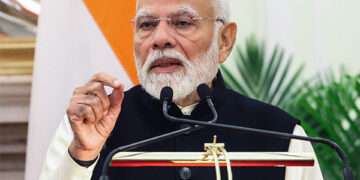
Kargil Vijay Diwas A Day To Recall unparalleled courage, valor of brave sons of mother India: PM Modi
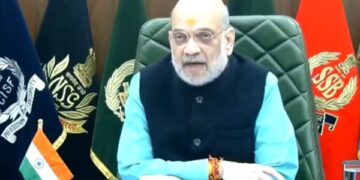
Kargil Vijay Diwas A Symbol Of The Unwavering Resolve Of Our Brave Soldiers Who Made The Enemy Retreat In Himalayas”, Says HM Amit Shah
Timeless Reminder Of Unwavering Resolve Of Our Forces: Rajnath
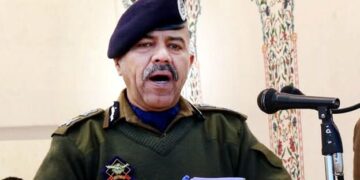
‘No mercy for terror’, Army chief reaffirms Kargil resolve
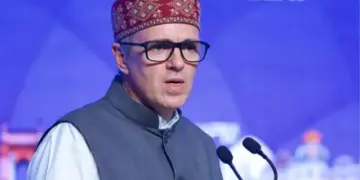
“I Salute The Bravery, Courage, Sacrifice Of Kargil War Heroes, Says LG Sinha
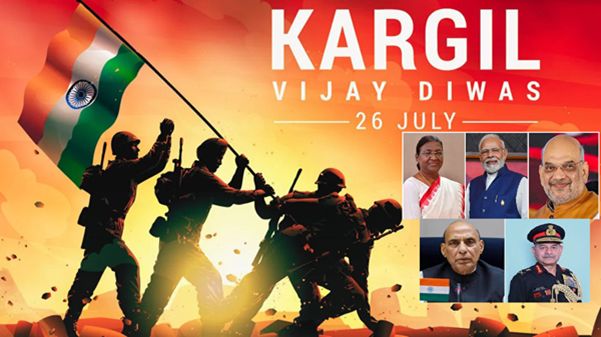
New Delhi, Srinagar: On the solemn occasion of Kargil Vijay Diwas, Prime Minister Narendra Modi, Union Home Minister Amit Shah, Defence Minister Rajnath Singh, and Jammu and Kashmir Lieutenant Governor Manoj Sinha paid heartfelt tributes to the brave soldiers who laid down their lives during the 1999 Kargil War.
Prime Minister Modi, in his message to the nation, hailed the courage and supreme sacrifice of the Indian soldiers who fought valiantly to defend the country’s sovereignty. “Kargil Vijay Diwas is a reminder of the indomitable spirit of our soldiers. Their bravery will continue to inspire future generations,” he said.
Home Minister Amit Shah described the day as a defining chapter in India’s military history. He recalled the heroism of Indian troops during Operation Vijay, noting how they pushed back enemy forces from strategic heights in the treacherous terrain of Kargil. “We will forever remain indebted to the martyrs who gave their all for the nation,” Shah said.
Defence Minister Rajnath Singh also honoured the fallen heroes, stating that their valour exemplifies the unwavering resolve of India’s armed forces. “The sacrifices made during the Kargil conflict serve as a powerful reminder of our soldiers’ commitment to the nation,” he said.
Lieutenant Governor Manoj Sinha, in his tribute, lauded the soldiers’ unmatched bravery. “On Kargil Vijay Diwas, I bow to our martyrs. Our heroes fought in the most difficult conditions and triumphed. Their gallantry will continue to inspire generations,” he said.
Marking Kargil Vijay Diwas at the War Memorial in Drass, Chief of Army Staff (COAS) General Upendra Dwivedi unveiled key military reforms aimed at boosting the Indian Army’s operational readiness in multi-domain warfare.
Addressing troops and officers, General Dwivedi announced the formation of a new integrated brigade named ‘Rudra’. Designed to bolster both combat effectiveness and logistical efficiency, the Rudra Brigade will unify infantry, mechanised infantry, armoured regiments, artillery units, special forces, and unmanned aerial systems under one command structure. The brigade is structured to provide rapid, multi-faceted support from a single location when required.
In a further boost to border defence capabilities, the Army has also raised a specialized light commando strike force named ‘Bhairav’. This unit, he said, is built for swift offensive operations and sustained pressure in sensitive and high-risk border areas.
The Army Chief also highlighted recent upgrades in firepower and surveillance capabilities. “Drone platoons have been inducted into each infantry battalion. Artillery units have been reorganized under the ‘Shaktiban’ regiments, now equipped with drones, anti-drone technologies, and loitering munitions,” he said. These regiments will include composite batteries with cutting-edge surveillance and strike capabilities.
In addition, he said the Army Air Defence has undergone a significant modernization drive. It is now equipped with indigenous missile systems capable of intercepting advanced aerial threats, including drones and incoming missiles.
“These enhancements are part of our continued effort to ensure that the Indian Army remains prepared for any eventuality,” General Dwivedi added.
Every year, July 26 marks the successful culmination of Operation Vijay in 1999, when Indian forces reclaimed strategic heights treacherously occupied by Pakistani soldiers during winter. The Kargil War, lasting over 60 days, is remembered not only for military bravery but for India’s political restraint in keeping the conflict limited to the Kargil-Siachen sector.
The Indian Air Force’s Operation Safed Sagar, launched on May 26, 1999, was a turning point. It marked the first large-scale air operation in Kashmir since 1971 and proved that air power could decisively shape battlefield outcomes without crossing international borders.
The 1999 conflict stands as a defining moment in Indian military history—a symbol of national resolve, strategic brilliance, and the unmatched spirit of its Armed Forces. As India commemorates 26 years of Kargil victory, the nation reaffirms its gratitude and continues to draw strength from the memory of its brave sons and daughters who gave everything for the tricolour to fly high.