“One of the major highlights of the security review meeting was the directive to identify and neutralize foreign militants operating in Kashmir. This aligns with the broader strategy of dismantling the militant ecosystem by targeting both its active members and logistical supporters. The importance of cyber vigilance was also emphasized, given the increasing use of digital platforms for radicalization and propaganda.”
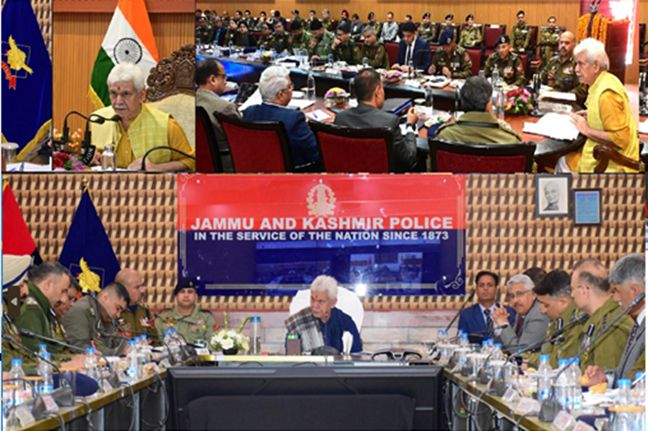
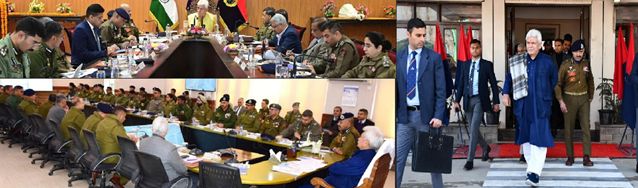
Lieutenant Governor Manoj Sinha recently chaired two high-level security meetings in Srinagar and Jammu to assess the prevailing security situation and devise strategic interventions to counter militancy and other security challenges. These meetings underscored the administration’s commitment to eradicating militancy, enhancing intelligence coordination, and strengthening security frameworks to ensure the safety of the citizens of Jammu and Kashmir. The presence of senior officials from various wings of J&K Police and other security agencies highlighted the significance of the discussions and the comprehensive nature of the security roadmap.
Strategic Approach The Key Highlight Of Security Review in Kashmir: In Srinagar, the security review meeting focused on key issues such as counter-insurgency operations, law and order maintenance, protection of minorities, and neutralization of militant networks. Director General of Police (DGP) J&K, Nalin Prabhat, along with other senior officials, provided an in-depth briefing on the current security landscape and outlined future strategies to combat militancy and related threats. The meeting underscored the importance of an integrated approach to security, with Lieutenant Governor Sinha emphasizing a 360-degree strategy against militancy. This includes intelligence-driven operations, close coordination among security agencies, and the dismantling of militant networks. Additionally, the Lieutenant Governor directed officials to enforce property attachment policies in cases related to militancy and narco-militancy, a move aimed at crippling the financial infrastructure supporting militant activities. One of the major highlights of the security review meeting was the directive to identify and neutralize foreign militants operating in Kashmir. This aligns with the broader strategy of dismantling the militant ecosystem by targeting both its active members and logistical supporters. The importance of cyber vigilance was also emphasized, given the increasing use of digital platforms for radicalization and propaganda.
Dismantling The Militant Ecosystem: The meeting in Kashmir also addressed the growing challenge of disinformation and propaganda. The Lieutenant Governor issued firm instructions to curb the misuse of cyberspace by extremist elements and directed the police to take stringent action against individuals involved in cyber-militancy. This step is crucial as militant organizations increasingly exploit digital platforms to spread radical ideologies and recruit vulnerable youth. Additionally, the meeting highlighted the need for community-oriented policing and confidence-building measures. Establishing trust between law enforcement and the common citizens was deemed essential in fostering public cooperation and preventing youth from being drawn into militant networks. The Lieutenant Governor also stressed the importance of proactive engagement with local communities to counter the influence of radical elements. He urged security officials to intensify efforts in monitoring and dismantling sleeper cells, which often operate undetected within civilian populations. The meeting called for stringent crackdowns on financial networks that facilitate militant activities, ensuring that no funds reach militants through illicit channels.
Counter Militancy Ops Dominates Security Review in Jammu: In Jammu, a similar high-level security review was conducted with a focus on eliminating any remnants of militancy from the region. The meeting, attended by top security officials, revolved around the complete dismantling of militant infrastructure and local support mechanisms. The DGP and IGP Jammu provided a detailed analysis of the security framework in the region, presenting future action plans aimed at strengthening counter-militancy measures. A crucial aspect of the discussion was the security of railway infrastructure, which remains a critical concern given the region’s strategic significance. The Lieutenant Governor stressed the need for decisive action against individuals and groups attempting to instill fear within society. He emphasized that any act of militancy should be met with the strictest legal measures, ensuring that perpetrators and their supporters face severe consequences. The meeting in Jammu also focused on securing border areas, particularly in vulnerable zones where infiltration attempts are frequent. The Lieutenant Governor reiterated the importance of strong inter-agency coordination to preempt and neutralize any threats before they materialize into attacks. He called for enhanced monitoring of transit routes, improved patrolling in remote areas, and deeper engagement with local communities to report any suspicious activities.
Stress On Technology-Driven Policing, Intelligence Sharing: One of the key takeaways from the Jammu security review was the focus on technology-driven policing. The Lieutenant Governor called for enhanced cyber patrolling, real-time intelligence sharing, and improved monitoring capabilities to counter emerging threats. This approach aligns with modern counter-militancy strategies, where technology plays a pivotal role in preempting and neutralizing threats. Additionally, the meeting underscored the necessity of strengthening border security, particularly against asymmetric threats. Given the region’s challenging geography, including riverine areas and mountainous terrains, security agencies were directed to enhance their vigilance and inter-agency coordination to prevent infiltration and cross-border militancy.
Inter-Agency Coordination, Legal Strengthening: A recurring theme in both meetings was the emphasis on seamless coordination between different security agencies. The Lieutenant Governor highlighted the importance of intelligence sharing and operational synchronization to ensure effective counter-militancy measures. Further, the meetings addressed the need to fortify the legal framework to deal with militant propagandists. Strengthening the police establishment at the local level was also emphasized to ensure efficient and modern policing practices. These measures are critical in preventing radical elements from exploiting legal and administrative loopholes to sustain their activities.
Challenges, Solutions: While the security forces have achieved significant milestones in counter-militancy efforts, several challenges remain. The persistence of cross-border infiltration, radicalization through online platforms, and local recruitment by militant outfits continue to pose serious threats. Addressing these challenges requires a multi-pronged approach, including technological interventions, community engagement, and strong legal frameworks.
Cross-Border Infiltration: One of the primary security concerns in Jammu and Kashmir is infiltration from across the border. With porous borders and difficult terrain, militant elements often take advantage of weak points in security. To counter this, the administration has prioritized stronger surveillance mechanisms, including the deployment of advanced sensor-based border monitoring systems and drone surveillance.
Cyber Security Measures; Focus On Digital Monitoring: With an increasing reliance on the internet for communication and recruitment, extremist groups exploit cyberspace to spread their ideology. Strengthening cyber intelligence units and enhancing digital monitoring tools are essential in preempting such threats. The security agencies have been directed to build capacities in cyber patrolling and digital forensic analysis to counter radicalization and militant financing networks.
De-radicalization, Community Outreach: An effective counter-militancy strategy cannot solely rely on enforcement. It must also include efforts to de-radicalize individuals vulnerable to extremist ideologies. The administration has called for community engagement programs, vocational training initiatives, and awareness campaigns to divert the youth from the path of radicalization. Local community leaders and religious scholars play a crucial role in these initiatives, fostering an environment of peace and coexistence.
“The security review meetings led by Lieutenant Governor Manoj Sinha mark a critical step towards achieving long-term stability in Jammu and Kashmir. A multi-dimensional approach encompassing intelligence enhancement, technological advancements, economic upliftment, and social outreach is the way forward. By integrating security measures with sustainable development, the Government can ensure a safer and more prosperous future for the people of Jammu and Kashmir.”
Implications,Future Outlook: The high-level security reviews in Kashmir and Jammu reaffirm the government’s firm stance against militancy and its enablers. The strategies discussed, including a zero-tolerance policy towards militancy, technology-driven policing, and enhanced intelligence coordination, mark a significant step in stabilizing the region. Moreover, the focus on community engagement and confidence-building measures signals an intent to balance security operations with public trust and cooperation. This holistic approach is vital in ensuring that the counter-militancy efforts do not alienate the local population but rather encourage their active participation in maintaining peace and stability. Going forward, the successful implementation of these security measures will depend on sustained political will, continuous inter-agency coordination, and adaptive strategies to counter evolving threats. The commitment displayed by Lieutenant Governor Manoj Sinha and the security establishment in these meetings reflects a determined effort to make Jammu and Kashmir a militant-free region while fostering long-term peace and development. By integrating modern surveillance techniques, strengthening the legal framework, and maintaining active engagement with the local population, the region can move towards a future where security and development go hand in hand. As these strategies unfold, the success of these security reviews will be measured by their long-term impact in ensuring peace, stability, and prosperity for the people of Jammu and Kashmir.
Kashmir Horizon View: The key to dismantling militant networks lies in enhancing intelligence gathering and surveillance. The government must invest in modern technologies such as AI-driven surveillance systems, advanced facial recognition software, and real-time data analytics to track and monitor militant activities effectively. Increasing collaboration between intelligence agencies at the national and international levels will also improve efficiency in tackling security threats. A long-term strategy for eliminating militancy should focus on winning the trust of the local population. Community policing initiatives, trust-building exercises, and frequent dialogues between law enforcement agencies and citizens can help bridge the gap. Educational institutions and religious leaders should also be engaged in de-radicalization efforts, providing alternative narratives to counter extremist ideologies. Special vocational training and employment programs should be implemented to offer a constructive path for youth susceptible to radicalization. The rapid growth of digital platforms has enabled militants to exploit cyberspace for propaganda and recruitment. To counter this, security agencies must develop specialized cyber units dedicated to monitoring extremist content, tracking digital footprints, and taking preemptive action against individuals promoting radical ideologies. Strengthening digital literacy among the public to identify and report extremist content is also crucial. To deter militant activities, a strong legal framework is essential. Existing laws must be enforced rigorously, and new legislations should be considered to address modern security challenges. Fast-tracking cases related to militancy, implementing strict financial penalties, and ensuring speedy trials will create a strong deterrent against militant sympathizers and enablers. Additionally, measures should be taken to ensure transparency in legal proceedings to maintain public trust in the judicial system. Economic instability often provides fertile ground for militant recruitment. A comprehensive economic development plan that includes investment in infrastructure, tourism, agriculture, and small-scale industries can provide sustainable employment opportunities. Special schemes focusing on youth entrepreneurship should be introduced to discourage them from being lured into militant networks. A holistic approach involving seamless coordination between various law enforcement bodies, intelligence agencies, and paramilitary forces is necessary for tackling militancy. Establishing joint task forces with clearly defined roles and responsibilities can ensure efficient decision-making and response mechanisms in crisis situations. The security review meetings led by Lieutenant Governor Manoj Sinha mark a critical step towards achieving long-term stability in Jammu and Kashmir. A multi-dimensional approach encompassing intelligence enhancement, technological advancements, economic upliftment, and social outreach is the way forward. By integrating security measures with sustainable development, the Government can ensure a safer and more prosperous future for the people of Jammu and Kashmir.
(In commitment to continuous improvement the “Team Kashmir Horizon” invites it’s valuable readers to share their valuable feedback and suggestions with the “Team Kashmir Horizon”. The insights of readers will surely play a vital role in improving the content quality of “Kashmir Horizon” and contribute more for the empowerment of people. Please feel free to reach out to us at editor@ thekashmirhorizon.com. Team “Kashmir Horizon” eagerly anticipates thoughts and ideas of it’s readers, which will help us serve people and even more effectively. The inputs of valuable readers are highly valued as “Kashmir Horizon” strives to provide it’s readers the best possible experience. Thank you for being a part of the reader community!)