“The restoration of statehood was a central theme of his discourse, with Abdullah reaffirming that it was one of the major promises made by the central government. While expressing hope that this process would not take much longer, he reminded the central authorities of the commitment to restore statehood, which has been a rallying cry for the region’s political parties since the revocation of Article 370 in 2019. Abdullah’s statement aligns with the aspirations of the people of Jammu and Kashmir”

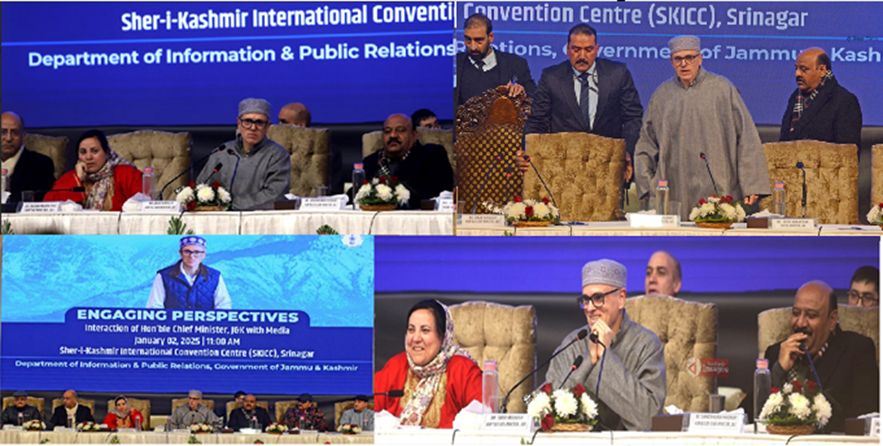
In his first major media interaction after assuming office, Chief Minister Omar Abdullah laid out his government’s vision for Jammu and Kashmir, articulating his belief that the region’s Union Territory status should be temporary, with the ultimate goal of restoring its statehood. CM’s statements, made under the banner of “Engaging Perspectives,” provides insight into the challenges his government faces and the promises made to the people of Jammu and Kashmir during the elections. Abdullah’s remarks, delivered alongside key members of his cabinet, including Deputy Chief Minister Surinder Choudhary, Education Minister Sakeena Itoo, and Advisor Nasir Aslam Wani, marked a significant moment in the region’s political landscape, reflecting his commitment to fulfilling electoral promises while managing the transition from a special status state to a Union Territory.
Restoring Statehood, A Critical Promise: One of the most poignant aspects of Abdullah’s address was his assertion that Jammu and Kashmir’s Union Territory status should not be permanent. He emphasized that the region’s people, having actively participated in elections, deserve to see the promises made by the central government fulfilled. The restoration of statehood was a central theme of his discourse, with Abdullah reaffirming that it was one of the major promises made by the central government. While expressing hope that this process would not take much longer, he reminded the central authorities of the commitment to restore statehood, which has been a rallying cry for the region’s political parties since the revocation of Article 370 in 2019. Abdullah’s statement aligns with the aspirations of the people of Jammu and Kashmir, who have long felt alienated by the decision to strip the region of its special status. However, the restoration of statehood remains a politically charged issue, with the central government and opposition parties holding differing views. Abdullah’s assertion that his government’s tenure will be dedicated to securing this outcome serves as a reminder of the ongoing political struggle and the desire for greater autonomy within the Union Territory.
Governance in Transition;A Steep Learning Curve: In his address, Abdullah also reflected on the early months of his government’s tenure. He acknowledged the steep learning curve involved in transitioning from a special status state to a Union Territory and the challenges of adapting to the Union Territory governance model. Despite these challenges, Abdullah expressed satisfaction with the government’s progress thus far. “There is a vast difference between this government and the previous one. Initially, I thought it would be difficult working in this new setup, but our start has been positive,” he said. This comment suggests that while the shift in governance has been challenging, it has also provided an opportunity for the government to implement reforms that were previously hindered by the unique status of Jammu and Kashmir. The adaptation to the Union Territory system, which effectively centralized power in New Delhi, has had significant implications for governance at the local level. Abdullah’s government is tasked with navigating this new political terrain, balancing the demands of governance while addressing the aspirations of the people of Jammu and Kashmir for greater autonomy.
Electoral Promises; A Commitment to Fulfilling Voter Expectations: Abdullah reiterated his government’s commitment to fulfilling the promises made during the elections, even though some would require systemic changes to be fully realized. The Chief Minister stated that the government had already begun implementing some electoral promises but acknowledged that others would require more time and effort to be fully achieved. His comment highlights the inherent challenges in transitioning from electoral promises to actual governance, particularly in a region like Jammu and Kashmir, where political, social, and economic issues are deeply interconnected. One of the most pressing issues for Abdullah’s government is the protection of jobs and land for the people of the region. Addressing concerns regarding land ownership and employment, the Chief Minister emphasized that safeguarding these resources is paramount. “We need to save what belongs to us first,” Abdullah said, suggesting that these concerns take precedence over other issues, such as reservation policies. This prioritization reflects the deep-rooted concerns in Jammu and Kashmir regarding the potential for outside influence, particularly in the context of land and employment rights, following the revocation of Article 370.
Handling the Reservation Issue; A Time-Bound Approach: Abdullah was also asked about his party’s position on the contentious issue of reservations, a topic that has sparked considerable debate in the region. He acknowledged that the matter was being handled in a time-bound manner and assured that a cabinet sub-committee had been established to address the issue. The sub-committee’s findings would be guided by decisions from the High Court and, ultimately, the Supreme Court. While Abdullah emphasized that the government is committed to addressing reservation concerns, he also made it clear that protecting land and jobs for the region’s people is the top priority. “Reservation can be addressed later, but safeguarding our land and jobs must come first,” he stated, signaling that the government would adopt a pragmatic approach to resolving the issue while ensuring that the rights of the local population are safeguarded.
Dual Governance Model: A Challenge, Opportunity: One of the more controversial aspects of Jammu and Kashmir’s new governance structure is the dual system of power, with the Union Territory being governed by both the Lieutenant Governor (appointed by the central government) and the elected Chief Minister. Abdullah expressed his belief that dual governance is not conducive to effective decision-making. He argued that governance works best when there is a single center of command, and the current dual system presents significant challenges. However, he also acknowledged that this system has provided valuable learning experiences for all parties involved, including the central government and local authorities. While the dual governance structure is viewed by some as a necessary safeguard for the region, Abdullah’s remarks suggest that it may be an impediment to efficient governance. The ongoing tensions between the Chief Minister and the Lieutenant Governor have raised concerns about the balance of power and the potential for conflicting policies. Abdullah’s statement calling for a unified approach to governance reflects the complexities of the political system in Jammu and Kashmir post-Article 370.
“The road ahead for Chief Minister Omar Abdullah is undoubtedly challenging, but it also presents an opportunity to reshape the future of Jammu and Kashmir. By focusing on key areas such as restoring statehood, managing the economic crisis, addressing social concerns, and prioritizing development, Abdullah’s government can lay the foundation for a more prosperous and autonomous region.”
Economic Challenges; Addressing the Budget Deficit and Power Supply: One of the key economic challenges facing the government is Jammu and Kashmir’s budget deficit, which has resulted in the region’s heavy reliance on financial support from the central government. Abdullah acknowledged this issue, stating that the Union Territory’s deficit budget makes it more dependent on the Government of India than other states and Union Territories. Despite this financial strain, he clarified that there has been no pressure from the central government to alter the government’s approach. “From the first day, the PM and HM have told me that we’ve been given the mandate, and there will be no effort to destabilize this government,” he said. Another critical issue discussed by Abdullah was the region’s power supply. Jammu and Kashmir’s electricity consumption exceeds supply, leading to high technical and commercial losses. The Chief Minister revealed that the region’s Aggregate Technical and Commercial (AT&C) losses are around 50 percent, making it one of the most power-deficient regions in India. Abdullah acknowledged the financial burden of purchasing electricity from the Centre, stating that Jammu and Kashmir spends Rs 9,500 crore annually on power purchases, despite suffering significant losses. To address this, Abdullah announced a plan to reduce power distribution losses and expedite the metering process. Once the metering is complete, the government intends to launch a scheme offering 200 free units of electricity to households in the region. However, the launch of this scheme is contingent on the completion of the metering process, which is expected to be completed by March or April.
Development, Infra: Balancing Growth With Local Needs: Abdullah’s government has also placed a strong emphasis on development, particularly in areas such as education and infrastructure. One of the most discussed issues is the proposed National Institute of Technology (NIT) campus in Pulwama district. In response to concerns from local residents, Abdullah assured that the government would explore alternative locations if the people of Pulwama collectively opposed the plan. This willingness to consider alternative locations reflects a sensitivity to local concerns and a commitment to ensuring that development projects align with the needs and aspirations of the local population. The Chief Minister also addressed concerns about the creation of satellite townships in the region. He clarified that no such proposal is currently on the table but confirmed that townships would be developed to alleviate congestion in Srinagar. These townships would be designed to offer a more sustainable and balanced approach to urbanization, allowing families to relocate from the city center to the suburbs.
Kashmir Horizon View: Omar Abdullah’s first media interaction as Chief Minister revealed a leader committed to addressing the multifaceted challenges facing Jammu and Kashmir. From the restoration of statehood to managing economic constraints and development projects, his government is navigating complex issues that require a delicate balance between local needs and national imperatives. While Abdullah’s optimism about restoring statehood is tempered by the reality of political negotiations and legal processes, his focus on fulfilling electoral promises and safeguarding the region’s resources signals a pragmatic and cautious approach to governance. As his government continues to address these challenges, the people of Jammu and Kashmir remain hopeful that the promises of autonomy, economic development, and social equity will eventually be realized. The road ahead for Chief Minister Omar Abdullah is undoubtedly challenging, but it also presents an opportunity to reshape the future of Jammu and Kashmir. By focusing on key areas such as restoring statehood, managing the economic crisis, addressing social concerns, and prioritizing development, Abdullah’s government can lay the foundation for a more prosperous and autonomous region. However, success will depend on careful governance, sustained engagement with the central government, and the ability to deliver tangible results to the people of Jammu and Kashmir. Ultimately, the people of the region are looking for a government that can balance political autonomy with the practicalities of governance, economic development with social justice, and traditional values with the demands of modernity. The way forward will require strategic decision-making, patience, and a deep understanding of the complex issues facing Jammu and Kashmir
(In commitment to continuous improvement the “Team Kashmir Horizon” invites it’s valuable readers to share their valuable feedback and suggestions with the “Team Kashmir Horizon”. The insights of readers will surely play a vital role in improving the content quality of “Kashmir Horizon” and contribute more for the empowerment of people. Please feel free to reach out to us at editor@ thekashmirhorizon.com. Team “Kashmir Horizon” eagerly anticipates thoughts and ideas of it’s readers, which will help us serve people and even more effectively. The inputs of valuable readers are highly valued as “Kashmir Horizon” strives to provide it’s readers the best possible experience. Thank you for being a part of the reader community!)