“Committed to Fulfill All Poll Promises, Safeguarding Jobs, Land”
“Efforts Underway To Reduce Power Losses, Improve Power Supply”
“Reservation Issue Being Handled By A Dedicated Cabinet Sub-Committee”
“200 Free Power Units Promise To Be Fulfilled By April”
“NIT Pulwama Relocation Possible If Locals Oppose”
“Govt’s Priorities Balanced Development, Cross-Political Cooperation”
“J&K’s Reliance On Centre Grows Due To Deficit Budget”
“No Plans To Establish Seattleite Townships, Stand By The Promises Made Before Elections”
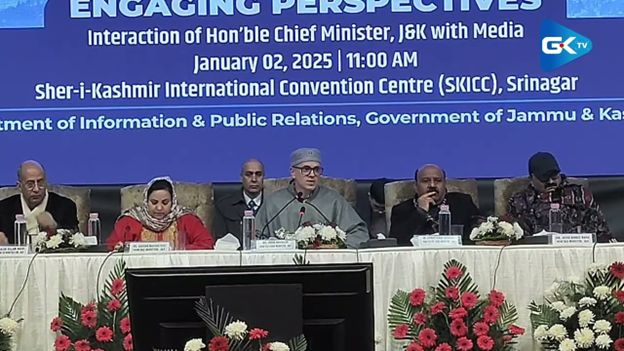
Srinagar: Chief Minister Omar Abdullah expressed hope that Jammu and Kashmir’s statehood would soon be restored and emphasized that the central government should fulfill its promise without further delay.
Addressing the media under the banner “Engaging Perspectives,” Abdullah was joined by senior government officials, including Deputy Chief Minister Surinder Choudhary, Education Minister Sakeena Itoo, Advisor Nasir Aslam Wani, and other cabinet members.
“We hope that Jammu and Kashmir’s status as a Union Territory is just a temporary phase. Since people here have actively participated in elections, they deserve to see something in return,” Abdullah said in his first media interaction after assuming office.
The Chief Minister reaffirmed that one of the major promises made to the people of Jammu and Kashmir by the central government is the restoration of statehood. “We hope this process doesn’t take much longer,” he added.
Abdullah noted that while his government has begun implementing some electoral promises, fulfilling others will require systemic changes.
Reflecting on his government’s early months in power, the Chief Minister acknowledged the learning curve in transitioning from the previous system of governance. “There is a vast difference between this government and the previous one. Initially, I thought it would be difficult working in this new setup, but our start has been positive,” he said.
He also acknowledged the challenges of adapting to the Union Territory governance model but stated that it has been more manageable than expected. “It took time to understand the system, but it’s easier than anticipated. However, the differences between this government and the last one are significant,” he added.
Regarding the promises made during the elections, Abdullah emphasized that the government remains committed to fulfilling them, with some requiring systemic changes to be fully realized. “We stand by the promises we made before the elections, which earned us the mandate to govern,” he said.
The Chief Minister addressed concerns regarding the safeguarding of jobs and land for the people of the region, calling these issues more pressing than the reservation policies. He responded to a question about party MP Aga Ruhullah’s support for student protests on reservation by emphasizing the democratic nature of the National Conference (NC).
“This is a democracy. The NC is secular and open. We are often labeled as dynasts, but we allow everyone to voice their opinions,” he said.
“Protests, once unimaginable, now take place outside our homes, and we engage with those involved afterward,” Abdullah added.
On the reservation issue, Omar assured that the matter is being handled in a time-bound manner and that a cabinet sub-committee has been established for this purpose. “The decisions by the High Court, and eventually the Supreme Court, will be binding on the sub-committee’s findings,” he said.
However, he stressed that protecting the region’s resources, such as land and jobs, was a priority. “We need to save what belongs to us first. Reservation can be addressed later, but safeguarding our land and jobs must come first,” he added.
Commenting on the issue of dual governance, Abdullah stated that a dual system of power is not beneficial. “Governance works best when there is a single centre of command. Dual centres of power aren’t effective. If they were, you’d see them everywhere,” he said. He also mentioned that Jammu and Kashmir’s Union Territory status has led to a dual system, but he described this as a learning opportunity for all parties involved.
Regarding tensions with the Raj Bhavan, the Chief Minister acknowledged occasional disagreements but dismissed reports of a confrontation. “The differences haven’t been as significant as some reports suggest. These speculations are baseless,” he said.
Abdullah also mentioned that the government is working on business rules, which will be reviewed by legal experts before being sent to Lieutenant Governor Manoj Sinha. He encouraged the public to approach the Raj Bhavan, local MLAs, or officials to resolve their concerns.
On the issue of Jammu and Kashmir’s deficit budget, Omar acknowledged the challenge, stating, “J&K runs a deficit budget, which makes us more dependent on the Government of India than other states and UTs.”
He further clarified that there has been no pressure from the Prime Minister, Home Minister, or anyone from the BJP or Raj Bhavan to change the government’s approach. “From the first day, the PM and HM have told me that we’ve been given the mandate, and there will be no effort to destabilize this government,” he said.
Regarding leaseholders and land policies, the Chief Minister stated that the government is working on policies for those whose leases have expired, such as hoteliers in Gulmarg and Pahalgam, and those under the Roshni scheme.
On holidays, Abdullah responded to concerns about the exclusion of some holidays from the 2025 GAD list, saying that martyrs like those of July 13 and Sheikh Abdullah do not need an official holiday to honor their legacy. “Nearly everything we do pays tribute to them,” he added.
Addressing his party’s manifesto, he emphasized that the NC’s promises, including resolutions for statehood, special status, and reversing the winter school zone policy, are being carefully implemented. “We plan to increase power supply before addressing other announcements, and public participation in governance has grown,” he said, promising a report after the first 100 days.
Taking a swipe at the BJP, Omar said, “Even if we accept that the status of Jammu and Kashmir is permanently resolved, a part of Jammu and Kashmir lies on the other side of the border. The Kashmir issue isn’t resolved, and that’s something we can discuss.”
his government is committed to reducing power distribution losses and expediting the metering process to ensure a better electricity supply for the people of Jammu and Kashmir.
“Metering is an ongoing process under a Government of India scheme. We are committed to it and will ensure its implementation. The more metering we do, the less electricity theft there will be,” Abdullah said during his first media interaction at SKICC.
The Chief Minister acknowledged that electricity consumption in Jammu and Kashmir exceeds the supply, and that the region’s Aggregate Technical and Commercial (AT&C) losses are currently around 50 percent. He expressed hope that the completion of under-construction power projects in the territory will help increase the supply in the future.
Abdullah highlighted that both the J&K government and the Union Power Ministry are working collaboratively to implement these reforms. He emphasized the financial burden on the region, stating, “J&K spends Rs 9,500 crore each year to buy electricity from the Centre, but we are suffering from 50 percent losses.”
On the issue of power cuts, the Chief Minister noted that the government is providing more electricity this year compared to the previous one. “We are supplying 1,700-1,800 MW of electricity, but the demand is higher,” he explained.
He further assured that once ongoing power projects are completed, the availability of electricity will increase. “Even if less power is generated in winter, we can store the power produced in summer for use in winter,” he said.
Abdullah acknowledged that Jammu and Kashmir’s power losses remain high, but efforts are underway to reduce them. “Other states have reduced their losses to 15-17 percent. Our goal is to bring the losses down to below 20 percent so we can supply more power to the people,” he said.
Regarding his election promise of providing 200 free units of electricity, Abdullah confirmed that the scheme would be launched in March or April, but only after the completion of full metering. “We can only measure units once metering is done,” he added.
About concerns regarding the proposed National Institute of Technology (NIT) Srinagar campus in Pulwama district, assuring that the government would explore alternative locations if the people of Pulwama collectively oppose the plan.
“Development should align with local needs and sustainable practices. We can collectively identify non-productive lands and shift the proposed NIT to a more suitable location,” CM Omar told reporters during a media interaction in Srinagar.
He added that other districts have expressed interest in hosting the NIT Srinagar project, with even an MLA from a different party requesting its relocation to their area.
The Chief Minister emphasized the need for cross-political and regional cooperation to ensure balanced development that considers the aspirations of all districts.
“While we understand people’s concerns, we cannot halt development. Development must go hand in hand with addressing those concerns. We will make every effort to ensure that land for roads or railways is non-productive,” he said in response to questions about land acquisition for government projects.
Omar also mentioned that a delegation from Newa in Pulwama had raised objections to the NIT project in their area. “If the people of Newa are opposed to the project, we will relocate it to a place where it is accepted wholeheartedly,” he assured.
Addressing allegations regarding the establishment of satellite townships, the Chief Minister clarified that no such proposal is currently on the table. He dismissed the claims, noting that those raising the most concern were the same individuals who previously discussed the concept of “greater Jammu and Srinagar.”
However, Abdullah confirmed that townships would be developed to help decongest Srinagar city.
“These townships are for those who wish to move to the suburbs. There are currently four to five families living in a single house in downtown Srinagar,” he added.