New York, Oct 23: Chief Justice of India D Y Chandrachud has said that unfortunately the legal system has often played a “pivotal role” in perpetuating “historical wrongs” against marginalised social groups and the harm caused by this can persist for generations.
Chandrachud delivered the keynote address at the Sixth International Conference on the ‘Unfinished Legacy of Dr. B.R. Ambedkar’ at the Brandeis University, Waltham, Massachusetts, on Sunday.
In his address titled ‘Reformation Beyond Representation: The Social Life of the Constitution in Remedying Historical Wrongs’, Chandrachud said that throughout history, marginalised social groups have been subjected to horrendous, egregious wrongs, often stemming from prejudice, discrimination and unequal power dynamics.
From the brutal transatlantic slave trade that forcibly uprooted millions of Africans, the Native American displacement, caste inequalities in India affecting millions of backward castes to the oppression of indigenous Adivasi communities in India, systemic oppression of women, LGBTQI individuals and other minority communities, the annals of history are “stained” with instances of profound injustice, he said.
“Unfortunately, the legal system has often played a pivotal role in perpetuating historical wrongs against marginalised social groups. Like in the United States, slavery was legalised in certain parts of India as well,” he said.
He added that in the United States, from the codification of discriminatory laws that supported the institution of slavery, the Jim Crow laws that enforced segregation in the American South to the forced assimilation policies targeting indigenous peoples, “the legal framework has frequently been weaponised to systematically oppress and marginalise certain communities.” “Furthermore, both in the United States and in India, the oppressed communities were denied voting rights for a long period of time. In that way, law as an institution was used to maintain existing power structures and to institutionalise discrimination, leaving a lasting legacy of injustice that continues to shape the lives of these groups and communities.” He noted that even when such laws have been eventually overturned or repealed, the “legacy of their harms can persist for generations, underscoring the complex and enduring relationship between law and historical wrongs committed against marginalised groups. These historical wrongs perpetuate injustice by creating a social system, where the marginalised communities are not allowed to rise above their oppression,” he said.
“It creates a kind of self-perpetuating” and hierarchal structure of society, which leads to the normalisation of injustice towards certain groups.
“This normalisation can creep up to the instances where the alienation of these communities makes them the ‘other’ in society. Otherness can then create a rift of violence and exclusion of these communities as well,” he said.
The 2023 edition of the conference focused on ‘Law, Caste, and The Pursuit of Justice’ and was presented by The Center for Global Development and Sustainability at the Heller School for Social Policy and Management at Brandeis University.
Chandrachud emphasised that since independence, affirmative action policies in India have offered crucial support to oppressed social groups by providing them with opportunities for education, employment and representation that might otherwise be inaccessible due to deeply entrenched inequalities.
“Reformation beyond representation entails ensuring that marginalised and underrepresented communities not only have a seat at the table, but also that they have a meaningful voice in decision-making processes. There is also a concern that in spaces where representation is not legally mandated, representation must not be confused with diversity,” he said.
“It has been stated by scholars that the sole focus on diversity can lead to tokenism where individuals from underrepresented groups are viewed as symbols of diversity, rather than being valued for their skills and qualifications. This can undermine their professional and personal growth,” he added.
He said that despite constitutional guarantees of gender equality, deeply-rooted patriarchal customs may persist, leading to gender-based discrimination and violence. Similarly, despite legislation prohibiting caste-based discrimination, incidents of violence against protected communities are on the rise.
He further said that even the slightest success of affirmative action is used by caste elites to dismiss the issues around caste inequalities.
“Arguments are advanced that just because affirmative action is being provided, structural issues of discrimination don’t exist anymore at all. Such binary narrations must be rejected and I believe, rejected at the constitutional level and at the social level as well,” he said.
Chandrachud added that today, non-discrimination and affirmative action are often differentiated by references to a negative and positive form of liberty.
“Arguments that a state ought to abstain from discriminating are distinguished from a positive command or mandate to uplift individuals who have suffered from historical wrongs. It is also argued that affirmative action is fundamentally contrary to the idea of equality, or colourblind equality, at the least. You find traces of that rationale, not only in India, but in the US as well, including in recent times.” Chandrachud underscored that Dr. Ambedkar’s idea of constitutionalism was instrumental in transforming Indian society by dismantling deeply entrenched caste hierarchy and promoting social, economic and political empowerment for marginalised groups.
Ambedkar’s “legacy continues to shape the constitutional values of modern India, serving as a beacon for social reform and the pursuit of justice for all.” He cited Ambedkar, who had said that however good a Constitution may be, it is sure to turn out bad because those who are called to work it happen to be a bad lot. “However bad a Constitution may be, it may turn out to be good if those who are called to work it happen to be a good lot.”
CM Omar Abdullah inaugurates, lays foundation of projects worth Rs 25 crore in Beerwah
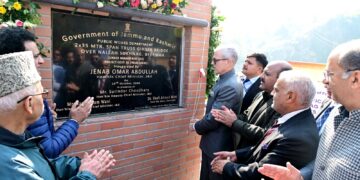
Bridge over Nallah Sukhnag opened to public; Projects to strengthen power infrastructure, civic amenities in Beerwah BEERWAH (BUDGAM), OCTOBER 23:...
Read moreDetails