

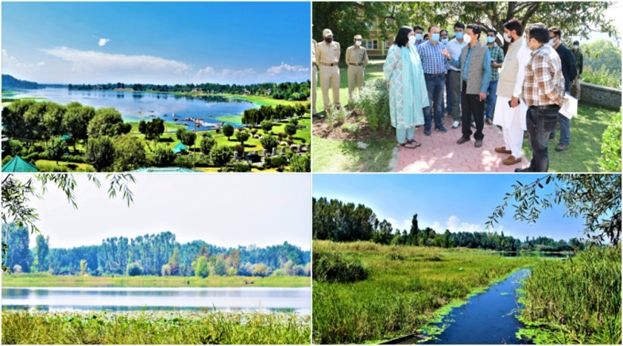
February 2 marks the World Wetland Day. The day is celebrated world over to raise awareness about the critical importance of wetlands for people and our planet Earth. Besides, the World Wetland Day is also an occasion to commemorate the signing of the Ramsar Convention on Wetlands in the Iranian city of Ramsar in 1971. It is pertinent to note today that according to the Global Wetland Outlook by the Ramsar Convention, wetlands, amongst the world’s most economically valuable ecosystems and regulators of the global climate, are disappearing three times faster than forests. While a lot is known about the importance of forests, the utility of wetlands is not always fully understood. Peatlands, which account for just 3 per cent of the world’s land surface, store twice as much carbon as forests thus playing a crucial role in delivering global commitments on climate change, sustainable development and biodiversity. Wetlands, of course, also help reduce the risk of disasters such as floods by protecting coastlines. A recent compilation of species richness in coastal and marine ecosystems has indicated presence of at least 14 species of sea grasses, 69 species of mangroves (including associates), over 200 species of diatoms, 512 species of porifera, 1,042 species of cnidaria, 55,525 species of molluscs, 2,394 species of crustaceans, 2,629 species of Pisces, 37 species of reptiles, 243 species of birds and 24 mammalian species. As many as 925 floristic and 4,107 faunistic species are known to inhabit Indian mangroves. Scleractinia corals of India have richer diversity as compared to other tropical reefs with at least 478 species thriving in significant reef areas of the country. Every year, millions of migratory birds flock to India and wetlands are critical to this annual phenomenon. Ecologically dependent on wetlands, migratory water birds connect continents, hemispheres, cultures and societies through their seasonal movements. Migration is a period of great vulnerability, a time when birds experience highest mortality rates. The “stopover” sites provide migratory birds rest, protection from predators and inclement weather before moving on to the next leg of their journey. A diversity of wetland community provides essential stopovers to birds. Migratory waterbirds, in turn, play an essential role in wetlands they inhabit at different stages in their life cycle, by contributing to resource fluxes, biomass transfer, nutrient export, food-web structure, and even shaping cultural relationships. The Central Asian Flyway (CAF) is one of the nine global waterbird flyways, comprising migratory routes from the northernmost breeding grounds in Siberia to southernmost non-breeding grounds in the West and South Asia, The Maldives and British Indian Ocean Territory (CMS 2005). Nearly 71% of the migratory waterbirds of the CAF use India as a stopover site. Sustaining the health of Indian wetlands is thus crucial for maintaining the waterbird populations within the flyway. Wetlands also have a deep connection with Indian culture and traditions. Loktak Lake in Manipur is revered as ‘Ima’ (meaning Mother) by the locals, whereas Sikkim’s Khecheopalri Lakeis popular as the ‘wish fulfilling lake’. The north Indian festival of Chhath is one of the most unique expressions of the association of people, culture, water and wetlands. Dal Lake in Kashmir, Khajjiar Lake in Himachal Pradesh, Nainital Lake in Uttarakhand and Kodaikanal in Tamil Nadu are popular tourism destinations of the country, contributing significantly to the local economy. Fisheries and tourism in Odisha’s Lake Chilika support livelihoods of over 2 lakh people living around the lagoon. Despite their huge importance, wetlands are globally under threat for a host of reasons including water drainage, pollution, unsustainable use, invasive species, deforestation and soil erosion.
Wetlands not only support high concentrations of biodiversity, but also offer a wide range of important resources and ecological functions such as food, water, fibre, groundwater recharge, water purification, flood moderation, storm protection, erosion control, carbon storage and climate regulation. The government of India accords high significance to wetlands conservation, and seeks to mainstream their full range of values at all levels of developmental planning and decision-making.
In India, however, we are proudly reversing the global trend of shrinking wetlands. In doing so, we continue to draw inspiration from our rich past. Wetland finds mention even in Chankaya’s Arthashastra where it is referred to as ‘anupa’, or incomparable lands, and considered sacred. With Prime Minister Narendra Nodi making sustainability a key aspect of development, there has been an overall improvement in how India cares for its wetlands. The country is now a land of 47 Ramsar Sites. This is the largest network of Ramsar Sites for any country in South Asia. A Ramsar Site, for those who may not know, is a wetland site designated to be of international importance. India’s National Wildlife Action Plan (2017-2031) identifies conservation of inland aquatic ecosystems as one of the 17 priority areas, and envisages development of a national wetlands mission and a national wetlands biodiversity register as key interventions. Integration of wetlands in river basin management has been identified as a strategy for the management of river systems. Wetlands purify and replenish our water, and provide fish and rice that feed billions. Understanding this criticality, the National Action Plan for Climate Change includes wetland conservation and sustainable management in the National Water Mission and the Green India Mission. Wetlands receive protection from a number of central enacted rules and regulation. Provisions of the Indian Forest Act, 1927, the Forest (Conservation) Act, 1980 and the Indian Wild Life (Protection) Act, 1972 define the regulatory framework for wetlands located within forests and designated protected areas. In 2017, MOEFCC notified the Wetlands (Conservation and Management) Rules under The Environment (Protection) Act, 1986 (EP Act). As per the provisions of these Rules, State Wetlands Authorities have been constituted as the main policy and regulatory bodies within states. Further, under the EP Act, coastal wetlands are protected under the Coastal Regulation Zone (CRZ) Notification (2018) and its amendments and the Island Protection Zone (IPZ) Notification 2011. In 2020, the MoEFCC took up ‘Wetlands rejuvenation’ as a transformative idea. The programme is structured around a four-pronged approach: a) Developing baseline information; b) Rapid assessment of wetlands condition using a set of parameters in the form of wetland health cards; c) Enabling stakeholder platforms in the form of wetland mitra; and d) Management planning. The programme has since been upscaled to cover over 500 wetlands. As part of the Azadi Ka Amrit Mahotsava celebrations and to get peoples participation in the conservation of wetlands, wetland mitras have been registered in all significant wetlands and value and threat signage have been installed in these wetlands. A national wetlands portal (https://indianwetlands.in/) has been developed as a knowledge hub on wetlands for use of all wetlands managers and stakeholders. Wetlands not only support high concentrations of biodiversity, but also offer a wide range of important resources and ecological functions such as food, water, fibre, groundwater recharge, water purification, flood moderation, storm protection, erosion control, carbon storage and climate regulation. The government of India accords high significance to wetlands conservation, and seeks to mainstream their full range of values at all levels of developmental planning and decision-making.
(Author Union Minister for Environment, Forest & Climate Change; and Labour & Employment. Press Information Bureau Srinagar has mailed this article to “Kashmir Horizon” for publication in this newspaper)
Recruitment Uncertainty In Kashmir

Behind every delayed examination lies an aspirant's time, a family's savings, and a future suspended between hope and uncertainty. Abrar...
Read moreDetails



