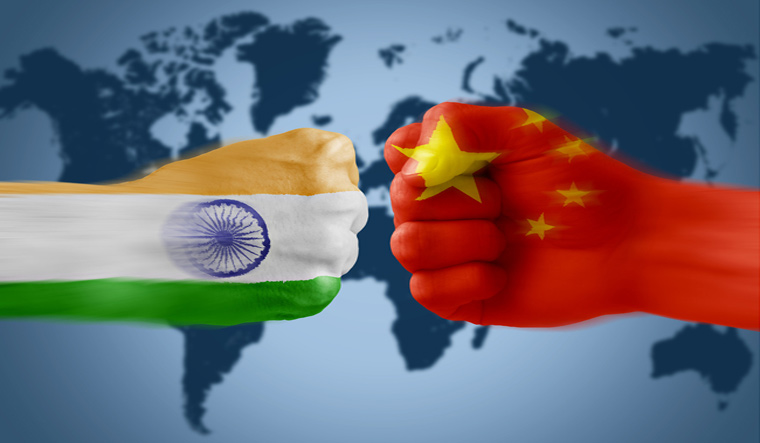
Washington: China has become the main threat across a wide arc of the Indo-Pacific. This has stirred its neighbouring countries – stretching from India in the southwest to Japan in the northeast, to form an effective bulwark against Chinese expansionism.
China has been asserting itself all across the Indo-Pacific arc and Beijing’s defense spending has increased six times from the start of the millennium, according to independent SIPRI estimates.
Over the last two decades, China has risen from sixth in the world to second in total defense spending–a spectacular increase, reported Foreign Policy.
In response, Indo-Pacific arc countries are beefing up their defenses. Japan’s Self-Defense Forces have a high reputation for technology and readiness. Countering China’s aircraft carrier building program, Japan is converting two existing helicopter carriers into fixed-wing aircraft carriers.
Although the Japanese carriers will be much smaller than China’s, the Japanese carrier-launched fifth-generation F-35 stealth fighters will pack a much bigger punch. By comparison, the PLA Navy’s Shenyang J-15 is a less advanced fourth-generation fighter that has experienced serious technical problems.
At the opposite end of the Indo-Pacific arc, India is often perceived to be a relative weakling when compared to China. But those perceptions are long out of date, if in fact they were ever true, reported Foreign Policy.
Salvatore Babones, writing in Foreign Policy said, “Back in 1962, China seized large tracts of Indian mountain territory in a lightning five-week war. But that victory was the result of a peacetime surprise attack against an unsuspecting friendly country. Since then, India has taken to heart the old proverb: Fool me once, shame on you; fool me twice, shame on me.”
Despite China’s massive military modernisation, India now has the upper hand on the Himalayan frontier. China’s infrastructure improvements have been matched by the mountain tunnels and all-weather roads built by India’s Border Roads Organisation (BRO).
Moreover, China’s 1962 advances, moved the front line closer to India’s supply bases–and further from China’s. BRO’s tunnelling has vastly increased the Indian Army’s ability to transport heavy equipment from rear bases up to the Indian-Chinese Line of Actual Control, reported Babones.
Further, the extensive experience fighting on glaciers and the toughness of India’s Special Frontier Force commandos have given New Delhi a winning proposition in high-altitude warfare.
The Indian Air Force also has a major technical advantage over China’s PLA. The acquisition of French Rafale jet fighters, the modernisation of its Russian Sukhoi SU-30 squadrons, and the impending delivery of advanced Russian S-400 anti-aircraft missile systems, puts Indian Air Force at absolute air superiority across the LAC. India’s indigenously-developed Tejas multirole fighter is just the icing on the cake, reported Foreign Policy.
Meanwhile, in the case of Myanmar, China is building a 10-foot (3-meter) high wall to seal it off. Moreover, the military takeover in Myanmar, widely perceived in the West as favouring China, has actually been a setback: China was especially close to Aung San SuuKyi’s National League for Democracy and now sees its position in the country threatened by both the military and the street protesters.
Vietnam has been on poor terms with its communist big brother ever since China’s 1979 invasion. Vietnam’s defense budget has focused its investments on coastal defense. Mirroring China’s early-2000s anti-access/area denial (A2/AD) strategy, it has invested heavily in anti-ship missiles and is perpetually rumoured to acquire the joint Russian-Indian BrahMos, a supersonic ramjet cruise missile that is reportedly the fastest such weapon in the world.
The Indo-Pacific arc is strongest at the ends and weakest in the middle. The weak spots in the Indo-Pacific arc are the islands. The Philippines, which under President Rodrigo Duterte has flirted with a potential Chinese alliance, is a wildcard.
But, the country’s armed forces favour maintaining close ties with the United States. Like its Vietnamese counterpart, the Philippine Navy is keen to acquire BrahMos anti-ship missiles.
In another A2/AD evolution, the only realistic target for these missiles would be China’s PLA Navy operating in the South China Sea, wrote Babones.
Taiwan is another weak spot. The problem here is not a failure of resolve — the repression in Hong Kong has only hardened Taiwanese opinion against China, reported Foreign Policy.
Taiwan has announced the purchase of 66 workhorse F-16 fighter jets, but its immediate need is for Harpoon anti-ship and Patriot anti-aircraft missiles.
South Korea has announced its own indigenous aircraft carrier and jet fighter programs. Some commentators have called them national vanity projects, but they might just as credibly be cast as efforts to catapult South Korea’s already impressive defense industrial base into the information era.
The defense preparedness of Indo-Pacific countries highlights the point that they hardly need US encouragement to raise their guard when it comes to China.
All Washington has to do is provide a security framework into which other countries can insert their own efforts. It could do this through the Quadrilateral Security Dialogue (Quad) mechanism, but that would require a Quad focused on maritime security, wrote Babones.