Says ‘Empires Changed Maps, Civilisational Dialogues Changed Ideas, Time To Harness Shared Heritage for Global Harmony’
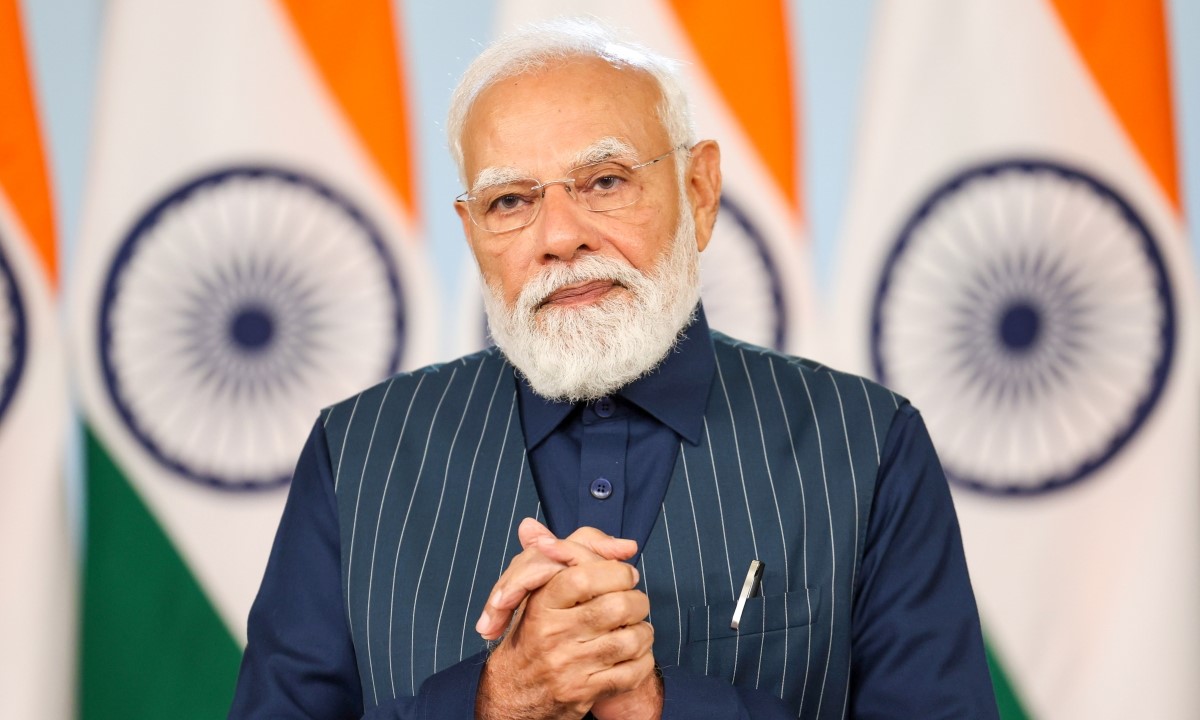
New Delhi|Nov, 20 : Prime Minister Narendra Modi on Friday called for civilisational dialogue to emerge as a powerful force in shaping global thinking, fostering international harmony and strengthening peace, arguing that while empires had altered geographical boundaries, civilisational exchanges had transformed ideas and enriched human knowledge across generations.
Inaugurating the first Shanghai Cooperation Organisation (SCO) Civilisational Dialogue Forum at the historic Purana Qila in New Delhi, Modi said the three-day gathering should go beyond being a ceremonial event and develop into a meaningful platform capable of providing direction to the international community at a time when wars, conflicts and instability dominated global discourse.
“Empires have certainly changed the maps of the world, but civilisational dialogues have changed the ideas of the world and enriched them,” he said, expressing confidence that the forum would generate fresh ideas, open avenues for cultural cooperation and enable the shared civilisational experiences of SCO countries to bring the world closer.
“At a time when discussions across the world are dominated by war and unrest, we in India are engaging in a dialogue on civilisational connections. This is significant because cultural connection serves as the strongest guarantee for global peace,” the Prime Minister said.
The forum, being held from November 20 to 22, brings together scholars, historians, academics, cultural representatives and experts from SCO member countries, observers and dialogue partners. Pakistan has also been invited to participate, lending the initiative a wider regional dimension despite continuing political and security differences among some participating countries.
The initiative seeks to expand the SCO’s engagement beyond its traditional focus on security, economic development and regional connectivity by placing shared cultural experiences, historical interactions and intellectual exchanges at the centre of regional cooperation.
Noting that the SCO had recently completed 25 years since its establishment, Modi said the organisation had made considerable progress in strengthening cooperation in security, economic development and connectivity.
Civilisational and cultural engagement, he maintained, would add another significant dimension to these partnerships and deepen understanding among the peoples of the region.
Tracing the historical foundations of cultural connectivity, the Prime Minister said exchanges between societies had been integral to human civilisation for thousands of years.
He recalled that the Indus Valley civilisation had established commercial links with Mesopotamia nearly 5,000 years ago, while successive trade routes connected India, China, Central Asia and other parts of Eurasia.
These routes, he said, carried much more than merchants and commodities. They facilitated the movement of scholars, travellers, Buddhist monks, languages, philosophies and cultural traditions, creating an enduring network of intellectual exchanges.
Modi referred to the spread of Buddhist teachings from India through Gandhara and Central Asia
to China, with Kucha and Dunhuang emerging as important centres of learning. Chinese scholars Faxian, Xuanzang and Yijing travelled to India to explore its knowledge traditions, while Nalanda developed into a major international centre of education. Kumarajiva, born in Kucha in Central
Asia, made an important contribution by translating Buddhist scriptures into Chinese.
He also cited the journey of India’s Panchatantra stories into Persian and Arabic, where they acquired a new identity as Kalila wa Dimna, and the spread of the Ramayana into Southeast Asia, where it became an integral part of Cambodia’s literary and cultural heritage through the Reamker.
The Prime Minister underlined that cross-cultural exchanges had also shaped scientific and mathematical progress.
Referring to Indian mathematician Brahmagupta and the subsequent contributions of scholars such as Al-Khwarizmi in Baghdad, he said the history of knowledge demonstrated how ideas travelled across geographical boundaries and were enriched through successive intellectual contributions.
Similar cultural interconnections, he said, were visible in architecture and music, including the relationship between Central Asian maqam traditions and Indian ragas, the influence of Sufi traditions on qawwali and the inspiration drawn by India’s charbagh garden architecture from the gardens of Samarkand and Herat.
Turning to contemporary opportunities, Modi said the 21st century offered unprecedented possibilities for taking cultural connectivity to a new level. Modern technologies, which had
made communication across continents possible within seconds, could be harnessed to promote knowledge-sharing, academic collaboration and cultural exchanges.
He proposed that SCO countries jointly undertake the digitisation and translation of ancient manuscripts, rare books, historical documents and archival material preserved in their museums, libraries and research institutions.
Artificial intelligence, he suggested, could accelerate the translation of important literary and historical works that remained accessible in only a limited number of languages.
He also advocated joint research initiatives, exhibitions, university-level academic exchanges and partnerships among cultural institutions to uncover lesser-known aspects of the region’s shared history and make its heritage accessible to younger generations. Developing heritage circuits connecting historical sites associated with the Silk Routes and Buddhist traditions, promoting cultural tourism and organising joint festivals were among the other initiatives he proposed.