
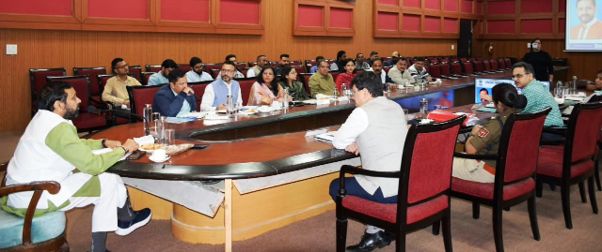
Makwana reviews implementation of Prohibition of Manual Scavenging Act in J&K Directs social security
Jammu| Nov, 16: Calling for an immediate end to all forms of manual scavenging in Jammu and Kashmir, National Commission for Safai Karamcharis (NCSK) Chairperson Bhagwat Prasad Makwana has directed officials to prioritize mechanised sanitation and ensure complete social security, insurance, and protective gear for every sanitation worker.
Chairing a high-level review meeting at the Convention Centre here on Monday to assess the implementation of the Prohibition of Employment as Manual Scavengers and their Rehabilitation Act, 2013, Makwana stressed that the law leaves no room for ambiguity. Cleaning dry latrines, sewers, septic tanks, open nallahs, or railway tracks by hand—whether in towns or villages—amounts to manual scavenging and is strictly prohibited. Emphasizing that machines must always come first, he clarified that manual intervention may be permitted only in exceptional circumstances depending on the gravity of the situation and with prior approval from a competent authority.
Seeking a detailed status report on the Act’s enforcement across the Union Territory, the Chairperson ordered the immediate reconstitution of the District Vigilance Committee. To safeguard the workforce, he directed officers to provide every sanitation worker with proper training, PPE kits, and insurance cover, while ensuring timely deposits of EPF and ESI contributions.
Makwana noted that the law can only protect workers if they are aware of their rights, prompting him to direct the administration to organize multi-departmental awareness camps. Alongside free health check-ups, these camps will educate workers on flagship welfare schemes including the Pradhan Mantri Awas Yojana, Pradhan Mantri Jan Dhan Yojana, and Ayushman Bharat.
Stressing the dignity of the community, he banned the use of derogatory and prohibited caste terms in any form, instructed that caste certificates for sanitation communities be issued under the name “Valmiki”, and highlighted the legal protections available against caste-based abuse under the Scheduled Castes and Scheduled Tribes (Prevention of Atrocities) Act, 1989.
Turning to living conditions, Makwana raised the long-pending issue of land rights for families residing in various localities of Jammu, ordering the priority development of their residential areas and the construction of community halls for social functions. He noted that the abrogation of Article 370 has granted the Valmiki Samaj domicile and employment rights in Jammu and Kashmir that were denied to them for decades.
Reiterating that Prime Minister Narendra Modi launched the Swachh Bharat Mission to restore dignity to sanitation labour and eliminate the age-old practice of manual scavenging, Makwana sought the active cooperation of States and Union Territories. He outlined major financial empowerment avenues for the community, noting that workers’ children can avail education loans up to ₹10 lakh for studies in India and ₹20 lakh for studies abroad, while workers themselves can access business loans up to ₹50 lakh. Under the Swachhta Udyami Yojana, sanitation workers can also secure loans up to ₹15 lakh individually, and up to ₹50 lakh as self-help groups or cooperatives, to purchase mechanised sanitation equipment and vehicles—a scheme already utilized by 16 local workers for loans worth ₹2.40 crore.
The meeting, which also addressed various occupational issues with necessary directions issued to the Jammu Municipal Corporation, was attended by Jammu District Magistrate Minga Sherpa, Social Welfare Director Ranjeet Singh, Urban Local Bodies Director Kapil Sharma, J&K SC Advisory Board Secretary Seema Bharti, senior officials from the Police, Municipal, Labour, and Information departments, NAMASTE Scheme officers, and Safai Karamchari representatives.